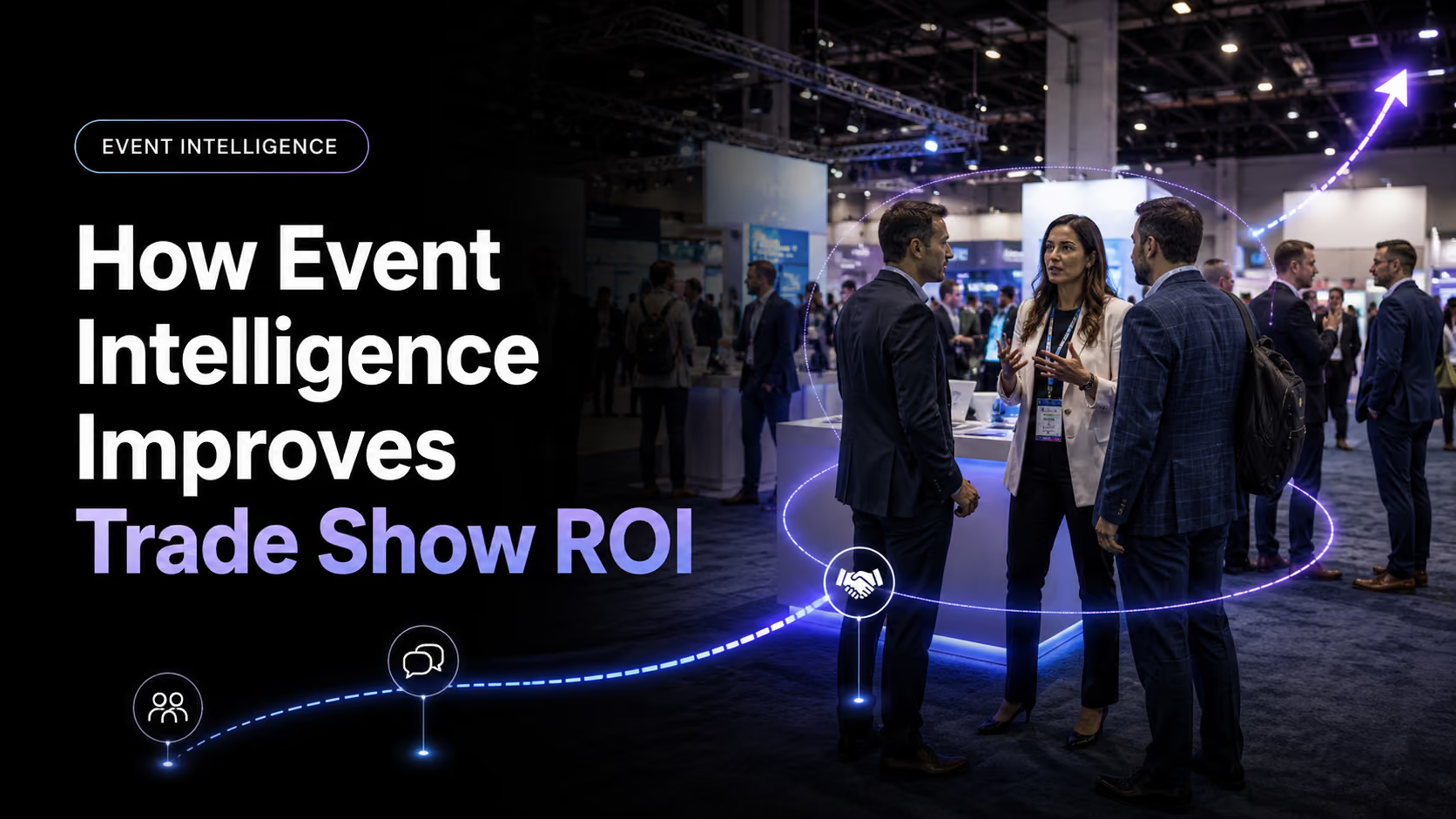
Most B2B companies treat trade shows like expensive lottery tickets. They book a $25K booth, fly in the sales team, print brochures, and hope the right people walk by. Then they measure success by counting badge scans — a metric that tells you almost nothing about pipeline.
Event intelligence changes the game. Instead of showing up and hoping, high-performing teams use data to engineer their outcomes before, during, and after every event. They know who will attend before the doors open. They arrive with pre-booked meetings. They follow up within hours, not weeks.
This guide breaks down exactly how to use event intelligence to transform trade shows from unpredictable expenses into a repeatable revenue channel.
What Is Event Intelligence?
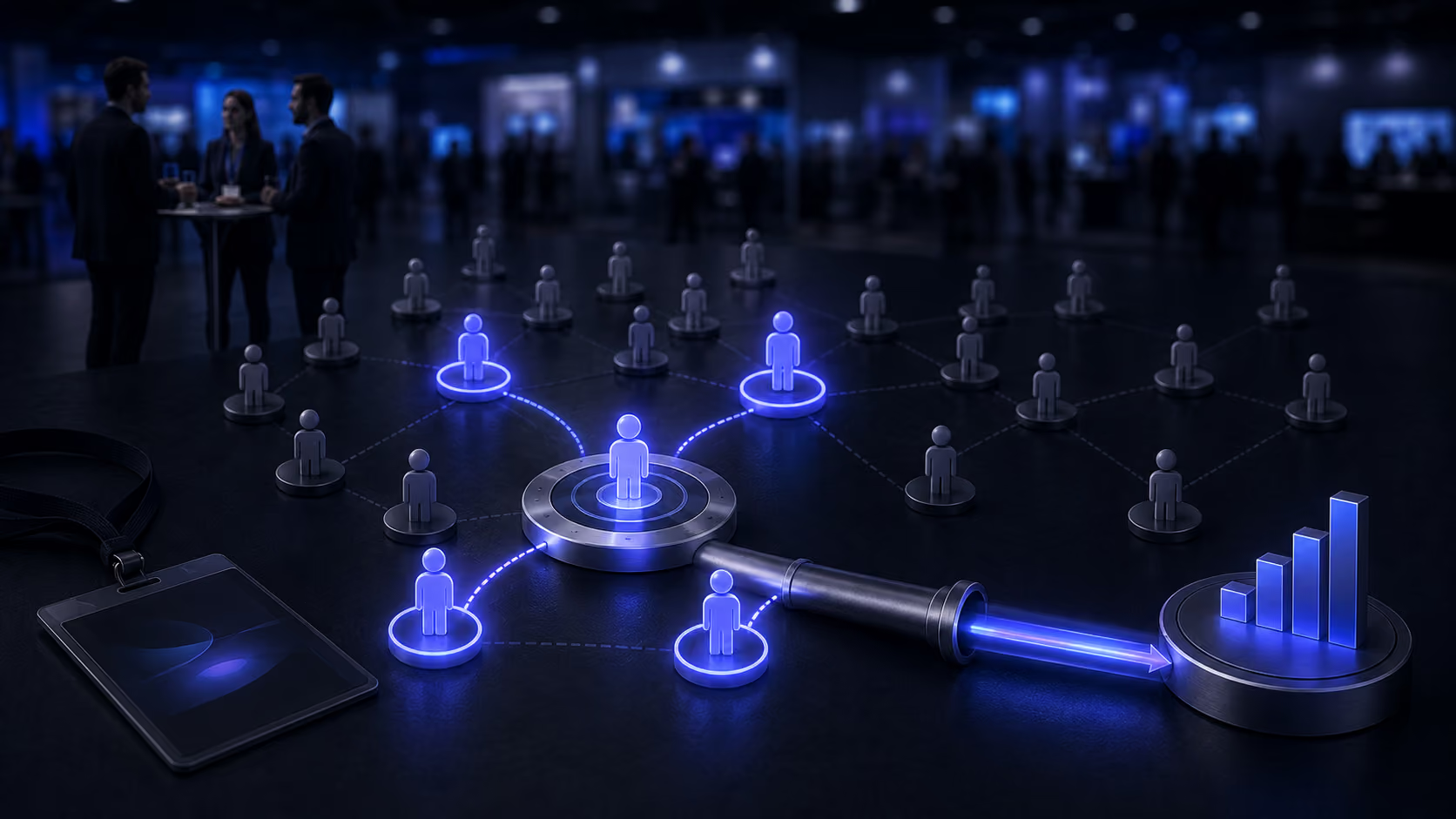
Event intelligence is the systematic collection and analysis of data about trade show participants — who attends, who exhibits, which companies are actively buying, and how these signals change over time. It covers three layers:
Exhibitor data — which companies have booths, their booth size, sponsorship level, and historical participation patterns across events.
Attendee signals — who has registered, who is predicted to attend based on past behavior and social signals, and which job titles and companies are represented.
Intent signals — firmographic and behavioral data indicating which accounts are actively evaluating solutions in your category right now.
Together, these three layers tell you where to show up, who to target, and what to say when you get there.
Why Traditional Trade Show Strategy Fails
The numbers make for uncomfortable reading. B2B companies spend an average of $276,000 on trade shows annually, yet research from EXHIBITOR Magazine shows that 82% cannot measure event ROI effectively. Half of all leads collected at trade shows are never followed up on. The average cost per qualified booth conversation — when you account for travel, booth, staff time, and logistics — runs $800 to $1,500.
That's not a trade show problem. That's an intelligence problem.
Without pre-event data, your strategy defaults to "hope for the right booth traffic." With it, you can pre-qualify your universe, reach prospects six weeks before they've filled their calendars, and walk into the event with 40 to 60 percent of your meetings already locked in.
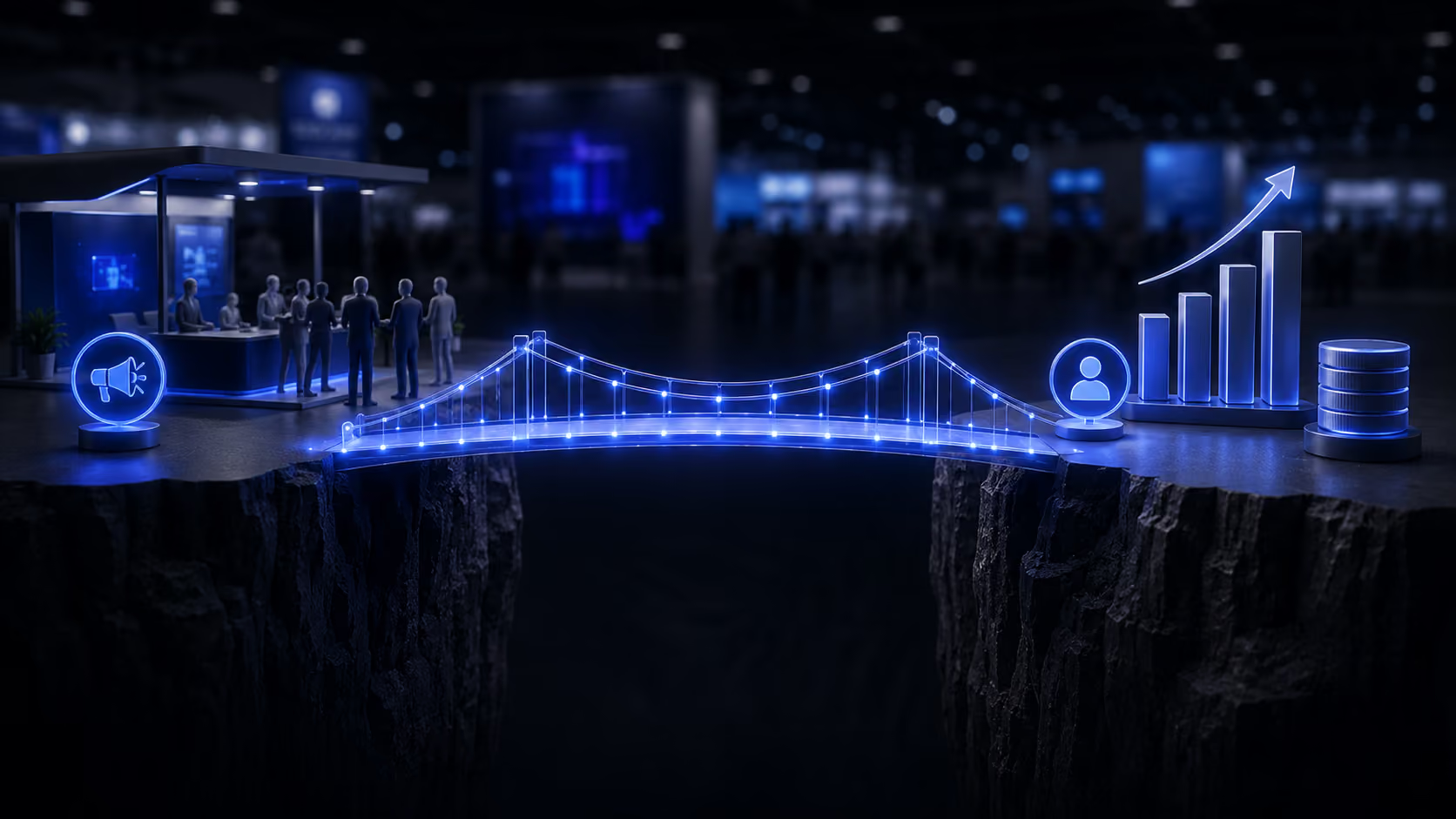
The gap between a $50K trade show that generates 8 qualified conversations and one that generates 35 isn't budget or booth design. It's the intelligence behind your preparation.
How Event Intelligence Improves Trade Show ROI
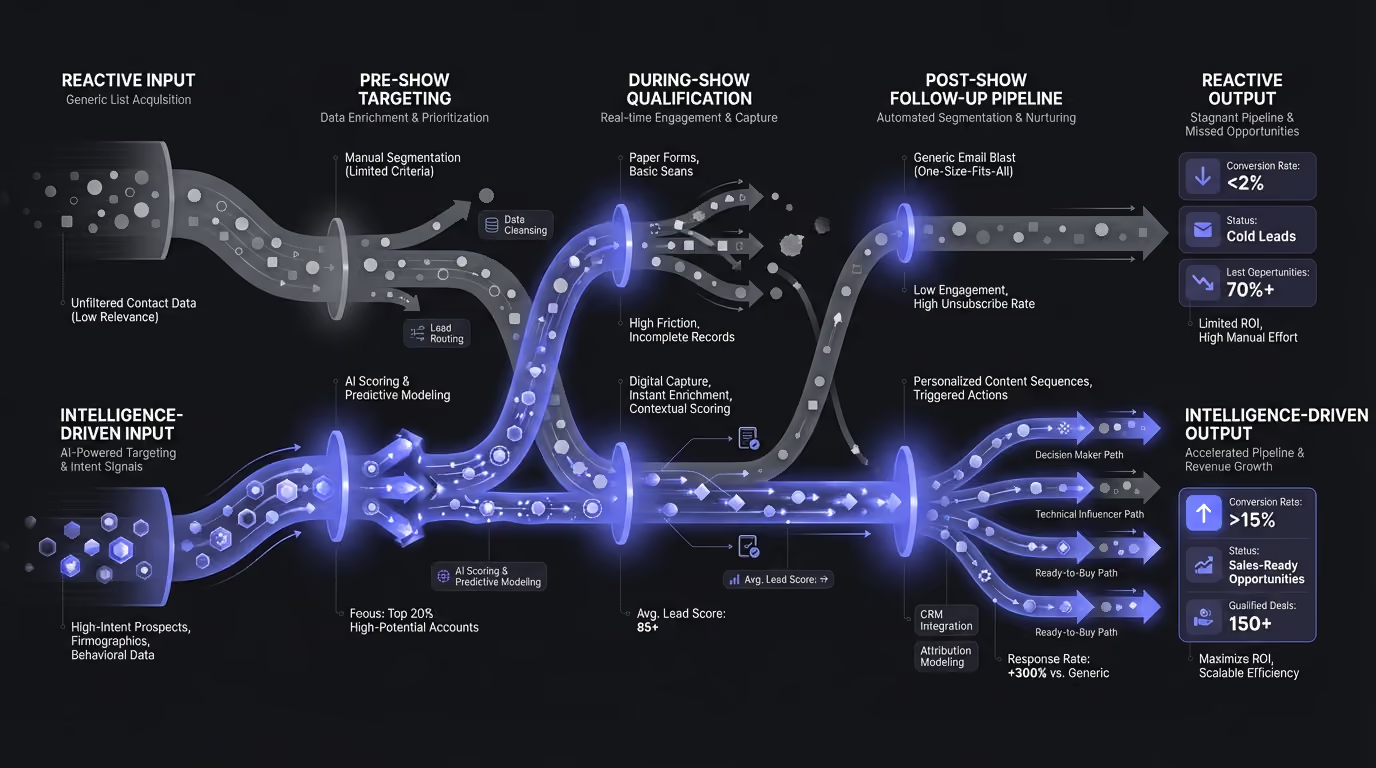
The impact plays out across three distinct phases.
Phase 1: Pre-Show — Target the Right People Before Doors Open
Pro Tip: Most event organizers release exhibitor and attendee lists 6–8 weeks before the show. Set a calendar reminder to pull the list the day it drops — early outreach consistently sees higher response rates before prospects's inboxes fill with competitor messages.
This is where most of the ROI is won or lost. By the time the event starts, the best prospects have already filled their calendars with meetings scheduled weeks in advance. If you're not in those calendars, you're competing for leftover time slots.
Event intelligence gives you a head start. When you know which accounts are likely to attend — based on historical attendance, event registrations, and social signals — you can reach them before they're distracted by the event itself.
A practical pre-show workflow looks like this:
-
Pull your target account list — typically your top 100 to 200 ICP accounts for the region.
-
Cross-reference against the event — which of those accounts have exhibited at this event before? Which have registered? Which have executives speaking or attending sessions?
-
Enrich and prioritize — layer in intent data (are they evaluating your category right now?) and firmographic fit (company size, tech stack, recent funding).
-
Launch personalized outreach — email and LinkedIn messages that reference their attendance, their specific business challenges, and a concrete reason to meet: "We'll be at [Event] in booth 214. Given that you're expanding your sales team this quarter, I'd love to show you how we help teams like yours get 3x more qualified meetings from events like this."
-
Book meetings before the event — aim to fill 40 to 50 percent of your calendar in advance. These pre-booked conversations typically convert to opportunities at 3 to 4 times the rate of walk-up traffic.
Pro Tip: Timing your outreach to 4 to 6 weeks before the event is the sweet spot. Too early and prospects haven't started thinking about the event. Too late and their calendars are already full. Track open rates by timing cohort and adjust each cycle.
Phase 2: During the Show — Qualify and Capture With Precision
Pro Tip: Use a simple A/B/C rating system during conversations — A (strong fit, active need), B (good fit, unclear timeline), C (early stage). Tagging leads in real time means post-show follow-up can be fully segmented within hours of the event closing, before the details fade.
Event intelligence doesn't stop once you arrive. The best teams use data during the show to prioritize their energy and capture high-quality information from every interaction.
The core principle: not all booth traffic is equal, and your response should reflect that.
For walk-up traffic, a simple qualification framework separates signal from noise. Instead of generic conversations, use three questions: What's your timeline for solving this problem? Who else is involved in the decision? What are you currently using? These answers — captured immediately in your CRM or lead retrieval app — let you segment leads in real time and assign appropriate follow-up sequences before you've left the conference floor.
For pre-booked meetings, the goal shifts from qualification to discovery. You already know the account fits your ICP. Now you're learning about their specific situation, timeline, and internal stakeholders. Event intelligence that surfaces company-level signals (recent news, funding, leadership changes) lets you walk in with context that makes conversations feel prepared, not scripted.
Pro Tip: Use a standardized meeting note template for every booth conversation. Include: primary pain point, current solution, buying timeline, decision-makers present, agreed next step. Fill it in immediately after each meeting — within 10 minutes, while the details are fresh. This is the difference between a personalized follow-up that converts and a generic "great to meet you" email that gets ignored.
Phase 3: Post-Show — Follow Up Before They Forget You
Pro Tip: The highest-leverage action after any trade show is sending a personalized recap to every pre-scheduled meeting that same evening. Most competitors send generic emails 5–7 days later. A same-day recap with specific next steps creates a contrast that prospects notice and remember.
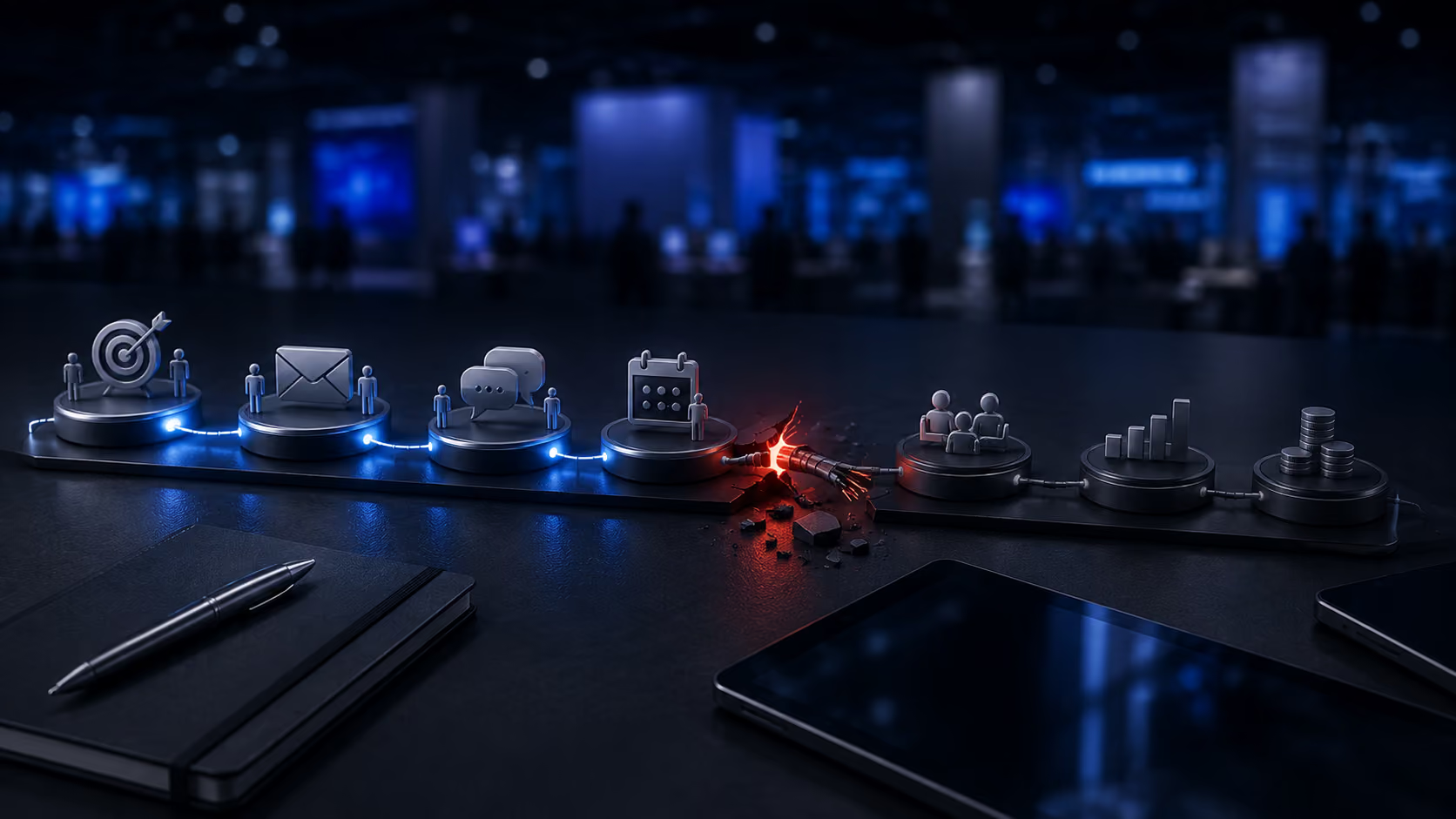
Most trade show leads die in the follow-up. Not because sales teams don't care, but because "follow up after the event" collides with "catch up on two weeks of email," and qualified leads sit cold for days or weeks until prospects have moved on. (See our full post-show follow-up playbook.)
Event intelligence structures your post-show process so follow-up happens with precision, not chaos.
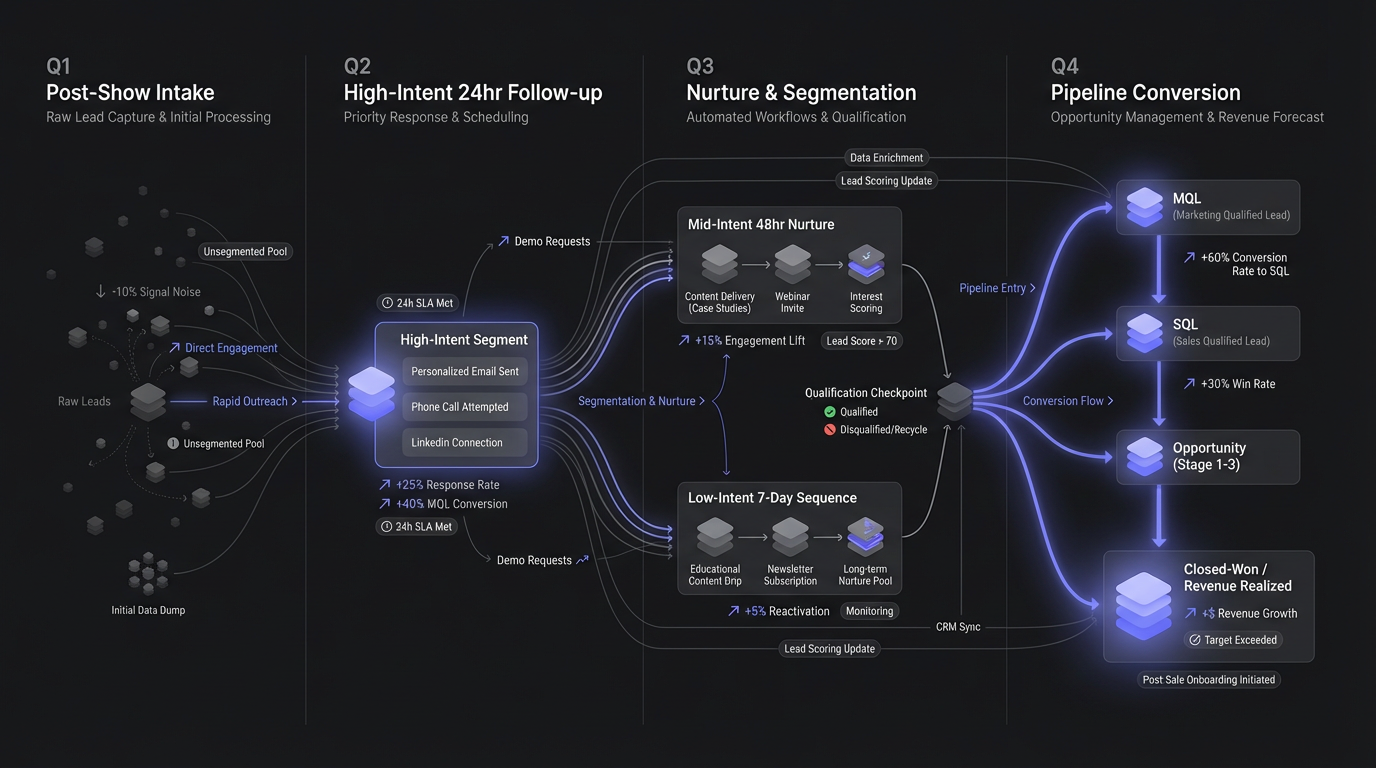
Within 24 hours: High-intent leads from pre-booked meetings get personalized emails. Not templates — emails that reference the specific conversation, attach the ROI calculation or document you discussed, and include a direct calendar link for the next step.
Within 48 hours: Mid-intent walk-ups who completed a demo or showed clear interest get a brief follow-up with a relevant case study and a low-friction ask: "Is a 20-minute call next week worth it?"
Within one week: Low-intent contacts who had a brief conversation enter a longer nurture sequence — educational content, no hard sell, staying visible without being aggressive.
The segmentation matters. Sending the same follow-up to everyone dilutes the message for high-intent leads and burns goodwill with low-intent contacts. Event intelligence data — the qualification notes you captured during the show — is what makes segmentation possible at scale.
Pro Tip: Multi-thread your enterprise follow-up. If you spoke to a VP of Sales at a target account, have an SDR reach out to the Director of RevOps within 48 hours: "I saw [VP] stopped by our booth at [Event]. We discussed how your team handles pre-event targeting — this tends to be a RevOps challenge too. Would a quick call be useful?" Accounts with two or more active contacts convert at significantly higher rates than single-threaded deals.
Measuring Event Intelligence ROI
Event intelligence creates a measurable feedback loop that compounds over time. Here are the metrics that matter (for a deeper framework, see how to measure trade show ROI):
Pre-show conversion rate — percentage of outreach recipients who book a meeting. Typical range without intelligence: 2 to 4 percent. With targeted, personalized outreach: 15 to 25 percent.
Meeting show rate — percentage of pre-booked meetings where the prospect actually shows up. Reducing no-shows from a typical 35 to 40 percent down to 15 to 20 percent requires tactics like sending booth location maps, rep photos, and a reminder the morning of the event.
Lead-to-opportunity conversion — how many leads within 60 days become active pipeline opportunities. Industry average sits around 5 to 10 percent. Teams with strong intelligence-backed follow-up regularly see 30 to 45 percent.
Cost per qualified opportunity — total event spend divided by opportunities generated. This is the number your leadership actually cares about. Event intelligence typically reduces this figure by 50 to 70 percent, simply by reducing the denominator: more opportunities from the same spend.
Track these across multiple events and you'll start seeing which shows consistently deliver for your ICP and which ones have never generated real pipeline despite significant spend. That data is the foundation of a smarter annual event calendar.
Getting Started With Event Intelligence
You don't need a sophisticated tech stack to start. The basics are straightforward:
Start with your existing CRM data. Which of your customers attended which events last year? Which accounts in your pipeline were at the same events as your sales team? This historical pattern tells you more about where your ICP actually shows up than any event directory.
Layer in external data. Use exhibitor lists (available on most event websites) to identify which companies in your target universe are attending upcoming events. Cross-reference against your account list. Prioritize events with the highest concentration of ICP accounts.
Build a pre-event targeting workflow. Six weeks before each event, pull the overlap between event exhibitors and your account list, enrich contacts, launch personalized outreach. Track responses. Iterate the timing and message based on what converts.
Capture structured data during the show. This is the input that powers everything after. A standardized note-taking template takes five minutes to build and transforms your post-show follow-up.
For teams that want to scale this without spending 40+ hours on manual research per event, event intelligence platforms like Lensmor automate the intelligence layer — surfacing predicted attendees, enriching contact data, and flagging which target accounts are showing up at which events — so your team can focus on conversations rather than research.
The Compounding Effect
Here's what makes event intelligence genuinely powerful as a long-term strategy: every event makes the next one better.
When you track which accounts attended which events and how they responded, you build a proprietary dataset that external vendors can't replicate. You know that your ICP tends to concentrate at three specific events per year. You know that outreach sent four weeks out converts better than five weeks out. You know which booth experiences generate the most post-show pipeline.
Traditional trade show strategy treats every event as a fresh start. Intelligence-driven strategy treats every event as a data point in a compounding system.
That's the difference between hoping for pipeline and engineering it.
Start Free — Start using Lensmor's event intelligence platform. Predict who will attend your next trade show, surface which target accounts are going, and build your pre-show outreach pipeline weeks before doors open. Limited spots available.