What Is an Event Marketing Tool?
An event marketing tool is a software platform designed to help B2B teams plan, execute, and analyze their trade shows and field events. Modern event marketing tools go beyond logistics to provide Event Intelligence—identifying competitor footprints, decoding buyer intent, and validating budget signals before the event starts.
Traditional Event Tools vs. Event Intelligence Platforms
Traditional Event Tools focus on logistics and registration—managing booth bookings, attendee lists, and post-event surveys. They tell you who showed up but not who's ready to buy.
Event Intelligence Platforms like Lensmor take a fundamentally different approach:
- Pre-Show Data: AI-verified buyer intent signals instead of static attendee lists
- Competitor Radar: Track competitor movements across 160,000+ global events
- Real-Time Alerts: Slack and email notifications when prospects show buying signals, not just post-event wrap-ups
- GTM Signal Focus: Designed around go-to-market signals, not event logistics
The tools you choose determine whether your team walks in with intelligence or walks in blind. Here is how to build a stack that delivers measurable trade show ROI.
Your Booth Isn't the Problem. Your Stack Is.
Picture this: two companies exhibit at the same trade show. Same floor, same attendee pool, roughly the same booth budget. Company A walks away with 14 qualified meetings and a pipeline worth $380K. Company B leaves with a box of badge scans and a vague plan to "follow up next week."
The difference isn't booth design or sales talent. It's the technology running behind the scenes.
Company A knew which prospects would attend six weeks before the event. Their reps walked in with pre-booked meetings, enriched contact data, and a CRM that tagged every conversation in real time. Company B showed up, scanned badges, and hoped for the best.
This gap is widening fast. The event marketing tools available in 2026 have fundamentally changed what's possible — from AI-powered attendee prediction to real-time lead routing that gets a follow-up email into someone's inbox before they've left your booth. But most B2B teams are still stitching together spreadsheets, generic CRMs, and a prayer.
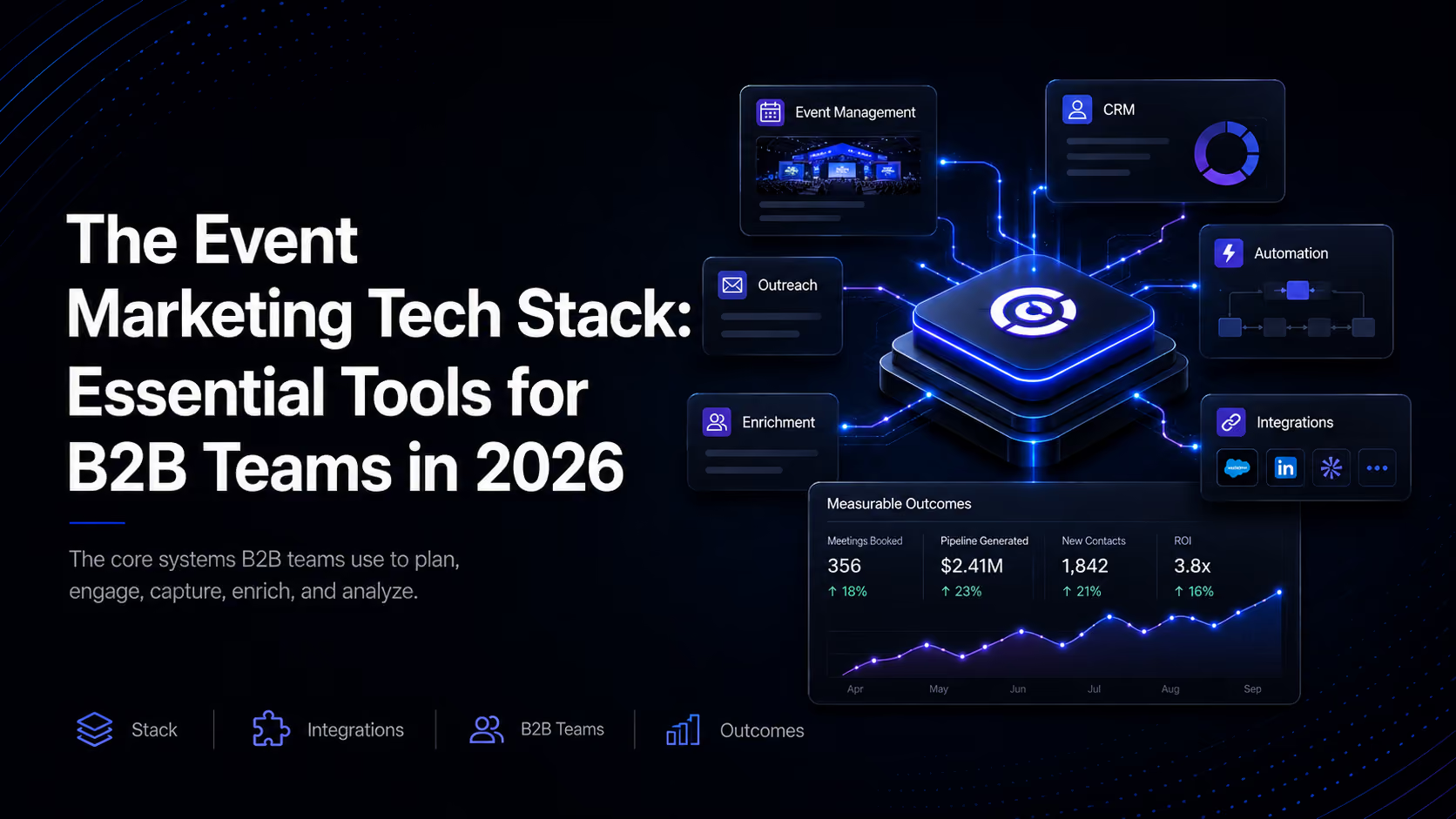
This guide breaks down the modern event marketing tech stack layer by layer. Not a "top 50 tools" listicle — a functional architecture that shows you what each layer does, why it matters, and how the pieces connect.
If your immediate question is which planning tasks to automate, compare these AI tools for event planning by workflow, limits, and review requirements.
Why Tool Selection Matters More Than Tool Count
Before diving into categories, a reality check: the average B2B marketing team already uses 12-15 tools across their stack. Adding more doesn't automatically create value. Adding the right tools in the right sequence does.
The event marketing stack is unique because it spans a compressed timeline. You're not nurturing leads over months with drip emails. You're operating in a 72-hour window where preparation meets execution meets follow-up — and gaps between tools become gaps in pipeline.
The jump from "partially tooled" to "fully integrated" isn't about spending more. It's about eliminating the handoff gaps where leads go to die — between your event app and your CRM, between your badge scanner and your follow-up sequence, between your gut feeling about which events to attend and actual data.
Pro Tip: Before evaluating any new tool, map your current event workflow end-to-end and mark every point where data moves manually (exports, re-entry, copy-paste). Those manual handoffs are where you're losing the most value — and where the right tool creates the biggest ROI.
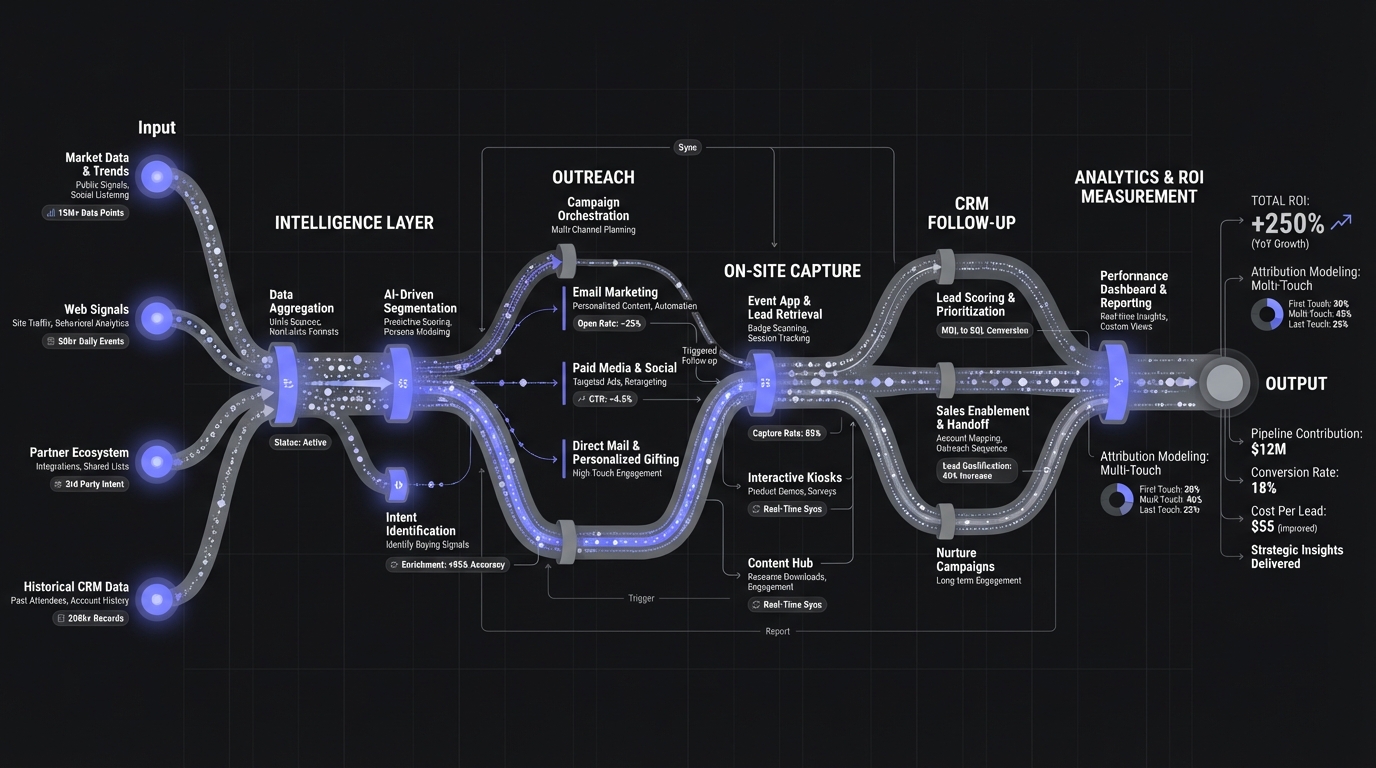
Layer 1: Event Intelligence and Discovery
This is the foundation layer, and it's the one most teams skip entirely. Event intelligence tools answer two questions that determine everything downstream: Which events deserve our budget? and Who will actually be there?
The old way of answering these questions involved browsing event directories, asking industry contacts, and relying on last year's experience. The problem is obvious — you're making $30K-$50K event investment decisions based on incomplete information and gut instinct.
Modern event intelligence platforms flip this approach. Instead of starting with events and hoping the right people show up, you start with your target accounts and discover which events they attend. This is the "reverse discovery" model, and it fundamentally changes how B2B teams plan their event calendars.
What to look for in this layer:
Event intelligence tools should give you exhibitor and attendee data across thousands of events, not just the ones you already know about. The best platforms offer attendee prediction — forecasting who will attend based on historical patterns, social signals, and registration data — weeks before the official attendee list drops. They should also support competitor tracking, showing where your competitors exhibit and how their event presence changes over time.
Lensmor sits in this layer as an event intelligence and lead generation platform. Its reverse event discovery lets you input target companies and find which trade shows they participate in, while the attendee prediction engine identifies likely attendees before official lists are published. This kind of pre-event intelligence is what separates Company A from Company B in our opening example.
If you're still choosing events based on last year's calendar, our guide to selecting the right trade shows covers the data-driven decision framework in detail.
Pro Tip: The ROI of event intelligence compounds over time. Your first event with predictive data might feel like an experiment. By the third event, you'll have enough pattern data to predict pipeline before you've even booked the booth.
Layer 2: Pre-Event Outreach and Meeting Scheduling
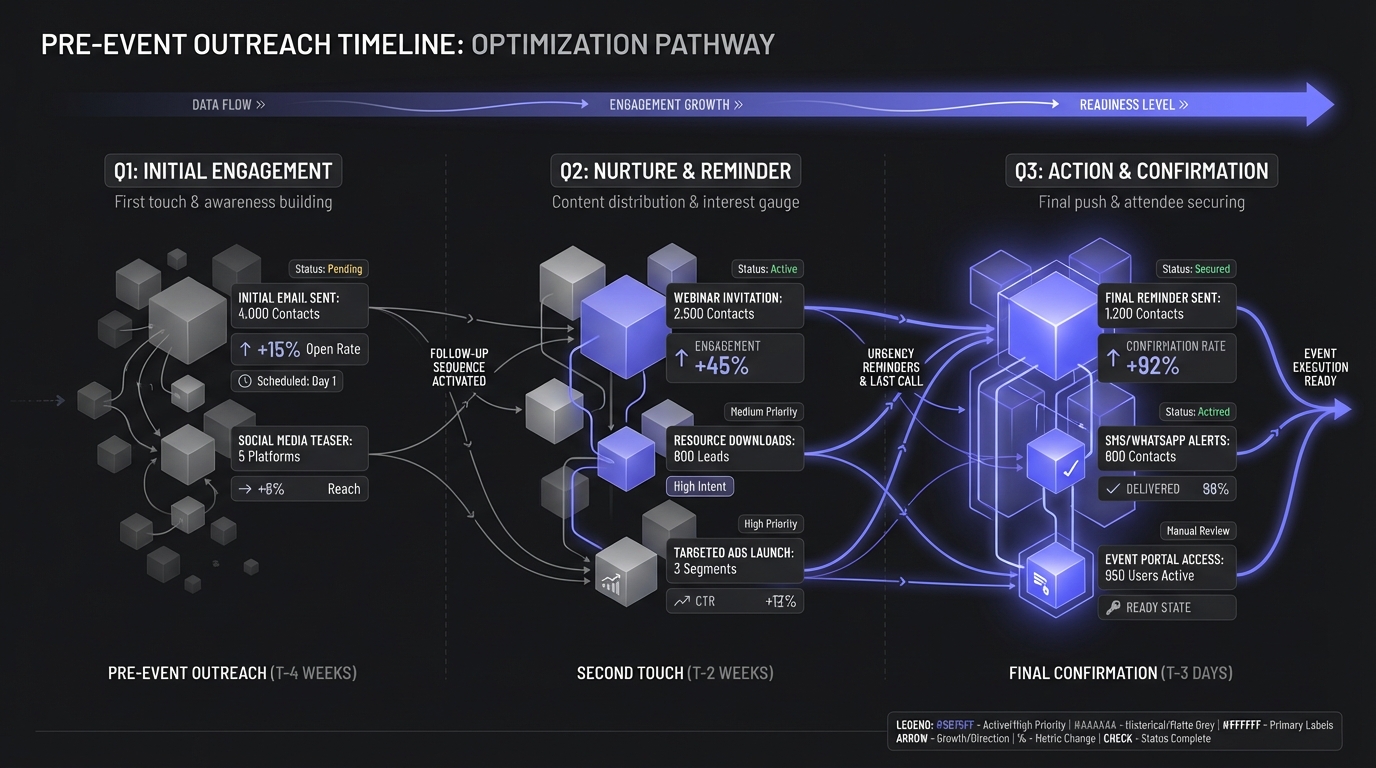
Intelligence without action is just research. The second layer converts your attendee data into booked meetings before the event opens.
This is where sales engagement platforms and scheduling tools earn their keep. The goal is simple: by the time your team arrives at the venue, they should have a calendar full of confirmed appointments with qualified prospects. Walk-up traffic at the booth is a bonus, not the strategy.
The tools that matter here are the ones your sales team already uses — platforms like HubSpot, Salesloft, or Apollo for sequenced outreach, paired with scheduling tools like Calendly or Chili Piper for frictionless booking. The difference is how you feed them. When your outreach sequence says "I noticed your company is exhibiting at [Event] next month — are you available for a 15-minute conversation at our booth on Day 2?" it converts at 3-5x the rate of generic cold outreach because the context is specific and the ask is grounded in a shared moment.
The critical integration point is between Layer 1 (intelligence) and Layer 2 (outreach). If your event intelligence tool can export enriched contact data — verified emails, direct dials, LinkedIn profiles — directly into your sales engagement platform, you've eliminated the manual research step that typically costs 15-20 hours per event. Lensmor's contact enrichment and CSV export, for instance, feeds directly into CRM and outreach workflows.
What to look for in this layer:
The outreach tool itself matters less than the workflow it enables. Can you build event-specific sequences? Can you track which contacts opened, replied, or booked? Can you hand off booked meetings to the right rep with full context? The tools that win here aren't the flashiest — they're the ones that reduce friction between "I know this person is attending" and "we have a meeting scheduled."
Timing matters too. The best pre-event outreach campaigns follow a cadence: a first touch four weeks out (introducing yourself and referencing the event), a second touch two weeks out (sharing a specific reason to meet), and a final confirmation three days before the event. Each touch should add value — a relevant case study, a preview of what you'll be showing at the booth, or a personalized observation about their business. Generic "let's connect at the show!" messages get ignored because every exhibitor sends them.
Layer 3: On-Site Lead Capture and Engagement
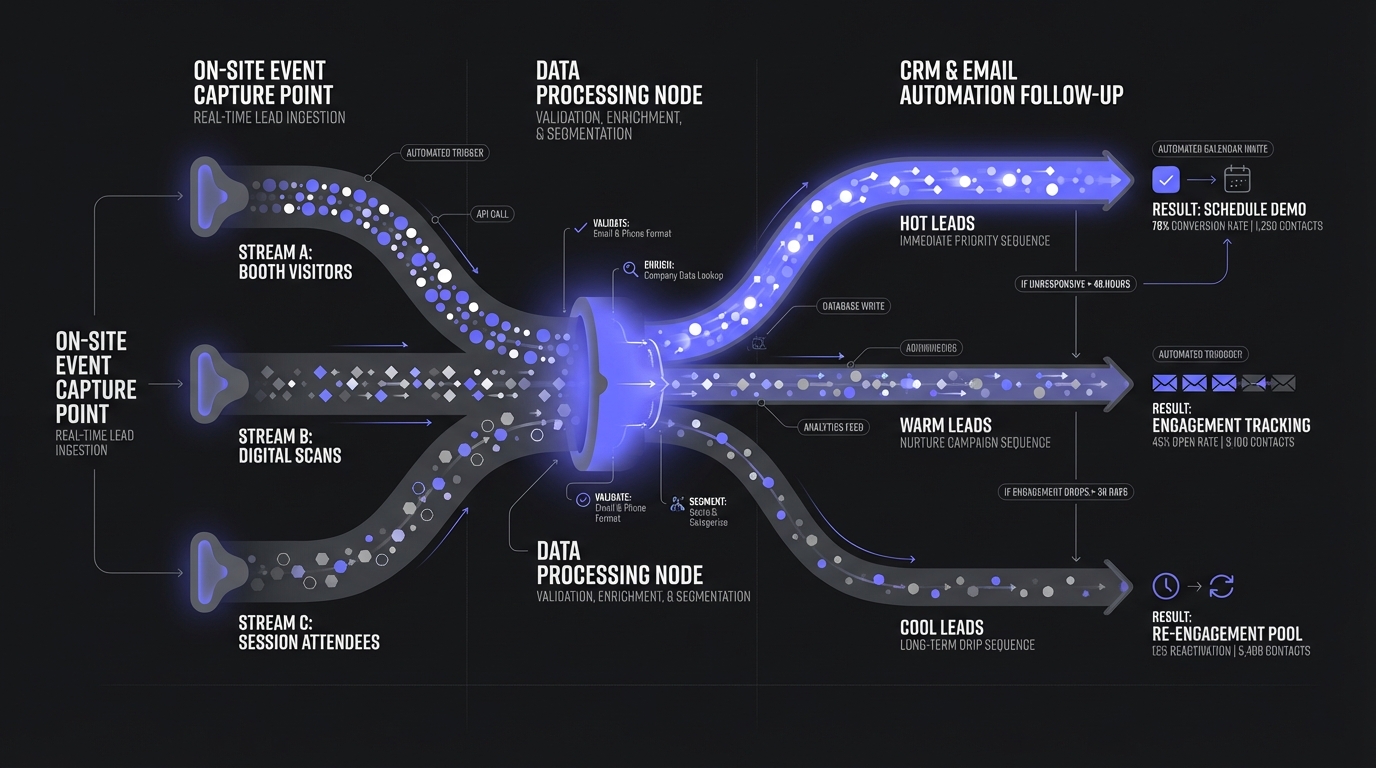
The event floor is where preparation meets execution. Your on-site capture layer needs to do three things simultaneously: collect contact data, capture conversation context, and route qualified leads to the right follow-up track — all within the 60 seconds a rep has between conversations.
Badge scanners are table stakes. Every major event provides one, and they all do the same thing: convert a barcode into a name and email. That's not lead capture. That's data entry.
Real lead capture tools layer qualification on top of collection. Look for apps that let reps tag leads with predefined categories (hot/warm/cool, product interest, buying timeline) and add voice or text notes in under 60 seconds. The best tools sync to your CRM in real time — not overnight, not "when we get back to the office," but while the prospect is still walking the floor.
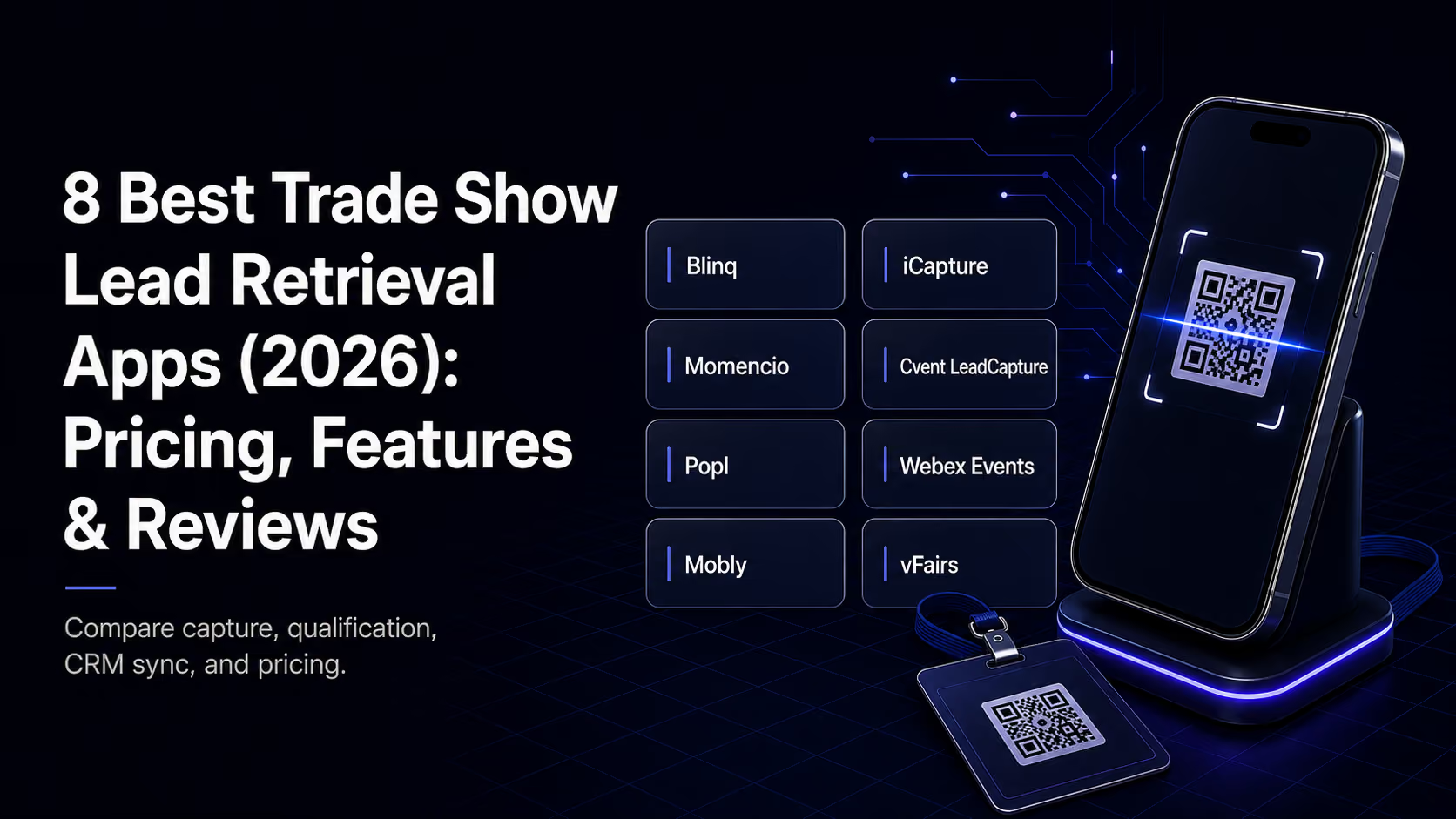
Popular options in this space include iCapture, Momencio, Cvent LeadCapture, and Popl. But the right choice isn't the one with the most features — it's the one your reps will actually use when they're tired, their phone is at 11%, and there's a line forming at the booth.
Beyond capture, some teams are layering in engagement tools: interactive demos, digital business cards, gamified booth experiences, and QR-code-driven content delivery. These serve a dual purpose — they create memorable interactions and they generate behavioral data (which demo did the prospect engage with? Which content did they scan?) that enriches the lead profile.
For a deeper framework on qualifying leads during booth conversations, see our lead qualification criteria guide.
Pro Tip: Test your capture app under realistic conditions before the event. Have two team members role-play a 3-minute booth conversation, then time the data entry. If it takes more than 60 seconds, simplify the form. Every extra field you add is a field that won't get filled when the booth is busy.
Layer 4: Post-Event Follow-Up and CRM Integration
The 48 hours after an event closes are where deals are won or lost. Research consistently shows that leads contacted within 24 hours convert at 7x the rate of those contacted a week later. Yet the average trade show follow-up takes over a week — and 79% of event leads never receive any follow-up at all.
This is a technology problem, not a discipline problem. When your capture data lives in a badge scanner that needs to be synced, exported, cleaned, and imported into your CRM before anyone can send an email, a week of delay is structurally inevitable.
The fix is real-time CRM integration. When a rep qualifies a lead on the event floor and it appears in Salesforce or HubSpot within minutes — tagged with event source, qualification tier, and conversation notes — the follow-up sequence can trigger automatically. Hot leads get a personal email from the rep within hours. Warm leads enter a 3-touch nurture sequence. Cool leads route to marketing automation.
What to look for in this layer:
Your CRM is the hub, but the connective tissue matters more. Tools like Zapier, Make (formerly Integromatic), or native CRM integrations in your capture app eliminate the manual export-import cycle. Marketing automation platforms (HubSpot, Marketo, ActiveCampaign) handle tiered nurture sequences. The key metric is time-to-first-touch by lead tier — if your Tier 1 (hot) leads aren't getting a personal email within 24 hours, your follow-up stack needs work.
For the full playbook on how to capture and convert event leads across the entire lifecycle, that guide covers the three-phase system in detail.
Layer 5: Analytics and ROI Measurement
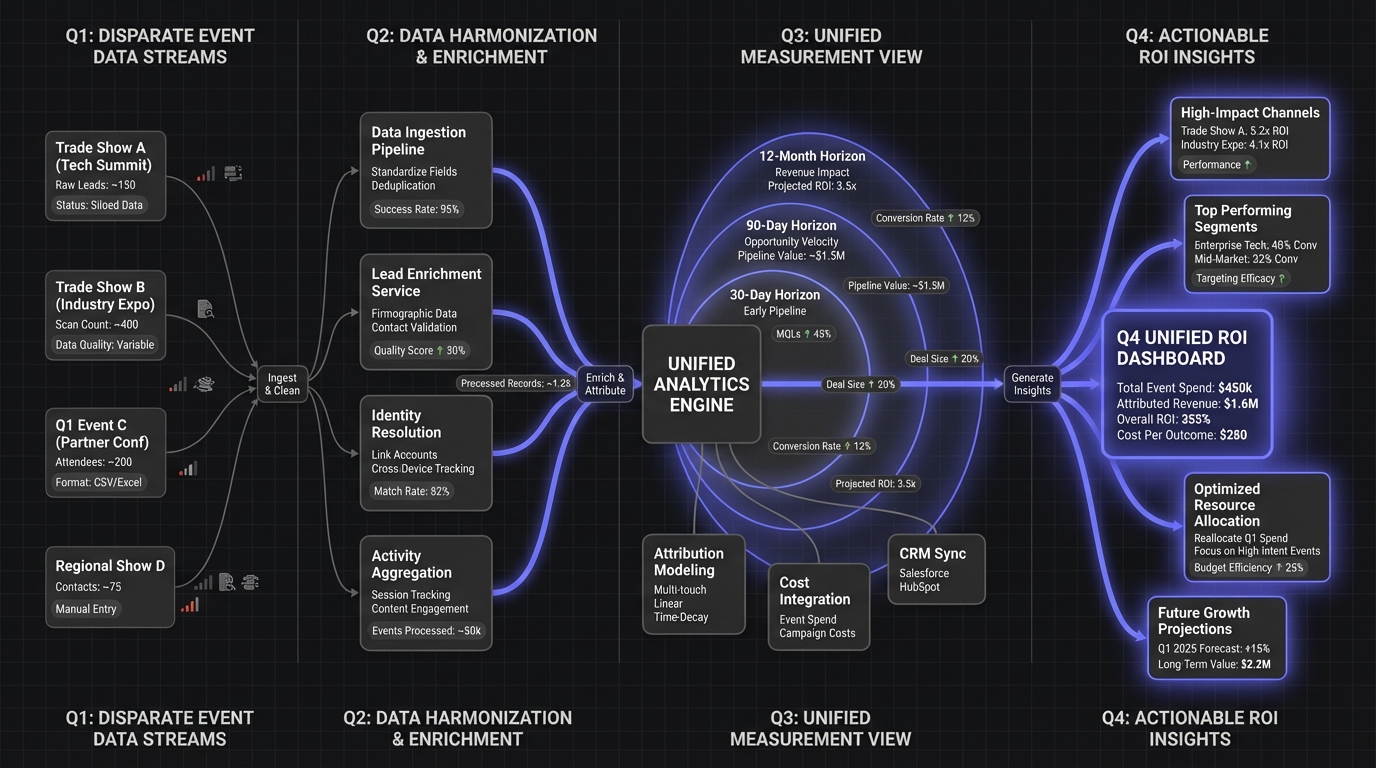
Every tool investment needs to prove its value, and event marketing has historically been terrible at this. The analytics layer closes the loop: it connects event spend to pipeline generated to revenue closed.
The challenge with event ROI is timing. B2B sales cycles run 3-9 months, so measuring ROI 30 days after an event captures maybe 10% of the real value. A proper analytics setup measures across three horizons: the 30-day snapshot (activity metrics, early pipeline), the 90-day assessment (pipeline advancement, initial closed deals), and the 12-month true ROI (closed revenue, influenced revenue, remaining pipeline).
Most teams cobble this together in spreadsheets. That works for 2-3 events per year. At scale — 10+ events annually — you need purpose-built reporting. Some CRM platforms handle this natively (Salesforce campaigns, HubSpot campaigns), but they require disciplined event source tagging. Dedicated event analytics tools like Certain, Splash, or Bizzabo offer event-specific dashboards that track attendee engagement, session participation, and post-event conversion in a single view.
The most underused metric in event analytics is cost per qualified lead by event. Not cost per badge scan — cost per lead that actually converted to a meeting. When you can compare this number across 10 events, the budget allocation conversation with your CFO becomes a data exercise instead of a debate.
One pattern worth noting: the companies that get the best analytics data are the ones that enforce tagging discipline early. If you wait until the post-event debrief to decide how to categorize leads, you've already lost context. Define your tags (event name, lead tier, product interest) before the event and bake them into your capture workflow so the data arrives in your analytics tool already structured. Retrofitting messy data after the fact is the analytics equivalent of cleaning up badge scans a week later — technically possible, but the fidelity is shot.
Our framework for measuring trade show ROI covers the three-horizon model in detail, including formulas and a calculator template.
Building Your Stack: Start With the Gaps
You don't need to rip out your existing tools and start from scratch. The most effective approach is to identify where your current workflow breaks down and fill that specific gap.
If you're flying blind on event selection — you pick events based on habit or industry buzz rather than data — start with Layer 1. Event intelligence is the highest-leverage investment because it affects every downstream activity. Choosing the wrong event means every dollar you spend on capture, follow-up, and analytics is optimized against the wrong audience.
If your pre-event prep is weak — your reps show up without booked meetings or target lists — the gap is between Layer 1 and Layer 2. You might already have sales engagement tools; you're just not feeding them event-specific intelligence.
If follow-up is your bottleneck — leads sit in a spreadsheet for a week before anyone sends an email — fix the Layer 3 to Layer 4 integration. Real-time CRM sync from your capture tool eliminates the single biggest source of lost pipeline.
If you can't prove ROI — leadership questions event spend every quarter — invest in Layer 5 infrastructure. Start with consistent event source tagging in your CRM and build from there.
Pro Tip: Resist the temptation to buy a single "all-in-one" event platform that promises to handle every layer. The best event marketing stacks are modular — specialized tools connected by clean integrations. An all-in-one that's mediocre at five things is worse than three tools that each excel at their core function.
What's Ahead: Event Technology Trends Shaping 2026
The event marketing technology landscape is evolving fast. Three trends are worth watching.
AI-powered personalization is moving beyond buzzword territory. Tools are emerging that can analyze a prospect's digital footprint — LinkedIn activity, content engagement, company news — and generate personalized talking points for your reps before each booth meeting. The ROI of pre-meeting preparation is well documented; AI just makes it scalable.
First-party data is becoming king. As third-party cookies disappear and data privacy regulations tighten, the contact data captured at events — with explicit consent, during a genuine conversation — is becoming one of the most valuable data sources in B2B marketing. Tools that help you capture and activate this first-party data cleanly are worth prioritizing.
Hybrid event infrastructure is maturing. The awkward virtual-event pivot of 2020 has evolved into purpose-built hybrid platforms that treat in-person and digital attendees as a single audience. For B2B teams running both in-person trade shows and virtual events, a unified tech stack across both formats eliminates duplicate workflows and fragmented data.
Integration-first architecture is replacing the all-in-one dream. The winning approach in 2026 isn't a single platform that tries to do everything — it's a set of best-in-class tools connected through APIs, webhooks, and integration platforms like Zapier or Make. This modular approach lets you swap out any layer without rebuilding the entire stack. When a better lead capture app launches, you plug it in. When your outreach platform raises prices, you switch. The tools that are being built for this era are designed with open APIs and native integrations as a core feature, not an afterthought.
Conclusion
The gap between event marketing teams that generate predictable pipeline and teams that collect badge scans isn't talent or budget — it's infrastructure. A thoughtful tech stack turns a 72-hour event into a quarter-long pipeline engine.
Start with the layer where your current process breaks down. If you're not sure where that is, trace a single lead from "we heard about this event" through "we closed the deal" and mark every point where data moved by hand or disappeared entirely. That map is your buying guide.
Ready to start with the intelligence layer? Start Free — start using Lensmor's event intelligence tools, including reverse event discovery, attendee prediction, and contact enrichment that helps B2B teams find the right events and the right people before the show opens.