The trade show floor opens in three weeks. Your booth is designed, your team is trained, and your swag is ordered. But here's the uncomfortable question most companies never answer until it's too late: Who else will be in that hall, and what are they planning to say to your prospects?
The difference isn't luck—it's preparation. While your competitors show up hoping for the best, you'll walk in knowing exactly who you're up against, what messaging they'll use, and how to position your solution as the obvious choice.
This guide gives you a complete template for pre-show competitor analysis that transforms guesswork into strategy. You'll learn what intelligence matters, how to gather it efficiently, and how to turn those insights into messaging that wins before the first attendee walks past your booth.
Build a pre-show competitor brief around observable evidence: the current exhibitor list, public product messaging, relevant use cases and questions buyers may ask. Translate each finding into a claim your booth team can support.
What is Pre-Show Competitor Analysis?
Pre-show competitor analysis is the systematic process of researching and evaluating which competitors will exhibit at an upcoming trade show, understanding their likely positioning and messaging, and crafting differentiated talking points that highlight your unique advantages. It's competitive intelligence applied specifically to the exhibition environment—where you have minutes, not months, to make an impression.
The most effective pre-show analysis happens 4-6 weeks before an event, giving you enough time to gather intelligence, refine your messaging, and train your team on differentiation strategies. This isn't about obsessing over competitors—it's about understanding the landscape so you can navigate it confidently.
Why Pre-Show Intelligence Separates Winners from Exhibitors
Trade shows represent compressed selling environments where hundreds of companies compete for attention in a confined space. The companies that consistently generate ROI from exhibitions understand that success depends on differentiation, and differentiation requires knowing what you're differentiating against.
Consider the reality of modern B2B exhibitions: Attendees typically visit 10-15 booths during a full day on the floor, spending an average of 3-5 minutes at each stop. They've researched solutions beforehand, they have specific pain points, and they're actively comparing options. When your sales team can articulate clear differentiation from competitors they're likely encounter, they transform those brief conversations into memorable encounters that advance deals.
Pro Tip: Assign a competitive intelligence owner for each major trade show. This person coordinates research, synthesizes findings into actionable briefs, and leads a pre-show strategy session where the team practices handling competitive positioning scenarios. The investment of 4-6 hours prevents countless wasted conversations on the show floor.

The Three-Layer Competitor Identification Framework
Not all competitors matter equally at trade shows. The most effective pre-show analysis categorizes competitors into three distinct layers, each requiring different levels of intelligence and preparation.
Direct Competitors are companies offering solutions nearly identical to yours, targeting similar customer profiles and use cases. These are your primary threats on the show floor—the companies attendees will actively compare you against.
Indirect Competitors offer different solutions that solve the same underlying problem. A CRM company's indirect competitor might be a spreadsheet or a manual process, but at trade shows, indirect competitors are more often adjacent solution providers—for example, a marketing automation platform competing for budget against a dedicated email tool. These competitors matter because attendees often discover them while exploring solutions and may shift their evaluation criteria based on what they see.
Emerging Threats are new entrants or startups attending the show to gain visibility. They might not have mature products or significant market presence, but they often bring fresh messaging, aggressive pricing, or novel approaches that can disrupt standard conversations.
Pro Tip: Use event intelligence platforms to identify which competitors have officially registered as exhibitors. Cross-reference this with historical attendance patterns to predict which companies will send representatives even without booth space. The most dangerous competitor at a trade show is often the one who didn't pay for a booth but is actively working the room.
Building Your Competitor Intelligence Database
Effective competitor analysis requires consistent, structured data collection across multiple sources. The strongest competitive intelligence databases combine official information with behavioral signals that reveal strategy and intent.
Start with exhibitor listings from the official show website, which provide confirmed booth numbers, sponsorship levels, and often descriptions of planned offerings. This foundational data tells you who will be present and where they'll be located—critical for planning booth positioning and routing strategies. Sponsorship levels indicate investment commitment; companies spending heavily on premium sponsorships are likely to aggressively promote their presence and drive traffic to their booths.
Social media monitoring reveals messaging focus and promotional strategies in the weeks leading up to the event. Follow your competitors' LinkedIn company pages and key executives to see what themes they're emphasizing, what assets they're creating, and how they're positioning themselves for the show. Count the number of posts mentioning the event by hashtag—companies with heavy pre-show promotional activity are likely to have significant presence and pull with attendees.
Website and landing page analysis exposes positioning, messaging priorities, and often new product announcements timed to trade shows. Many companies launch landing pages specifically for major exhibitions, sometimes weeks before the event. These pages frequently contain downloadable content, session schedules, or meeting booking forms that reveal strategic priorities.
Press releases and media coverage often announce partnerships, product launches, or executive appearances scheduled around trade shows. Industry publications frequently run "who to see" or "what to expect" preview articles that mention key exhibitors. These mentions indicate which companies the industry views as relevant and worth attention—valuable validation of competitor importance.
Previous show analysis provides historical context. If you've attended this event before, review which competitors were present, how they positioned themselves, and what seemed to resonate with attendees. Companies that return year after year have found value in the event and likely have established relationships with regular attendees. New exhibitors may indicate shifting industry dynamics or emerging solution categories.
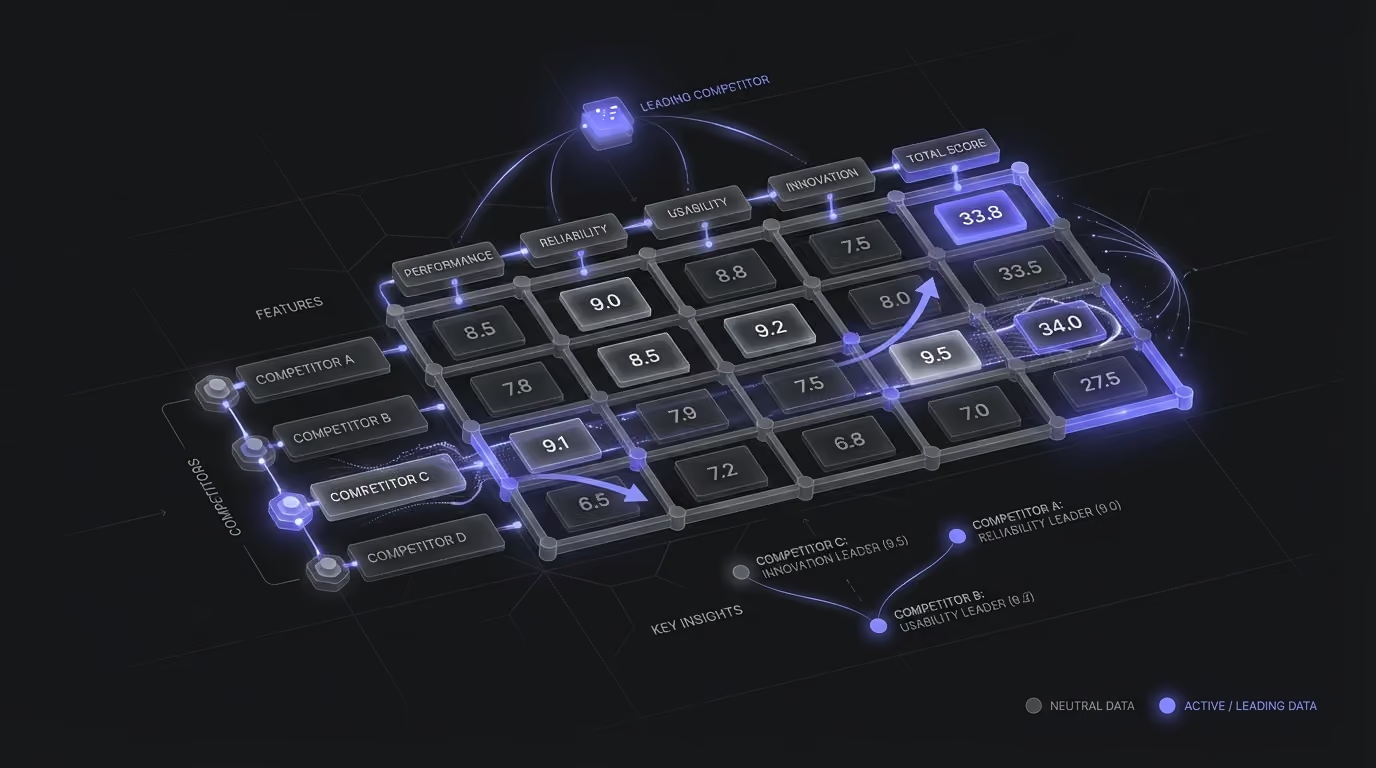
Pro Tip: Create a simple spreadsheet template for each trade show with columns for competitor name, booth number, key messaging themes, new announcements, differentiation points, and your planned counter-positioning. This living document becomes your competitive playbook and can be reused and refined for future events.
Analyzing Competitor Positioning and Messaging
Once you've identified which competitors will be present, the next layer of analysis focuses on understanding how they position themselves and what messages they'll likely bring to the show floor. This positioning analysis reveals the conversational landscape your team will navigate.
Start with value proposition extraction by reviewing competitors' websites, recent content, and social media posts. Document the core claims they make about their solutions—phrases like "the only platform that," "most trusted by," "fastest," "easiest," or industry-specific differentiators. These claims form the foundation of their messaging and will likely surface in booth conversations. Pay special attention to comparative language that explicitly or implicitly references competitors—this indicates where they feel vulnerable or aggressive.
Target customer analysis reveals who competitors are trying to reach. Examine their case studies, testimonials, and customer logos to identify company sizes, industries, roles, and use cases they emphasize. This tells you which attendee segments they'll target and what pain points they'll address. Understanding their target audience helps you predict which booth visitors might be good fits for them versus better fits for you.
Feature prioritization shows what competitors consider most important about their solutions. Browse their product pages, documentation, and recent release notes to identify which features they highlight most prominently. Features prominently displayed on homepage banners or in recent announcement posts represent messaging priorities. These are likely the talking points their booth staff will emphasize in conversations.
Pricing and packaging intelligence is often the hardest to gather but valuable for differentiation. Review pricing pages if available, look for mention of enterprise plans, and note any promotional offers tied to the trade show. While you may not find exact pricing, you can often discern pricing models—per seat, per usage, tiered packages, or custom enterprise pricing. This context helps you position your own pricing as competitive or justified by value.
Partnership and ecosystem mentions indicate competitive moats or strategic advantages. Many companies announce new partnerships around major trade shows, expanding their capabilities or distribution reach. These partnerships can be competitive threats if they add functionality or channels you don't match, or they can reveal areas where competitors have gaps they're trying to fill through integration rather than native development.
Executive visibility provides additional clues about strategic priorities. Note which executives are speaking at the event, appearing on panels, or actively promoting their company's presence. C-level leaders often appear at events tied to strategic initiatives or major announcements. The presence of product executives suggests product-focused messaging, while sales or marketing leadership indicates revenue and growth-focused positioning.
Pro Tip: Create a simple messaging matrix for each major competitor with three columns: Their likely primary claim, the reality or limitation behind that claim, and your differentiated counter-message. Train your booth staff to have natural conversations that reference these points without sounding defensive or overly negative about competitors.
Crafting Your Differentiated Messaging Strategy
The purpose of all this competitor intelligence isn't to copy what others are doing—it's to identify white space where your solution stands out. Effective differentiation in trade show conversations requires translating competitive intelligence into clear, concise talking points that resonate with attendees.
Differentiation mapping starts by listing your unique advantages across five dimensions: product capabilities, service and support, company attributes, pricing and value, and customer outcomes. For each dimension, document how you compare to key competitors on specific, meaningful points.
Message testing and refinement happens before the show, not on the floor. Draft potential talking points and test them with internal teams, trusted customers, or prospects who aren't attending the show. Ask which points resonate, which seem defensive rather than confident, and which naturally connect to common prospect pain points. The most effective differentiation feels relevant to the prospect's situation, not like a laundry list of product features.
Scenario planning prepares your team for specific competitive conversations they're likely to encounter. For each major competitor, develop 2-3 brief scripts or talking points that address common comparisons. For example, if a competitor claims to be the "enterprise solution" in your category, prepare a response that reframes enterprise in terms relevant to the prospect—perhaps security certifications, scalable infrastructure, or proven customer success at similar companies.
Visual differentiation extends beyond messaging. Review competitor booth designs from previous events to understand the visual landscape you'll enter. If every competitor uses blue color schemes with stock photos of handshakes, consider a different visual approach that makes your booth memorable and distinct. Your differentiation should be visual as well as verbal—attendees form impressions before anyone speaks.
Proof point preparation strengthens differentiation claims. Gather customer testimonials, case studies, metrics, and awards that support your unique advantages. When a competitor makes a generic claim about customer satisfaction, your ability to cite a specific satisfaction score or share a relevant customer story creates credibility. These proof points should be easily accessible in booth collateral, on tablets, or in easily shareable formats.
Pro Tip: Create a one-page competitive brief for booth staff that includes the 3-5 most important differentiation points for each major competitor, along with specific proof points and natural conversation starters. Keep it brief enough to reference quickly between conversations, and review it in daily team briefings during the show.
The Pre-Show Planning Timeline
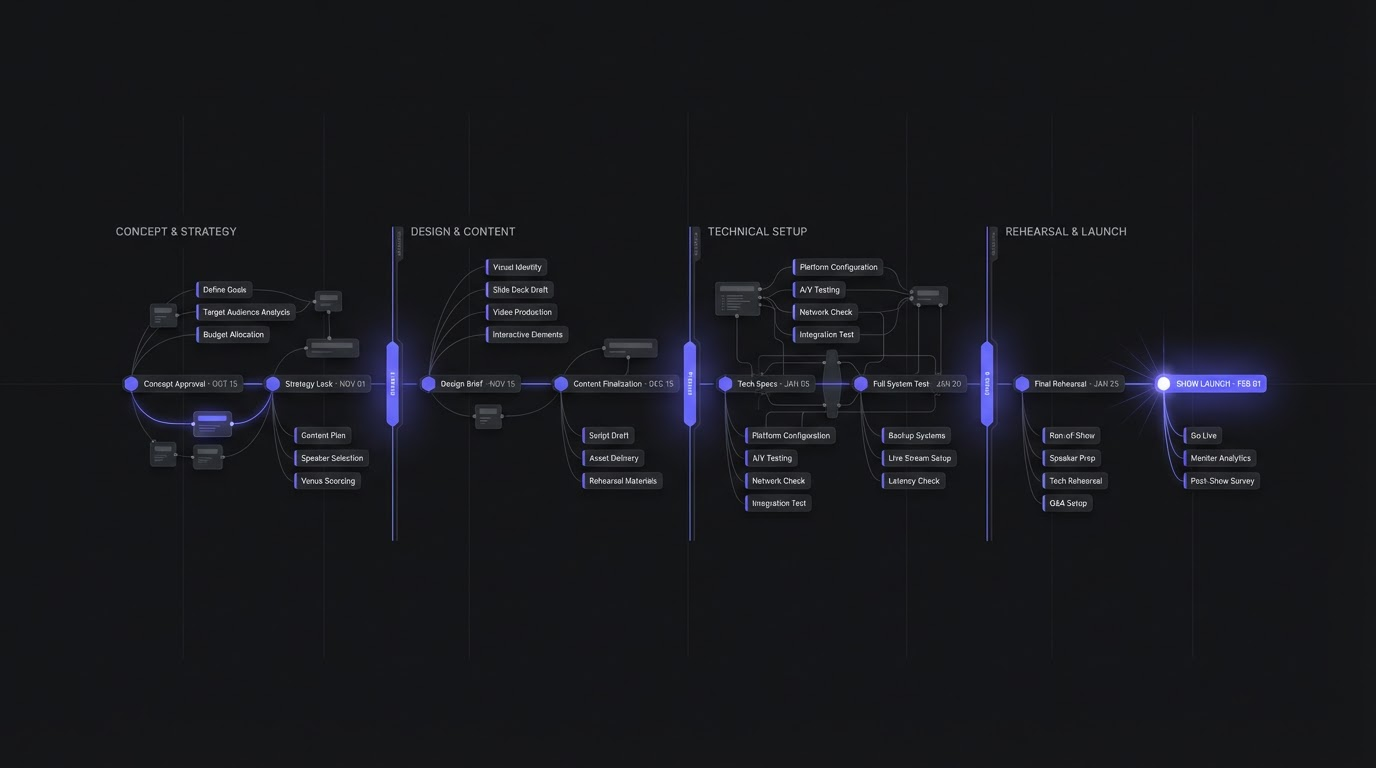
Effective competitor analysis follows a timeline that builds intelligence systematically from initial event selection through final booth preparations. Spacing your competitive research prevents last-minute scrambles and allows for strategic adjustments based on what you learn.
8-10 weeks pre-show: Conduct initial competitor landscape analysis as part of event selection and budgeting. This is when you're deciding which events to attend and at what investment level. Use event intelligence platforms to see which competitors regularly attend which shows, and prioritize events where your target customers and key competitors intersect. This early analysis doesn't need to be deep—just enough to confirm that the event attracts the right competitive presence and audience mix.
6-8 weeks pre-show: Begin detailed competitor research once you've committed to the event. Review the exhibitor list as it becomes available, identifying which competitors have secured booths and their relative positioning through sponsorship levels and booth locations. Start monitoring social media and websites for early announcements or positioning shifts. This is also the time to assign competitive intelligence responsibilities and create your research templates.
4-6 weeks pre-show: Deepen your analysis with messaging and positioning research. By this point, most companies are actively promoting their participation and may have released new features or positioning relevant to the show. Document their key claims, target audiences, and likely talking points. Begin drafting your differentiated messaging and testing it with internal stakeholders. This is also when you should review previous years' booth designs and presence to anticipate their visual approach.
2-4 weeks pre-show: Finalize your competitive playbook and train your booth staff. Update your intelligence with any late-breaking announcements or messaging shifts. Conduct role-playing exercises where team members practice handling competitive scenarios using your differentiated talking points. Finalize booth collateral, ensuring that your key differentiation points are visually prominent and supported by proof points. Schedule daily briefing times during the show to share competitive intelligence gathered from conversations.
1 week pre-show: Final review and preparation. Check for any last-minute competitor announcements or positioning changes. Ensure your competitive brief is distributed to all booth staff and that everyone is comfortable with key differentiation points. Prepare a simple system for capturing competitive intelligence from booth conversations—this might be a shared document, a form for booth staff to complete, or designated times during debriefs to share what was learned.
Pro Tip: Schedule a 30-minute daily competitive intelligence sync during the show, ideally before the floor opens. Have booth staff share what they're hearing from attendees about competitors, new messaging they've encountered, and any booth visits they've made to competitors. These insights help you adjust your approach in real-time and build intelligence for future events.
Turning Competitive Intelligence into Conversational Advantage
All this research and preparation must translate into natural, confident conversations on the show floor. The most effective competitive conversations feel helpful to prospects, not defensive or aggressive about competitors.
Prospect-led competitive discovery starts with asking questions that reveal what prospects already know about your category and which alternatives they're considering. Questions like "What other solutions have you looked at?" or "What's your impression of the options in this space?" reveal competitive context without making you appear focused on competitors. Listen for their current perceptions, misconceptions, and priorities—their answers guide which differentiation points will resonate most.
Reframing competitive comparisons shifts the conversation from features to outcomes. When a prospect asks how you compare to a specific competitor, acknowledge the competitor briefly and pivot to the decision criteria that matter most. For example: "Competitor X focuses on [their positioning]. Our customers typically choose us because [your differentiated outcome]. What matters most to you in this decision?" This approach shows confidence and keeps the conversation focused on the prospect's needs rather than feature-by-feature competition.
Proof point delivery builds credibility when comparisons arise. When prospects express interest in a competitor's claim, support your position with specific evidence rather than assertions. "Competitor X mentions [their claim]. We measure that differently through [your methodology], and our customers at [similar company] saw [specific outcome]." Specific examples and metrics are far more persuasive than general statements about being better.
Visual and contextual differentiation reinforces your verbal positioning. If competitors cluster around a specific approach or positioning, emphasize your difference through booth design, collateral, and demonstrations. If every competitor focuses on enterprise scale and you specialize in mid-market speed and simplicity, make that difference visually obvious through your booth layout, messaging, and the prospects featured in your collateral.
Competitive intelligence capture turns booth conversations into future advantages. Document what prospects tell you about competitors—pricing they've been quoted, features they've been pitched, messages that resonated or fell flat. This real-time intelligence from dozens of conversations is incredibly valuable for refining your positioning and messaging for future events and sales situations.
Pro Tip: When prospects seem enthusiastic about a competitor, acknowledge their excitement rather than immediately arguing against it. "It sounds like they're addressing [specific need]. That's important. The area where we take a different approach is [your differentiation], which matters because [outcome]. Can you tell me more about what's driving your interest in their solution?" This respectful approach builds trust and opens conversation about deeper needs.
5-Step Pre-Show Competitor Analysis Checklist
To effectively analyze your competitors before a trade show, follow this checklist:
- Map Their Event Footprint: Identify which tier-1 and tier-2 events they are sponsoring or exhibiting at globally. Use an event intelligence platform to track their movements across regions.
- Decode Product Announcements: Monitor their press releases, blog posts, and social media activity 30 days prior to the event for new product launches or messaging shifts.
- Analyze Tech Stack Signals: Review their recent hiring patterns—for example, hiring Salesforce admins implies they are scaling their sales operations.
- Identify Key Personnel: Track which executives and SDRs they are sending to the booth. LinkedIn activity spikes near event dates often reveal their roster.
- Set Up Active Monitoring: Use a tool like Lensmor to get real-time alerts on their event-related social interactions and competitor booth activity.
Building Sustainable Competitive Intelligence Processes
The most sophisticated competitor analysis isn't just for individual trade shows—it's part of a continuous competitive intelligence process that strengthens all your go-to-market efforts. By building systems and habits around competitive intelligence, you transform trade show insights into lasting competitive advantage.
Centralized competitive intelligence creates a shared resource across marketing, sales, and customer success. Use a simple shared workspace—whether a spreadsheet, notetaking app, or dedicated competitive intelligence tool—to maintain profiles of key competitors. These profiles should include positioning, messaging, pricing, features, recent announcements, and win/loss insights. Each trade show adds fresh intelligence to these profiles, creating an increasingly valuable resource over time.
Regular competitive reviews keep your team aligned. Monthly or quarterly competitive reviews where teams share what they're hearing from prospects and customers about competitors keep your intelligence current and relevant. These reviews surface new competitive developments, validate or update assumptions, and ensure that new team members have access to institutional competitive knowledge.
Integrate competitive intelligence into sales enablement. The research and messaging developed for trade shows should inform sales scripts, objection handling guides, and marketing materials. What works in face-to-trade show conversations often translates effectively to other sales contexts. After each show, extract the most effective differentiation points and proof points to incorporate into ongoing sales and marketing efforts.
Feedback loops improve intelligence quality over time. After each trade show, compare your pre-show competitive analysis with what actually happened on the floor. Which predictions were accurate? What did you miss? How did prospects respond to your positioning? This post-show review refines your analytical framework and makes future intelligence more accurate and actionable.
Pro Tip: Document not just what competitors are doing, but why it matters to your customers and prospects. The most valuable competitive intelligence connects competitor actions to customer needs and decision criteria. Understanding not just the competitive landscape but the customer's perspective on that landscape creates more effective positioning and messaging.
Conclusion: From Competitive Fear to Competitive Confidence
Most companies approach trade shows with some anxiety about competitors—who will be there, what they'll say, whether they'll outshine your presence. Systematic pre-show competitor analysis transforms that anxiety into confidence by replacing uncertainty with intelligence and reactive conversations with proactive positioning.
The companies that consistently win at trade shows aren't necessarily those with the biggest booths or the largest budgets. They're the ones who understand the competitive landscape, articulate clear differentiation, and train their teams to have confident, differentiated conversations. They know their competitors not to obsess over them but to navigate around them—turning potential threats into opportunities to highlight their unique strengths.
Your next trade show is an opportunity to put this into practice. Start your competitor analysis 6-8 weeks before the event, build a simple but systematic intelligence framework, and translate that intelligence into confident, differentiated conversations. You'll find that the show floor feels less like a competitive battlefield and more like an opportunity to connect with prospects who truly value what you offer.
Ready to transform your trade show strategy? Start Free - Create a free Lensmor account and start using its event intelligence tools. Discover which competitors attend which events, analyze their positioning, and plan your differentiated approach before the show floor opens.