Download this free event marketing plan template to connect your B2B event goals, target accounts, budget, outreach and follow-up in one working plan. The Excel file includes a blank plan and a fully filled example. No email required.
Two worksheets · editable .xlsx · includes budget totals, task owners, due dates and separate actual-result fields.
What is inside the event marketing plan template?
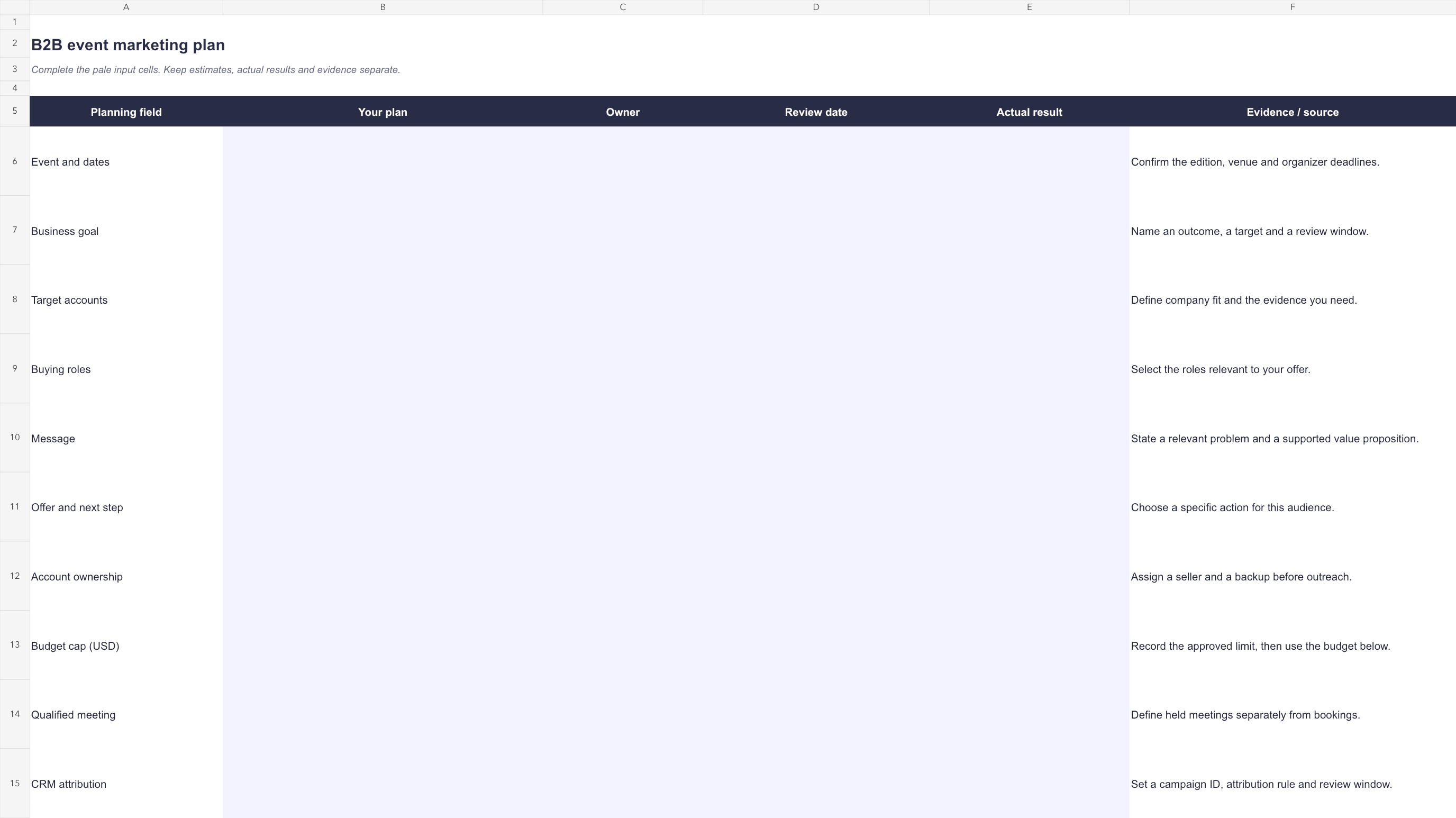
Use the Blank plan worksheet for your own event. The Filled example worksheet shows how each field connects to a budget, a measurement target and an execution task. You can also copy the planning fields below directly from this page.
For each phase below, add a task list with these columns: deliverable, owner, due date, status, and evidence or result. Review it weekly before the event and daily onsite.
What Is an Event Marketing Plan?
An event marketing plan is a structured document that outlines your goals, target audience, messaging, timeline, and tactics for marketing before, during, and after a specific event. For B2B teams, it bridges the gap between "we're attending a trade show" and "we generated $X in pipeline from that trade show."
A strong plan answers five questions: Why this event? Who are we targeting? What's our message? How will we execute? And how will we measure success?
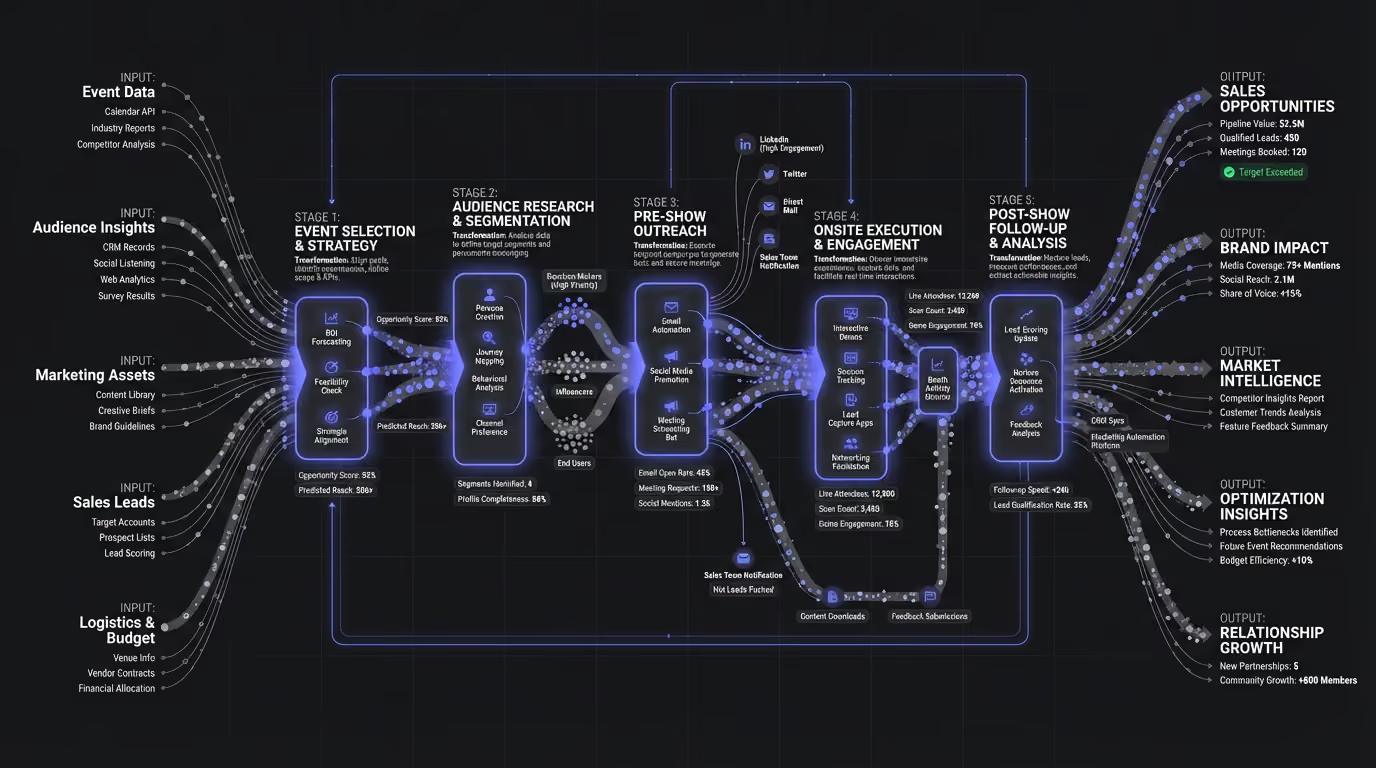
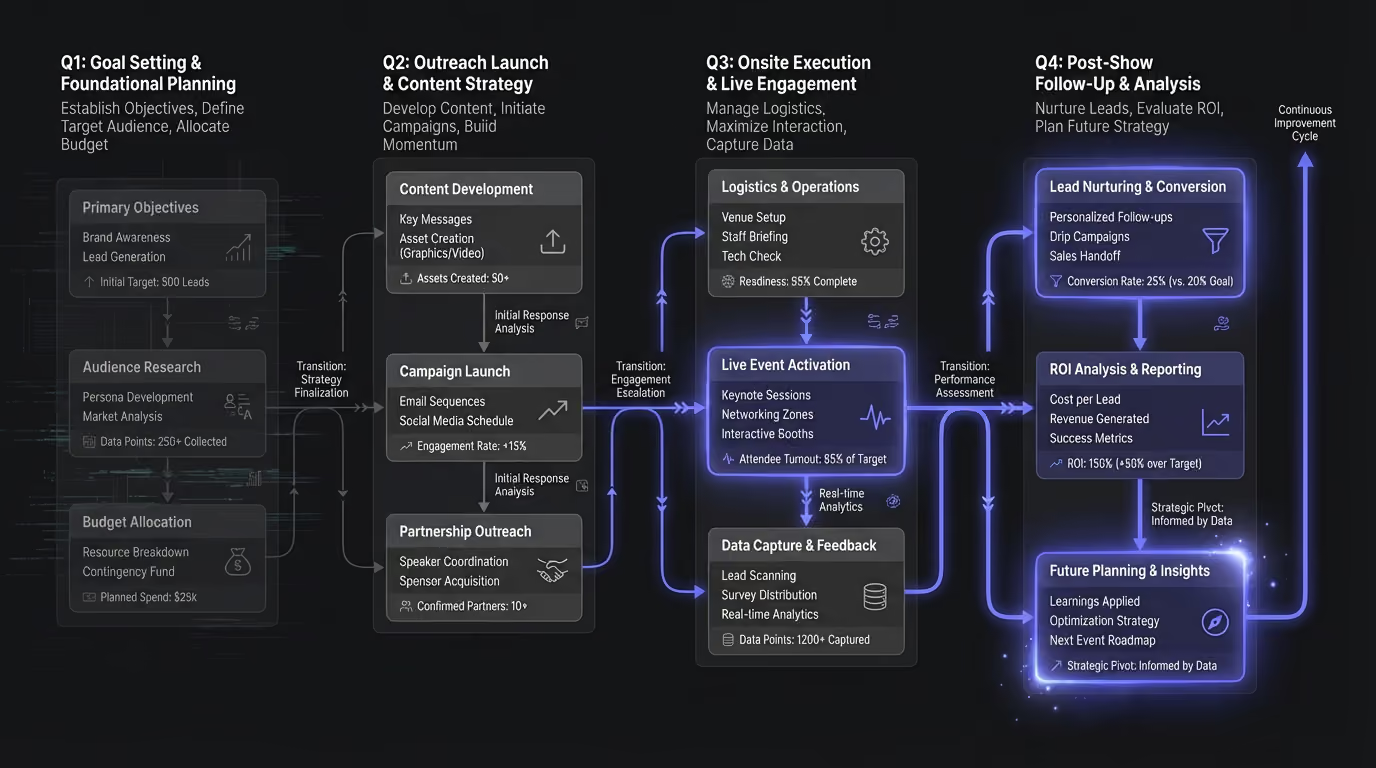
The 5-Phase Event Marketing Plan Template
Phase 1: Event Selection and Goal Setting (8-12 Weeks Out)
The biggest event marketing mistake happens before any marketing starts: choosing the wrong event. Too many teams pick trade shows based on industry reputation or "we've always gone to this one" logic, without verifying whether their actual buyers attend.
Start by defining what success looks like in hard numbers. Not "generate leads" — that's a wish, not a goal. Try: "Book 15 qualified meetings with VP+ titles at companies with 200+ employees in manufacturing." Specific goals drive specific tactics.
Pro Tip: Check event fit before committing budget. Exhibitor and sponsor listings provide evidence of company participation, not proof that a particular buyer will attend or wants to buy. Use Lensmor to research event and company information, then confirm relevant contacts and meetings directly. For a worked event-selection starting point, review our Workday Rising 2026 dates, pricing, and agenda guide.
Once you have selected an event, build a budget from current organizer and supplier quotes. The ranges below are illustrative planning inputs for a hypothetical B2B team, not market averages; allow separately for taxes, contingencies, and costs not covered by these categories.
Give follow-up an explicit owner and budget. Estimate the time and tools needed to qualify, route, and contact leads; then compare actual costs and outcomes after the event instead of assuming a fixed return.
Phase 2: Audience Research and Messaging (6-8 Weeks Out)
With your event selected and goals set, shift to understanding exactly who you'll target. Pull the exhibitor list and attendee information. Build a hit list of your top 20-30 accounts — this is your priority tier.
For each priority account, answer three questions: What problem might the team need to solve? What evidence supports that hypothesis? Who is the relevant person to ask? Use the research to open a specific conversation, such as: "I noticed your team is expanding into Europe. How are you choosing events in the new market?" Do not invent a customer result to support the pitch.
Pro Tip: Don't just research companies — research the specific people attending. Check LinkedIn for attendees posting about the event, look at the speaker list for potential contacts, and review the exhibitor directory for key decision-makers. Pre-show research is the single highest-leverage activity in event marketing.
Your messaging should adapt to the event context. Generic product pitches don't work at trade shows — attendees hear dozens per day. Instead, craft a "booth story" that connects your solution to a specific pain point relevant to that event's industry. You need three versions: a 30-second elevator pitch for the floor, a 2-minute version for scheduled meetings, and a slide-free demo flow for deeper booth conversations.
A useful booth story names a relevant problem, explains your approach, and offers a specific next step. If you have a documented customer result, include its context and limitations. Otherwise, demonstrate the workflow rather than presenting a hypothetical improvement as measured performance.
Phase 3: Pre-Show Outreach (3-5 Weeks Out)
This is where most event marketing plans fall apart — or never existed in the first place. Pre-show outreach is the difference between hoping the right people walk by your booth and knowing your calendar is already full before you arrive.
Build a 3-touch email sequence targeting your priority accounts:
The key is leading with value, not a sales pitch. Share a relevant report, invite them to a private event you're hosting, or offer a personalized analysis related to their business. The meeting request comes naturally after you've demonstrated relevance.
Pro Tip: Don't write outreach emails from scratch. Fork our open-source trade show email templates — adapt the examples for pre-show introductions, meeting requests, VIP invitations, and follow-up sequences. Customize the structure and variables for your event and prospects.
Parallel to email, run a lightweight LinkedIn campaign. Connect with attendees and speakers 3-4 weeks before the event with a personalized note referencing the show. Post about your participation — what you're showcasing, who you want to meet, and what conversations you're excited about. This creates ambient awareness so when prospects see your booth, you're not a cold introduction.
One underused tactic: engage with the event's official hashtag and share original content (a data point, a bold opinion, a question) that positions your team as knowledgeable in the space. Attendees who see your posts before the event are far more likely to stop at your booth — they already feel like they know you.
Phase 4: Onsite Execution (During the Event)
Your plan should make onsite execution almost automatic. Every team member knows their role, their priority accounts, and the qualification criteria before the event opens.
Set up a daily rhythm:
The same-day follow-up is critical. Send a brief "great meeting you today" email within hours of a conversation — not two weeks later when nobody remembers who you are. Your onsite follow-up templates should be pre-loaded in your CRM and ready to send with minimal customization.
Pro Tip: Capture structured notes, not just badge scans. For every meaningful conversation, reps should record the specific pain point discussed, timeline for a decision, budget range if mentioned, and agreed next step. A badge scan alone does not establish qualification. Notes such as "evaluating solutions in Q3, budget approved, wants a technical demo" help sales assess fit; create an opportunity only when your agreed criteria are met. Our guide on lead qualification at trade shows breaks down exactly what to capture and how to score it.
Phase 5: Post-Show Follow-Up (1-14 Days After)
Follow-up needs the same planning discipline as the event itself. Without a named owner, qualification notes, and a due date, a useful conversation can lose momentum. Set a suggested response cadence by lead tier, honor agreed next steps, and respect contact preferences.
Use this suggested follow-up cadence as a starting point, adjusting it to the conversation and contact preferences:
The post-show email templates in our open-source collection cover each tier — from the thank-you email to the breakup email. The key principle: every follow-up should reference something specific from your conversation, not a generic "great meeting you at [Event Name]."
Pro Tip: Set up your follow-up sequences before the event, not after. Pre-build email templates for each lead tier, create CRM tags for segmentation, and brief your sales team on the handoff process. The 48 hours after a show are chaotic — if your system isn't ready to fire, leads will slip through the cracks. Our post-show playbook breaks down the complete follow-up workflow.
Turn the five phases into owned tasks
Use the execution checklist in the workbook instead of maintaining a second plan. Assign a person, a due date and an evidence field to each task: approve the event and budget; review target accounts; research roles; prepare outreach; confirm meetings; record conversations; and review actual costs and opportunities.
Review it weekly before the show and daily onsite. Adjust the dates to your organizer deadlines and sales cycle; the dates in the filled example are illustrative.
A filled B2B event marketing plan example
This is a fictional plan for Example B2B Expo, March 15–17, 2027, using a $15,000 budget cap and an eight-meeting target. It expands the small-team scenario into the same fields as the downloadable worksheet. It is not a customer case study or a forecast.
| Planning field | Filled example | Owner | Review date |
|---|---|---|---|
| Event and dates | Example B2B Expo, March 15–17, 2027 | Event lead | 2027-01-18 |
| Business goal | Hold 8 qualified meetings; review opportunities 60 days after the show. | Sales lead | 2027-01-18 |
| Target accounts | 20 manufacturing companies; 51–500 employees; sells into Germany. See a real event research starting point. | Sales lead | 2027-02-01 |
| Buying roles | Operations or engineering decision-makers for an equipment evaluation. | Account owner | 2027-02-05 |
| Message | Discuss one equipment workflow and the current evaluation constraints. | Marketing lead | 2027-02-08 |
| Offer and next step | A 15-minute conversation with a defined agenda. | Account owner | 2027-02-08 |
| Account ownership | One named seller per account; sales lead is the backup. | Sales lead | 2027-02-05 |
| Budget cap (USD) | $15,000 | Event lead | 2027-01-18 |
| Qualified meeting | A held conversation with a relevant role, confirmed need and agreed next step. | Sales lead | 2027-02-08 |
| CRM attribution | EXAMPLE-2027-03; sourced and influenced opportunities separate; 60-day review. | Revenue operations | 2027-01-25 |
How the budget and results fit together
The six example cost lines total $14,000, leaving $1,000 against the assumed cap. Change an input in the workbook to recalculate the total. Actual costs stay blank until you have invoices; meeting and opportunity results stay blank until supported by records.
The target is eight held, qualified meetings. Track calendar bookings separately. Record sourced and influenced opportunities in separate fields, then review them 60 days after the show.
After building your account list, use the pre-show meeting planning guide to prepare contact research and invitations. The spreadsheet is the plan; your existing CRM and sending tools handle execution.

How to Measure Your Event Marketing Plan
Agree on definitions before the event and use the same cost scope and attribution window when comparing results. Booked meetings, held qualified meetings, leads, and opportunities are different measures.
- Cost per lead (CPL) = total event cost ÷ leads captured under your agreed definition.
- Cost per qualified meeting = total event cost ÷ held meetings that meet your qualification criteria.
- Cost per opportunity = total event cost ÷ attributed opportunities created.
- Event ROI = (attributable gross profit − total event cost) ÷ total event cost × 100.
Illustrative example: a $20,000 event with 100 leads, 20 held qualified meetings, and 5 attributed opportunities has a CPL of $200, cost per qualified meeting of $1,000, and cost per opportunity of $4,000. If closed business produces $30,000 in attributable gross profit within the agreed window, event ROI is 50%. These are arithmetic examples, not performance benchmarks. When a denominator is zero, report the metric as undefined rather than as zero cost.
Report sourced and influenced pipeline separately; open pipeline is not realized revenue or gross profit. Review early follow-up outcomes after two weeks and continue tracking closed business over a window that matches your sales cycle.
Reuse the plan for your next event, keeping the lessons and replacing the assumptions. Lensmor can support event and company research before outreach. Treat public participation signals as research inputs, and verify individual attendance and interest directly.
Start Free - Create a free Lensmor account and start using its event intelligence tools.