.avif)
At 7:18 a.m., the show floor was still quiet.
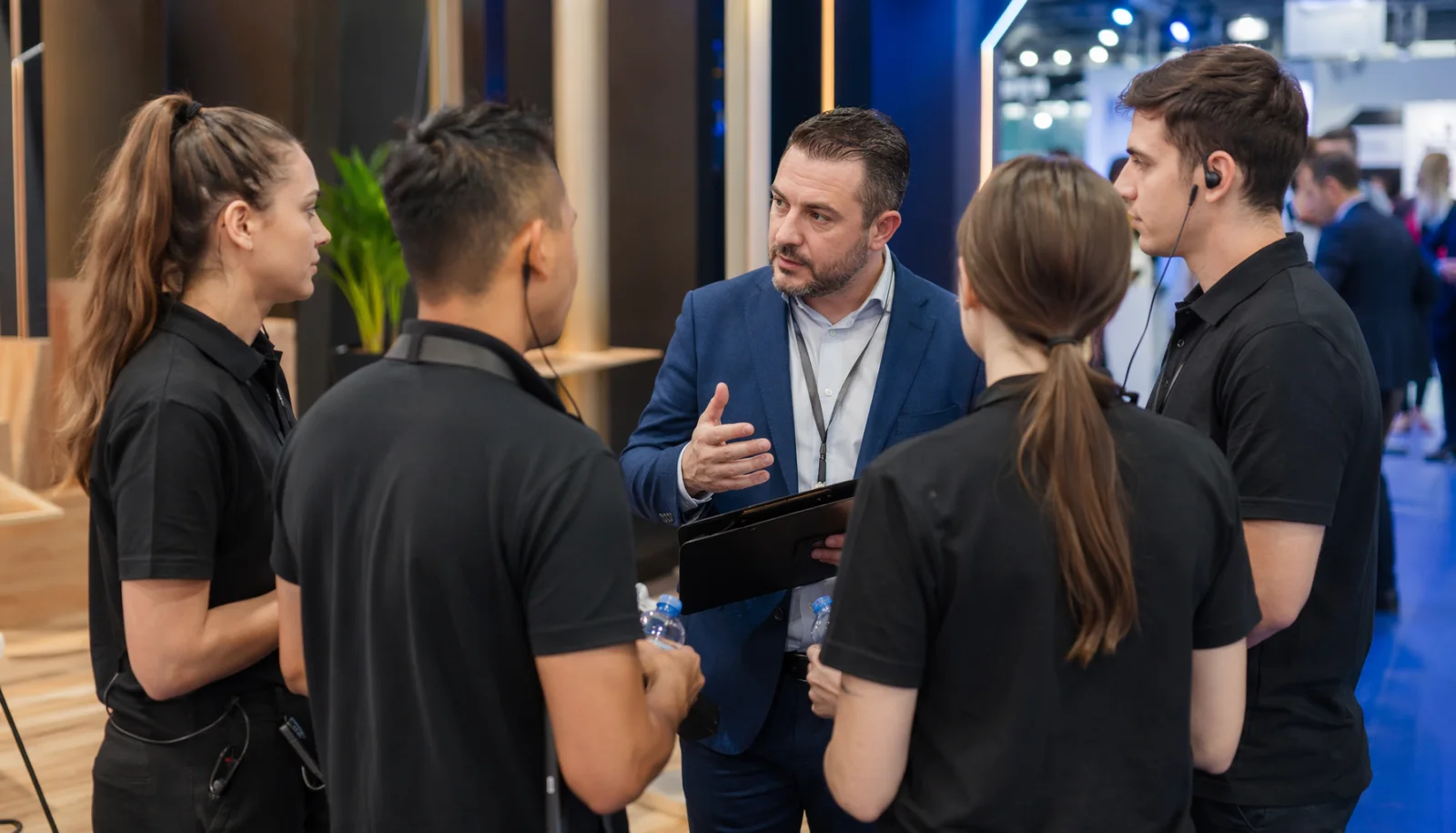
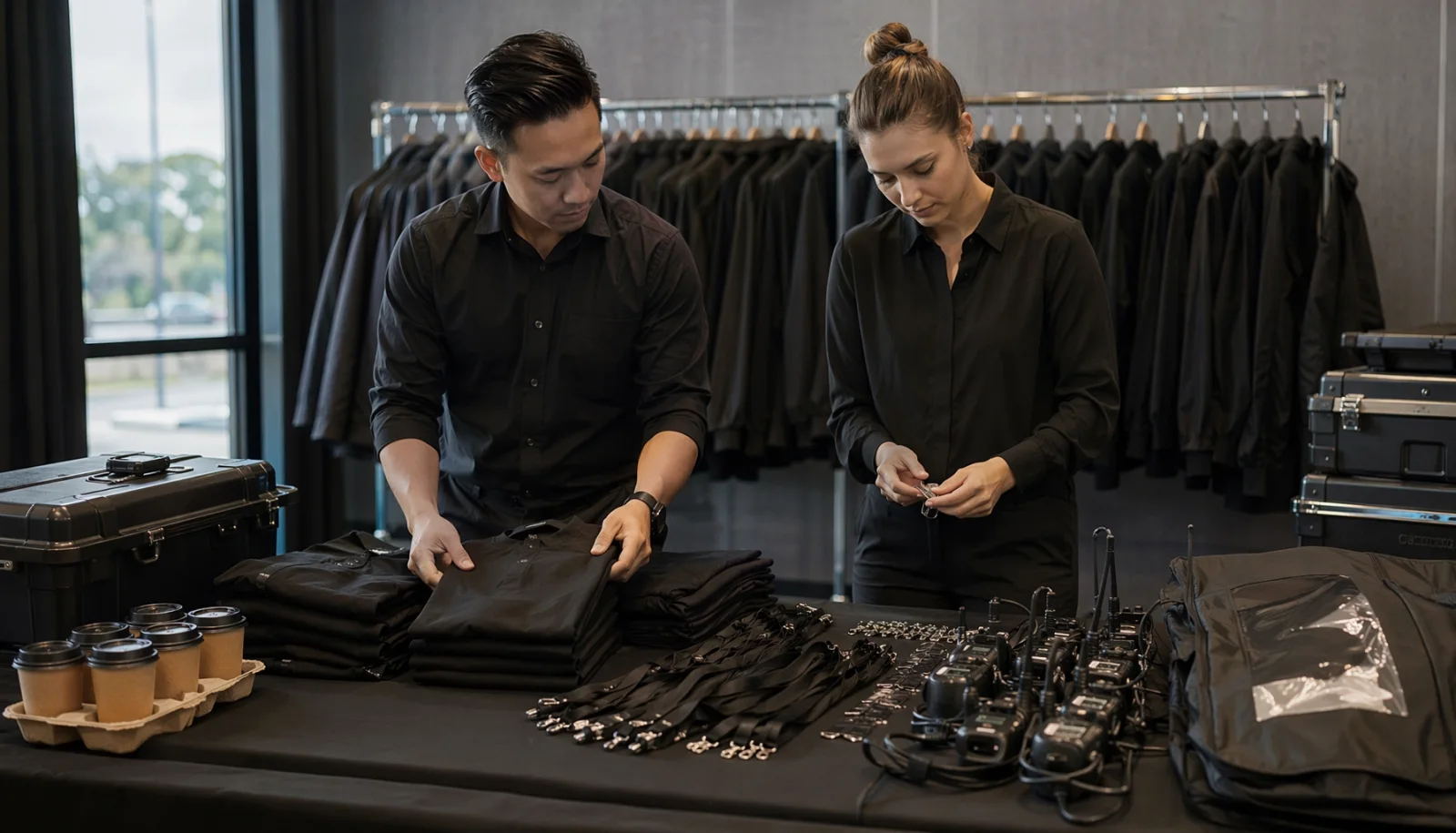
The aisle carpet had just been rolled out. Freight doors were open at the far end of the hall. A forklift beeped somewhere behind a black curtain. Two brand ambassadors stood near a half-built booth, wearing plain black jackets and blank badges, waiting for a client who had asked for "just a few more people" three days before the event opened.
For the event staffing agency, this was normal. Too normal.
The team was good at staffing. They could find reliable brand ambassadors, train booth hosts quickly, and rescue a client when a local show became more crowded than expected. But the business kept arriving late. By the time an exhibitor called, the booth was already designed, the hotel rooms were already expensive, and the agency was trying to fill shifts instead of choosing the right clients.
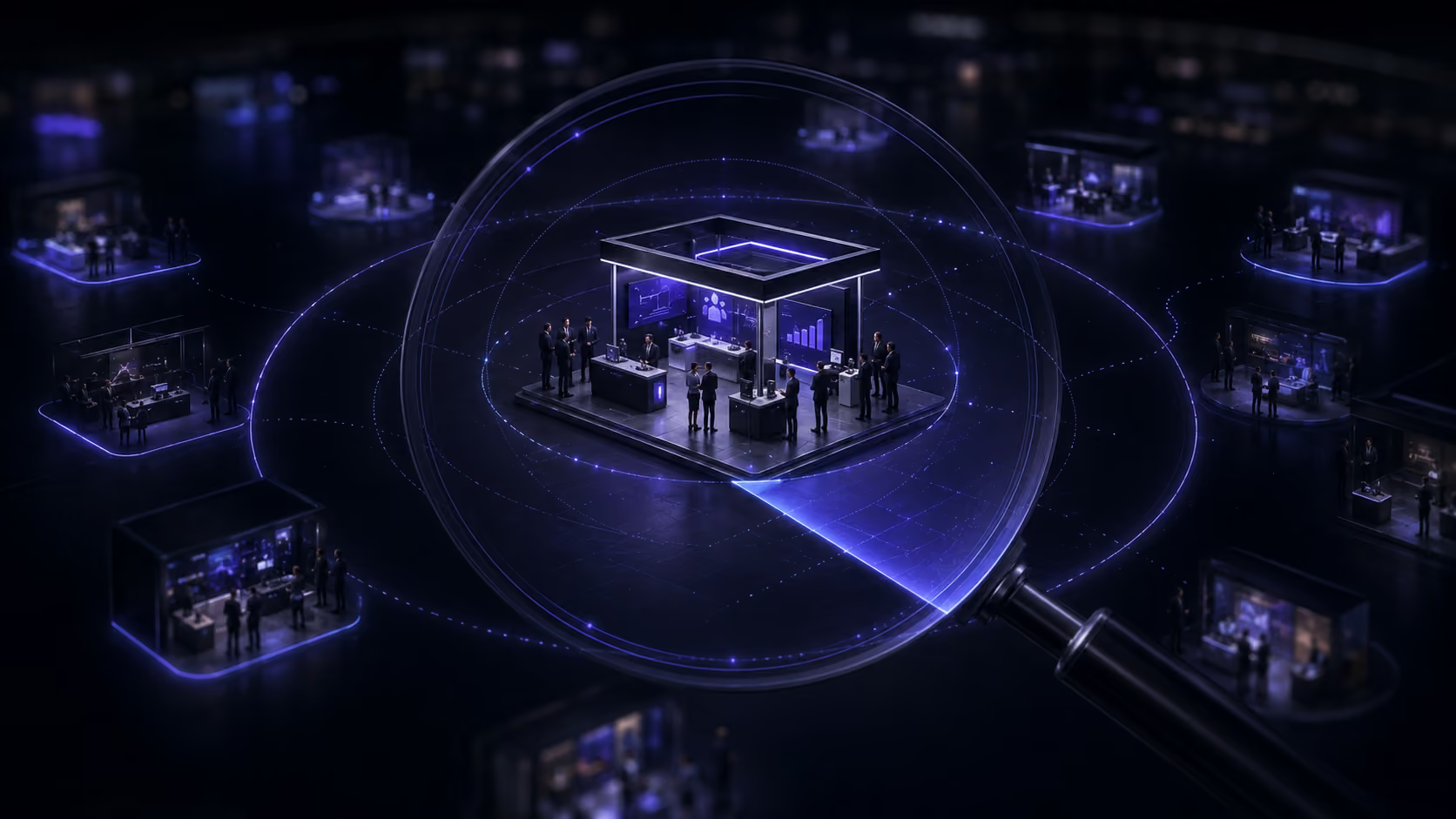
This anonymized case study follows a small event staffing agency that used Lensmor to change that timing. Instead of waiting for last-minute requests, the team started finding upcoming trade shows, identifying exhibitors that would likely need booth staff, and reaching the right people before the event became an emergency.
The result was not a louder sales pitch. It was a calmer calendar, earlier conversations, and a repeatable way to book trade show staffing work before the show floor opened.
The real problem was not demand
The founder had spent years building a local roster.
There were experienced booth hosts, bilingual brand ambassadors, product demo helpers, registration desk staff, and field supervisors who could keep a chaotic check-in line moving. The agency knew which people showed up on time, which people could handle a technical demo, and which people were better for a high-traffic consumer booth.
The problem was not service quality.
The problem was that buyers usually appeared too late.
A field marketer would send an email ten days before the show. A regional sales lead would ask whether the agency had six people available for a three-day booth. A sponsor would realize that the internal team could not cover meetings, demos, lead capture, and hospitality at the same time.
By then, every job carried friction.
The agency had to check staff availability, negotiate rush pricing, confirm wardrobe, collect W-9s, arrange supervisors, and hope the best people were still free. Even when the deal closed, the margin felt thinner because the operation became reactive.
For an event staffing agency, late demand is expensive demand.
Why exhibitors are such strong prospects
An exhibitor is not just another company in a database.
An exhibitor has a deadline. A booth. A city. A product story. A team that is about to stand in front of buyers, investors, partners, analysts, or customers.
That makes exhibitors unusually good prospects for event staffing agencies and brand ambassador agencies.
They may need:
- Booth hosts who can welcome visitors and qualify traffic.
- Brand ambassadors who can explain a simple product story.
- Demo support staff who can keep the booth moving while sales reps take meetings.
- Registration, hospitality, or VIP lounge staff.
- Local supervisors who understand the venue and can manage shift changes.
The challenge is that most staffing providers discover those exhibitors after the planning window has already started closing.
Before Lensmor, this agency found opportunities the old way. The founder scanned event calendars, searched Google, watched LinkedIn posts, asked friendly exhibit builders for referrals, and sometimes walked shows in person to collect cards. Those tactics worked occasionally, but they were slow and uneven.
They also missed the most important question:
Who is exhibiting soon, and who inside that company is likely responsible for making the event work?
The old workflow felt busy but not strategic
On a Monday morning, the founder would open a spreadsheet with three tabs.
One tab had events. One tab had companies. One tab had people. None of them lined up cleanly.
An event page might list sponsors but not booth-level exhibitors. An exhibitor list might have company names but no useful contacts. LinkedIn could show marketing titles, but it could not say who was actually going to the show. Clay workflows and crawlers could pull fragments together, but the agency still had to spend hours checking whether an account was real, relevant, and timely.
That work looked productive from the outside. Internally, it felt like standing in a service hallway while the show was already starting.
The founder did not need more generic leads. He needed the trade show calendar to become a sales calendar.
That is the shift Lensmor created.
What changed after the agency tried Lensmor
The founder first heard about Lensmor through another operator in the event industry.
The pitch sounded almost too specific: find relevant upcoming trade shows, see the exhibitors that mattered, and identify likely people to contact before the show. It was not a generic prospecting database. It was built around event timing.
That mattered immediately.
Instead of starting with "companies that might someday need event staff," the agency started with a sharper question:
Which exhibitors are going to need people on the floor in the next few weeks?
Lensmor helped the team move through the market in a different order.
First, they filtered upcoming trade shows by city, date, and industry. Then they looked for exhibitor profiles that matched staffing demand: out-of-town companies, product demo booths, AI and SaaS teams with small field teams, hardware companies showing physical products, sponsors with hospitality needs, and exhibitors likely to care about visitor experience.
Then they moved from account to person.
The agency did not want to email a generic inbox. It wanted event marketers, field marketing managers, demand generation leads, regional sales leaders, founders, or operations people who would feel the staffing problem before anyone else.
That is where the outreach became more natural.
The message was no longer, "We provide event staffing services."
It became:
"I saw your team is exhibiting in Chicago next month. If you need trained local booth staff, demo support, or brand ambassadors for the show, we can cover the floor without pulling your sales team away from meetings."
That message landed differently because it was tied to a real event and a real deadline.
Watch the workflow
The staffing walkthrough connects upcoming local shows with overseas exhibitors that may need a local crew. It gives the agency a starting audience; language requirements, shift coverage and availability still need to be confirmed in the conversation.
Watch on YouTube · 0:51
The first win was earlier timing
The founder noticed the difference before the first deal closed.
The conversations started earlier.
Instead of hearing, "Can you help us next week?" the agency heard, "We are still finalizing booth coverage" or "Our event manager is checking headcount" or "We may need two people for reception and two for demos."
Those replies were not glamorous, but they were valuable. They meant the agency was inside the planning window instead of outside it.
Earlier timing changed the whole operation.
The staffing coordinator could check the best people before their calendars filled. The founder could quote with more confidence. The client had time to approve the statement of work. The supervisors could prepare a cleaner briefing. The agency could choose jobs that matched its roster instead of accepting every rush request.
In a business where reliability is the product, that operational calm matters.
For a typical trade show staffing job, even a modest engagement can be meaningful. Four booth hosts for three days can become dozens of paid staff hours. Add a supervisor, training, wardrobe requirements, and weekend coverage, and the job becomes a real revenue line for a small agency.
But the margin depends on timing. A job booked four weeks ahead is planned. A job booked four days ahead is rescued.
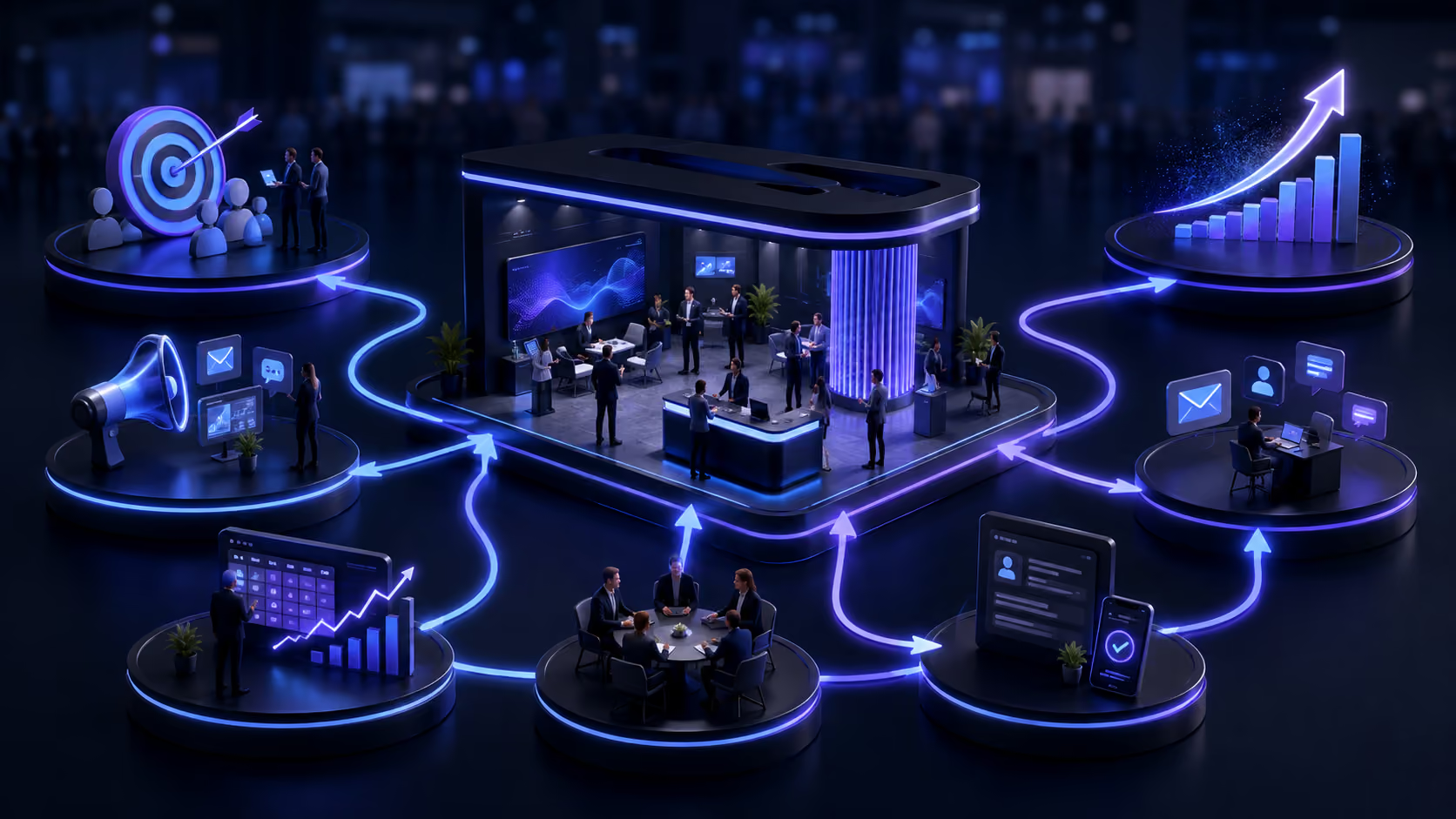
The workflow became repeatable
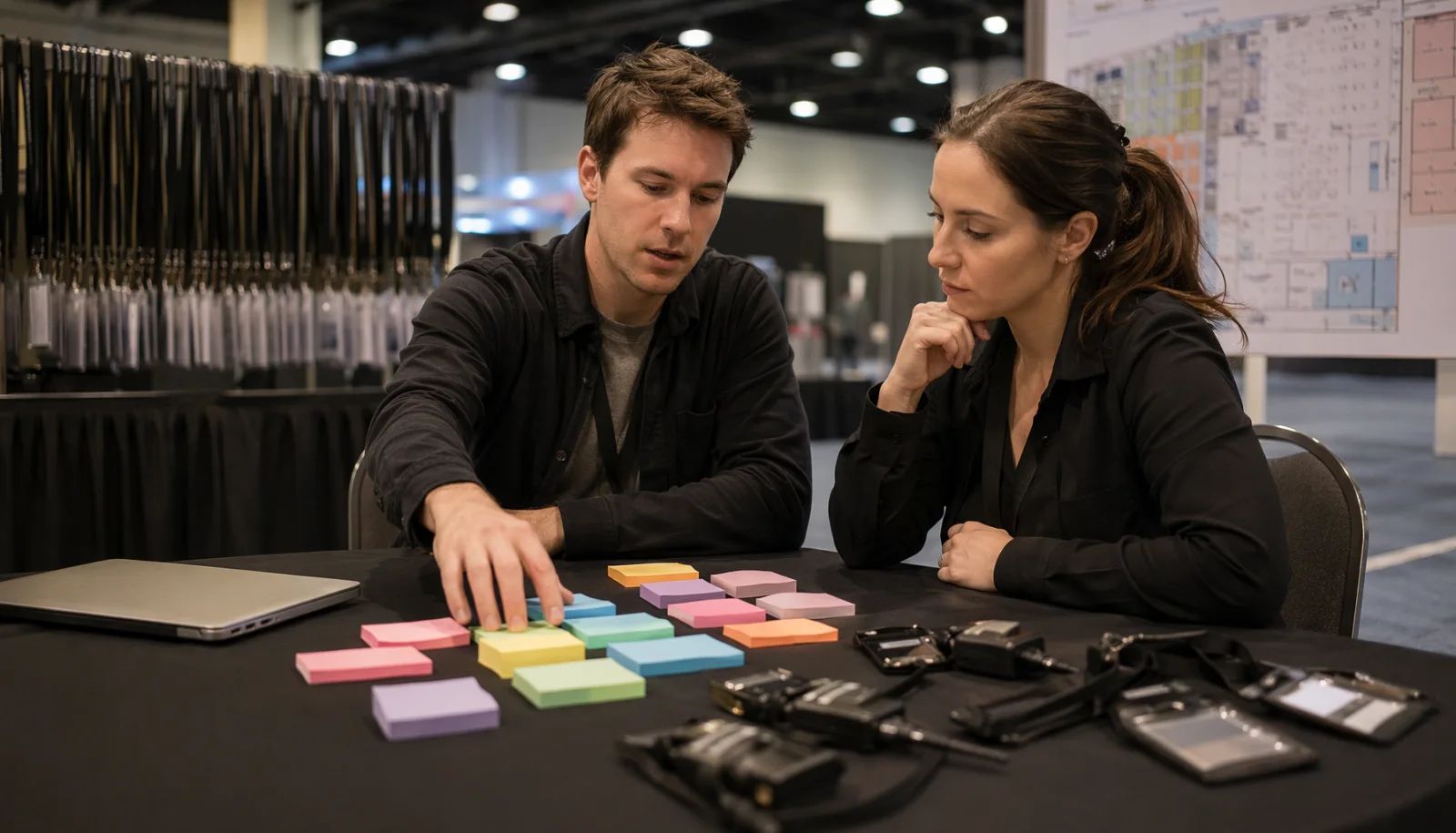
After the first campaign, the agency stopped treating each trade show as a one-off hunt.
The founder built a weekly rhythm:
- Pick target cities and venues where the agency could staff reliably.
- Use Lensmor to find upcoming trade shows in those markets.
- Review exhibitors and score them by likely staffing need.
- Identify likely decision-makers and likely attendees.
- Send event-specific outreach three to five weeks before the show.
- Track replies, quote early, and reserve staff only when the opportunity looked real.
That rhythm turned prospecting into an operating cadence.
The agency no longer waited for referrals from exhibit builders or last-minute inbound forms. Those channels still mattered, but they were no longer the only source of opportunity.
Lensmor gave the team a way to look forward.
The comparison table the founder kept coming back to
The founder described the change in simple terms: the agency went from chasing "companies that need staff" to targeting "exhibitors that have a staffing deadline."
That distinction is the whole story.
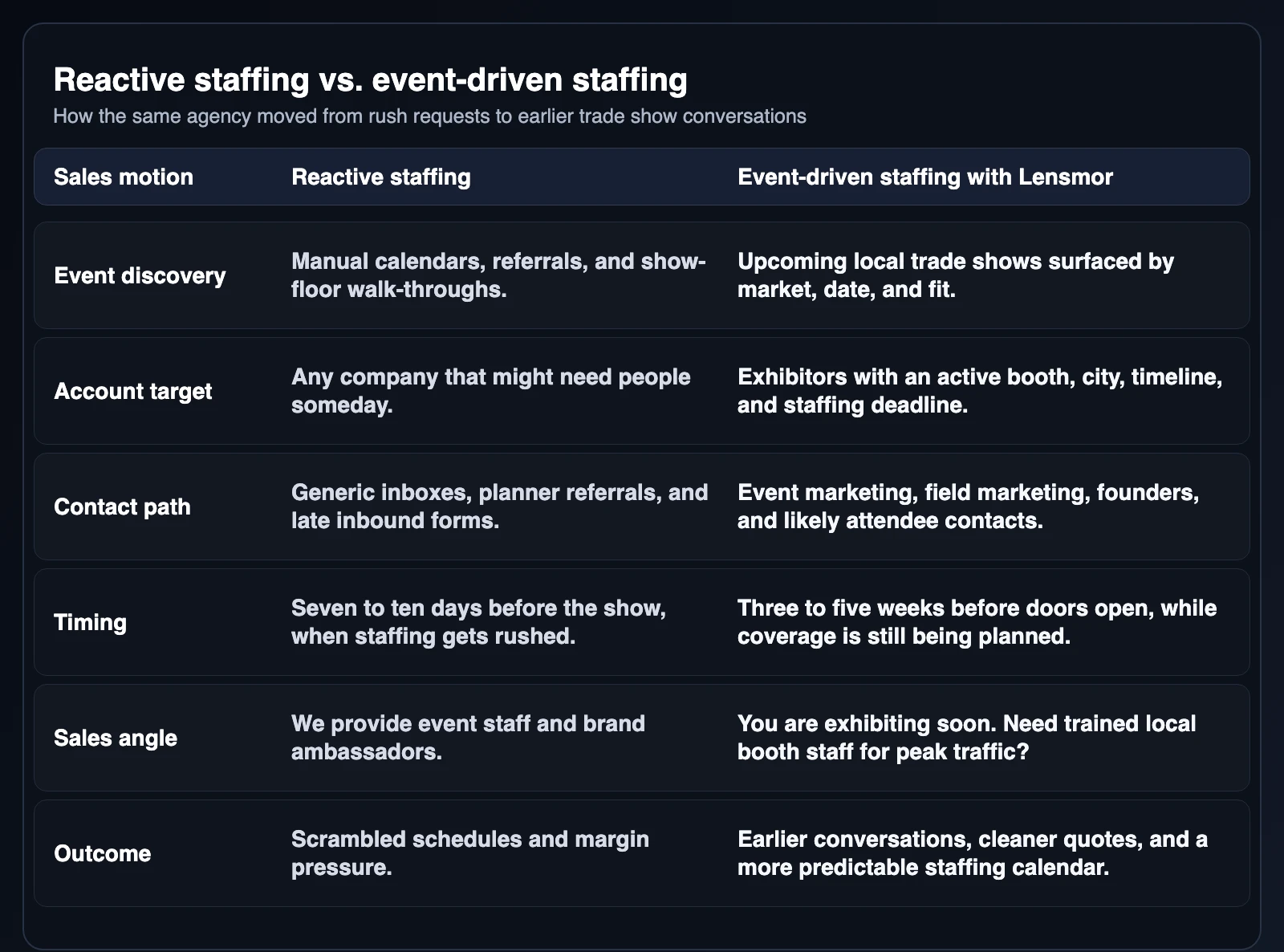
The table looks simple because the improvement was simple.
The agency did not hire a bigger sales team. It did not buy a broader contact database and hope volume would solve the problem. It changed the trigger.
Trade show exhibitors already had intent. Lensmor helped the agency see that intent before the local market became crowded with every other staffing provider.
Why this matters for brand ambassador agencies
Brand ambassador agencies often sell into messy timing.
Marketing teams know they need people, but they do not always know how many until booth plans, meeting schedules, sponsorship packages, and internal travel plans are clearer. That uncertainty pushes staffing decisions later than the agency wants.
The wrong response is to wait.
The better response is to enter the conversation before the buyer has fully defined the staffing problem.
That is where event context helps. A trade show creates a credible reason to reach out even when the prospect has not filled out a form. The agency can ask about the booth, the product demo, the expected traffic, the number of internal reps attending, and whether the team needs local support.
That conversation feels useful because it is attached to something real.
It also helps the agency qualify faster. If a company is exhibiting locally with a small internal team, staffing pain is more likely. If a company is traveling from another state or another country, local staff may be even more useful. If the booth is demo-heavy, the need for crowd flow and visitor handling goes up.
Those signals are hard to see in a normal contact database. They are much easier to see when the starting point is the event.
What other event staffing agencies can copy
The event staffing client prospecting workflow puts service region, event timing, relevant buying roles, and capacity checks into one research brief before outreach.
The playbook does not require a massive team.
Start with the cities where you can deliver strong service. Do not chase every show in the country if your roster is concentrated in Chicago, Las Vegas, Orlando, New York, Austin, or San Francisco. Local reliability is part of the offer.
Then use upcoming events as the account filter.
Look for exhibitors that are likely to need human support: companies launching products, first-time exhibitors, overseas exhibitors, AI and software companies with small field teams, hardware companies running demos, sponsors hosting lounges, and companies attending multiple shows in the same quarter.
Next, build the people list.
For event staffing, the best contact is often not the CEO. It may be field marketing, event marketing, demand generation, sales operations, regional sales, partner marketing, or a founder in a smaller company. The buyer is the person who will feel exposed if the booth is understaffed.
Then write the message around the show.
Bad outreach says: "We are a brand ambassador agency."
Better outreach says: "You are exhibiting at this show soon. If your sales team is covering meetings and demos, we can provide trained local booth staff so the floor does not get thin during peak traffic."
That is specific. It is useful. It respects the buyer's reality.
The broader lesson
Most event staffing agencies already know how to deliver once a client says yes.
The harder part is getting into the conversation early enough to shape the work.
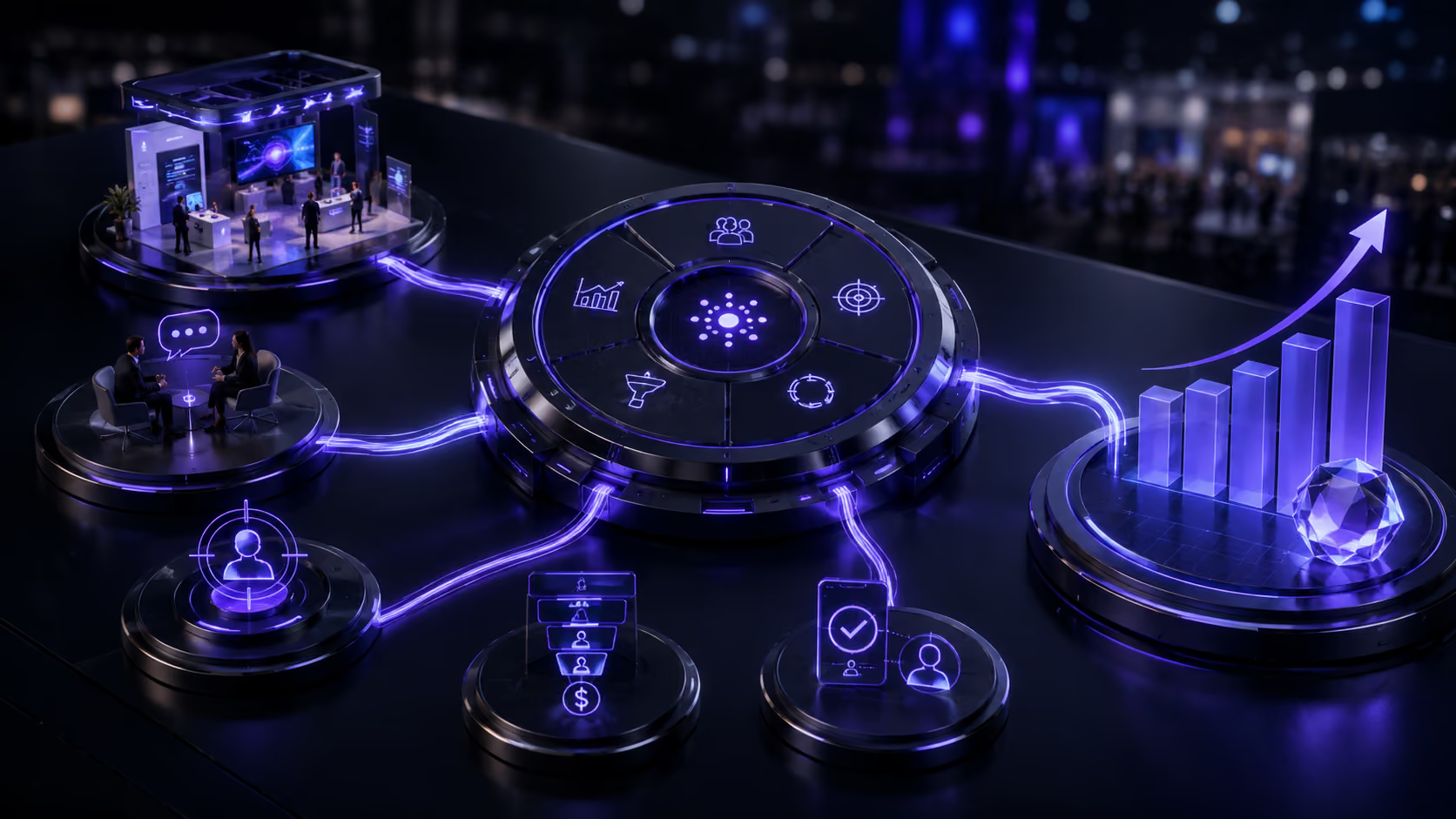
Lensmor helped this agency do that by turning upcoming trade shows into a forward-looking prospecting system. The team could see which events were coming, which exhibitors mattered, and which people were worth contacting before the show became urgent.
That is the lesson for every event staffing agency, trade show staffing provider, and brand ambassador agency selling into the exhibition market.
Do not wait for the booth to be built.
Find the exhibitor when the staffing plan is still being formed.
Start Free - Start using Lensmor's event intelligence platform today. Predict attendee lists, discover relevant events, and enrich contact data for your next trade show.
Related reading: how to find buyers before a trade show and how to book pre-show meetings.