
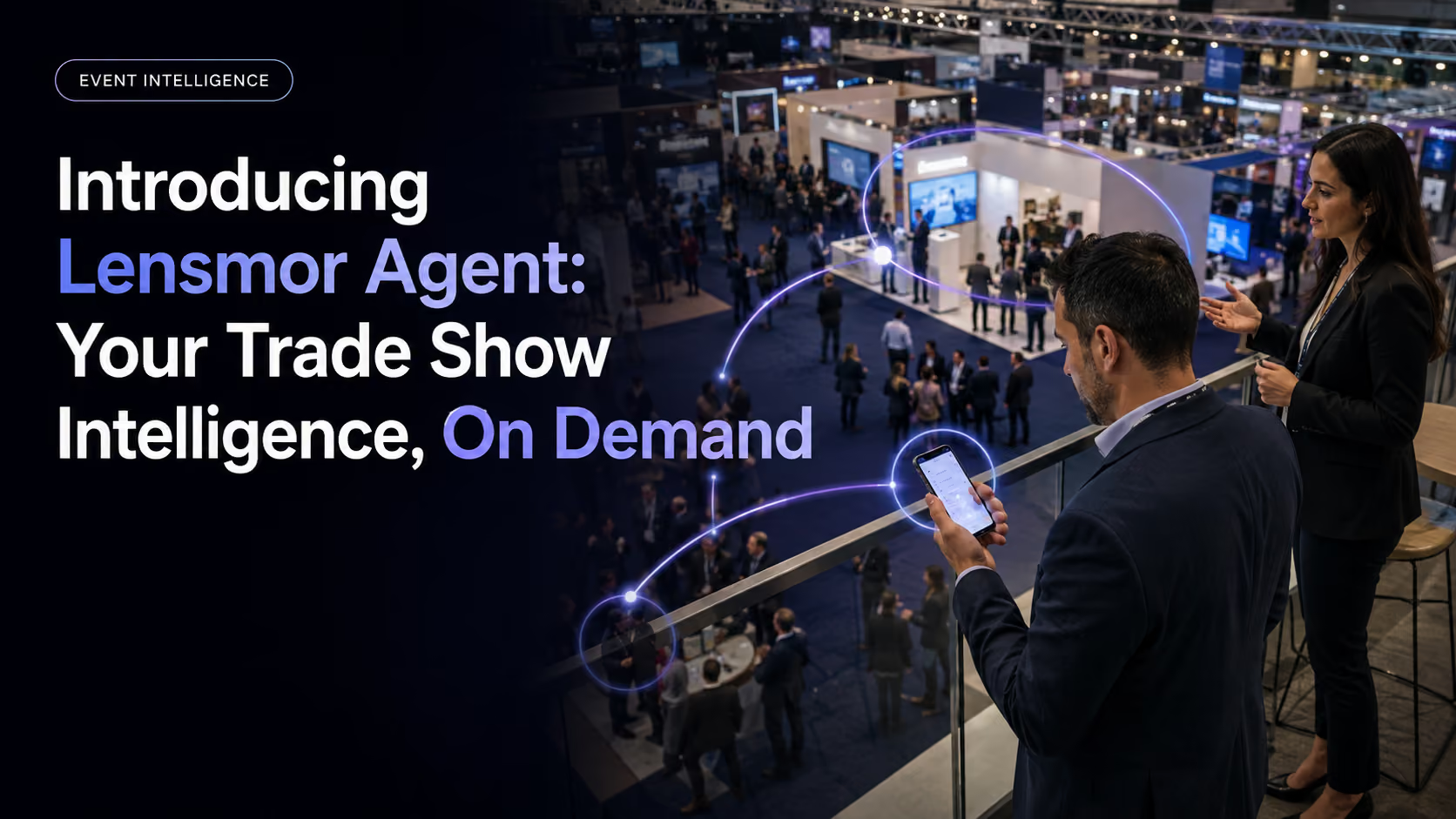
Three weeks before a major industry show, your typical pre-show research looks something like this: pull the exhibitor list from the organizer's PDF, paste it into a spreadsheet, cross-reference against your CRM, manually Google each company to figure out if they fit your ICP, hunt LinkedIn for the right contact, find an email finder tool, and repeat — 200 times.
By the time you've got a usable prospect list, you've burned two weeks of research time, and you still don't know which of those 200 companies actually have budget, buying intent, or a project timeline that aligns with your show schedule.
That's the problem Lensmor was built to solve. And today, with the launch of Lensmor Agent, it gets a lot faster.
What Is Lensmor Agent?
Lensmor Agent is a conversational AI interface built directly into the Lensmor platform. Instead of clicking through filters and export menus, you describe what you need in plain language — and the Agent handles the rest.
It's built on OpenClaw, an open-source AI agent framework that handles multi-step reasoning, tool orchestration, and persistent memory. On top of that foundation, we built five custom Skills that connect directly to Lensmor's database of 160,000+ global events, millions of exhibitor records, and enriched contact data.
The result: a single conversational interface that can take you from "I need leads for InfoComm" to a prioritized list of decision-makers with verified contact details — in minutes, not weeks.
What You Can Actually Do With It
The Agent ships with five core Skills, each targeting a different step in the pre-show intelligence workflow.
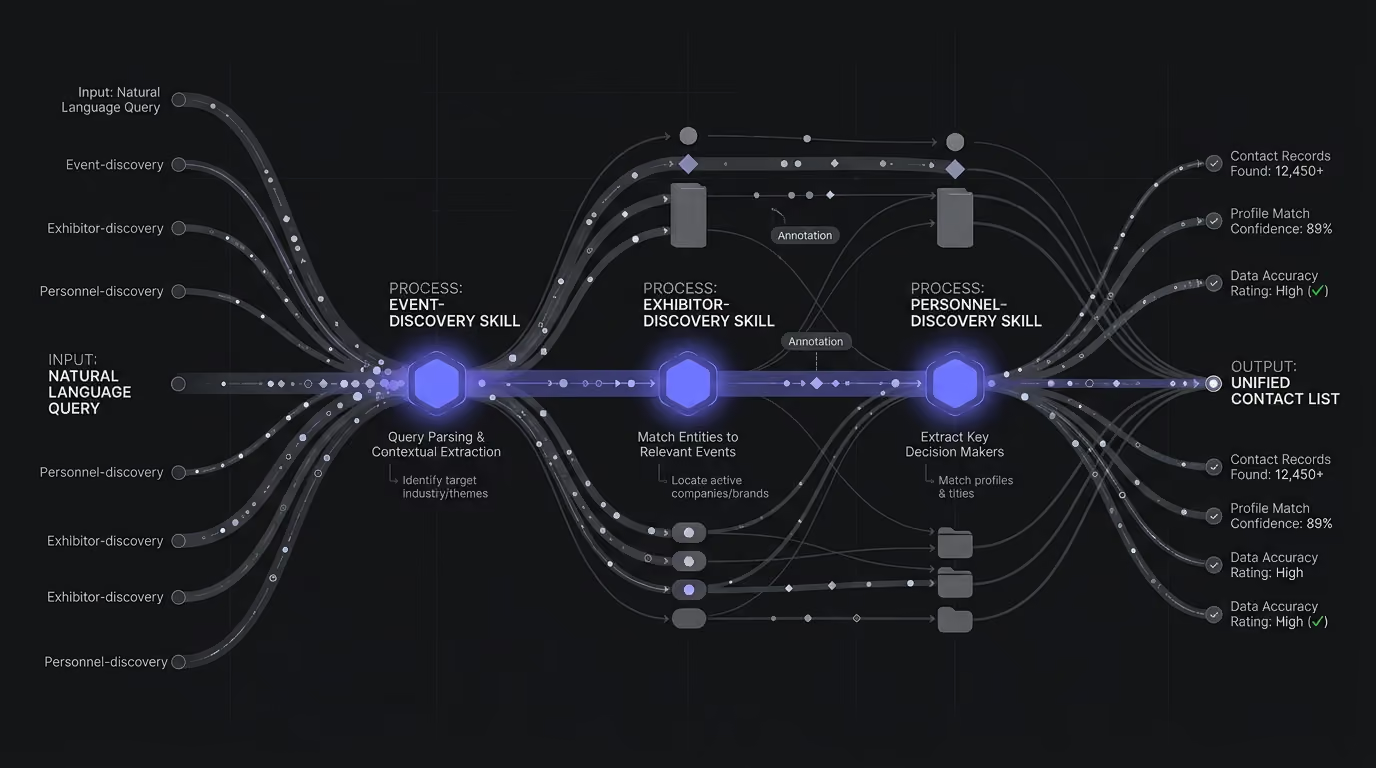
Event Discovery lets you find shows that match your criteria — industry vertical, geography, timing, audience type — without browsing directories. Ask "what are the biggest hardware tech shows in North America this fall?" and the Agent surfaces a ranked list from Lensmor's event database.
Exhibitor Discovery pulls the full exhibitor list for any show and lets you filter it against your ICP. You're not just getting a raw list of company names — you're getting a filtered view of the companies that actually match who you sell to.
Reverse Exhibitor Lookup flips the query. Instead of starting with an event, you start with a company: "which trade shows has Cisco exhibited at in the last two years?" This is particularly useful for account-based strategies where you already know your targets and want to find where you'll be in the same room as them.
Personnel Discovery finds the right contact at each company — filtered by role, seniority, department, or whatever criteria matter for your sales motion. The Agent returns verified contact details alongside LinkedIn profiles, so you're not sending cold emails into a black hole.
Reverse Personnel Lookup answers the question "where does this person show up?" — useful when you've already identified a key decision-maker and want to know which upcoming events they're likely to attend.
Pro Tip: Chain these Skills in a single query. "Find me the VP of Operations at tech hardware companies exhibiting at CES 2027" triggers a three-step workflow automatically — the Agent calls Event Discovery, then Exhibitor Discovery with your ICP filter, then Personnel Discovery for the right role — and returns a consolidated contact list without you having to manage each step.
A Real Workflow, End to End
Here's what this looks like in practice.
A field marketing manager is planning outreach for InfoComm 2026, the AV industry's biggest North American show. She opens Lensmor Agent and types: "Find me C-level contacts at AV integrators exhibiting at InfoComm 2026."
Agent can research relevant exhibitors and senior contacts and return a structured result. She reviews the matches, checks available contact details and downloads the table when offered. Contact reveal and enrichment may require separate access or Credits.
She can refine the company and role criteria in the conversation. To exclude existing CRM contacts, compare the reviewed result with the CRM rather than assuming Agent automatically reads or deduplicates HubSpot.
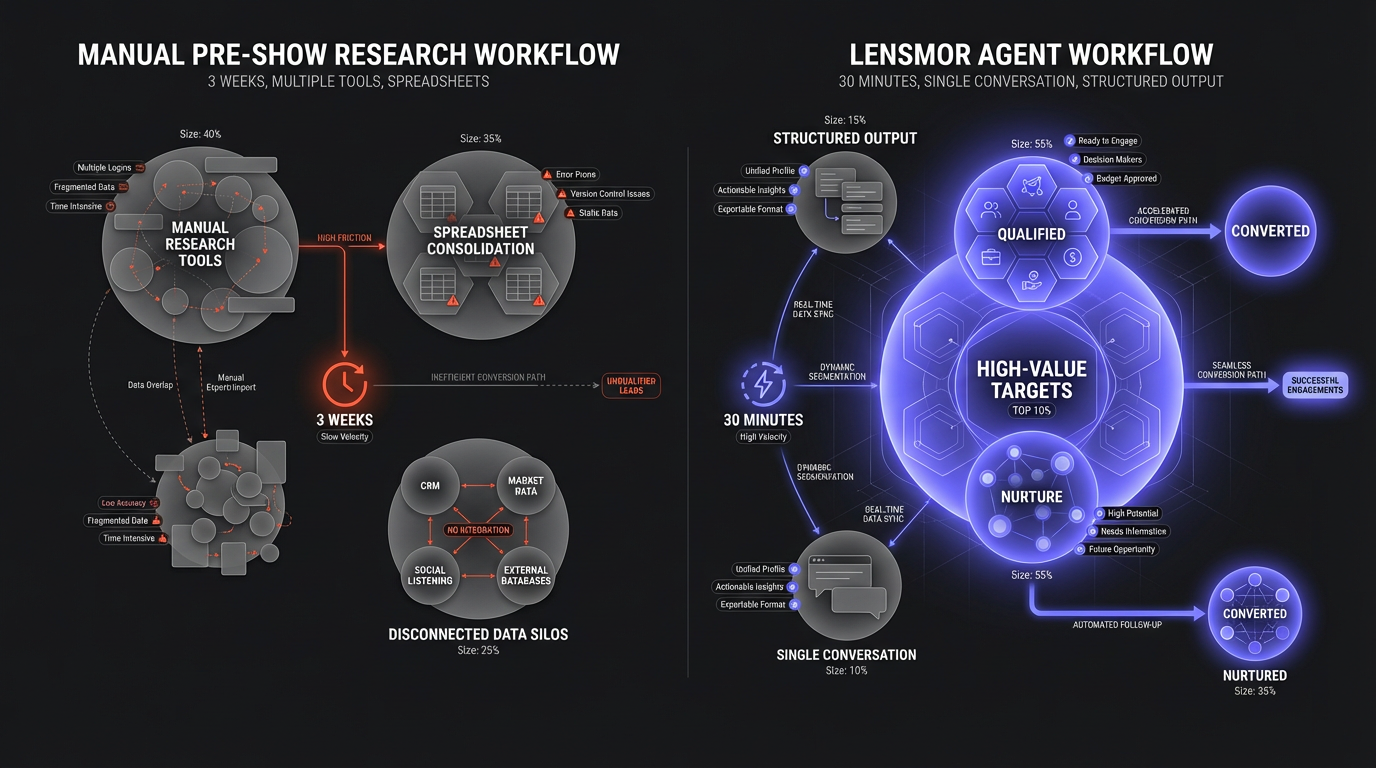
What used to take three weeks of manual research now takes about three minutes of conversation.
Why Conversational Intelligence Changes the Workflow
The shift from filter-based interfaces to natural language isn't just a UX upgrade. It changes who can actually do the research.
With a traditional tool, pre-show intelligence is a specialist task — someone has to know which filters to apply, in what order, and how to interpret the output. With a conversational interface, any rep can describe what they're looking for and get a usable answer. The bottleneck moves from "does this person know how to use the tool" to "does this person know their ICP" — which is exactly where it should be.
It also makes complex queries accessible. Chaining three data sources in sequence — show → exhibitors → contacts — used to mean three separate tools, three separate exports, and a lot of manual reconciliation. The Agent handles the orchestration invisibly. You get the output without managing the workflow.
Pro Tip: If you're running an ABM motion, use Reverse Exhibitor Lookup to build your event calendar around your target accounts rather than the other way around. Pull the last two years of event history for your top 20 accounts, map the overlapping shows, and you'll have a data-driven event strategy in about ten minutes.
Current workflows and integrations
Use Agent in the web platform for event and company research. Its current help guide documents structured results, CSV downloads, saved chats and personal Skills. Check documented availability before planning around an additional channel.
HubSpot now supports user-initiated contact export from an event’s Attendees view. It is not an ongoing automatic sync. See the current HubSpot workflow; review destination records and keep CRM ownership and follow-up in your sales process.
The goal is a system that does the research before you ask — not just faster, but proactively.
Pro Tip: Keep a separate Agent chat for each event or campaign, and download a structured result when available. Review company fit, contact relevance and access requirements before outreach.
How It Compares to the Traditional Approach
Workflow comparison: Manual research uses directories, company sites and contact tools separately. Agent can combine event and company research in a conversational task and return a table. The team still reviews fit, resolves CRM duplicates and decides which records are ready for outreach.
Start Using Lensmor Agent Today
Lensmor Agent is live now on the web platform. If you're running any show in the next 90 days, the time to start your pre-show research is now — not two weeks before the show when you're already behind.
Start Free — Run your first natural language query against an upcoming show on your calendar.
Related reading: best event intelligence platforms and how to find buyers before a trade show; also see the complete trade show lead generation guide.


.avif)