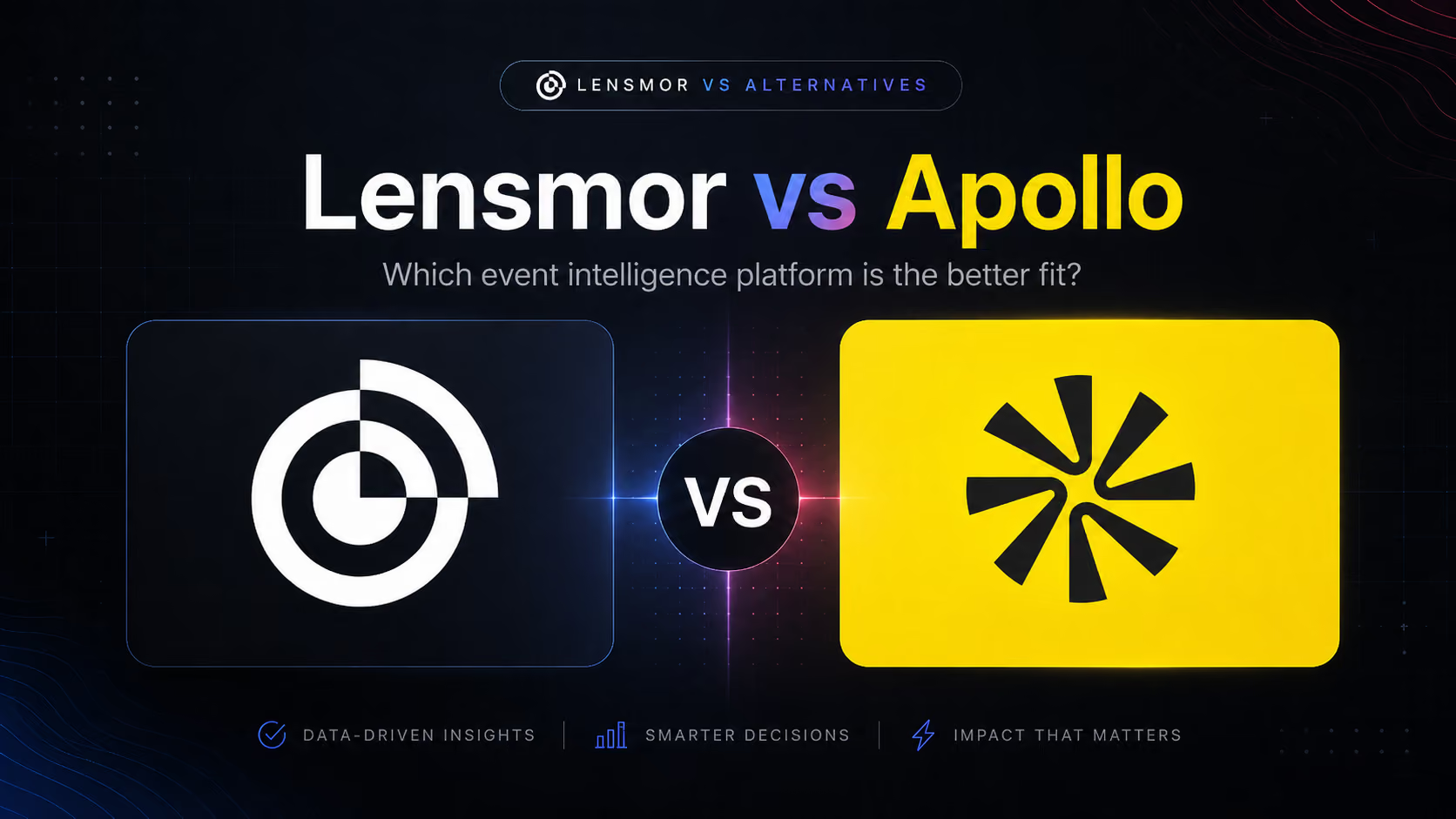
The Core Distinction Between Apollo and Lensmor
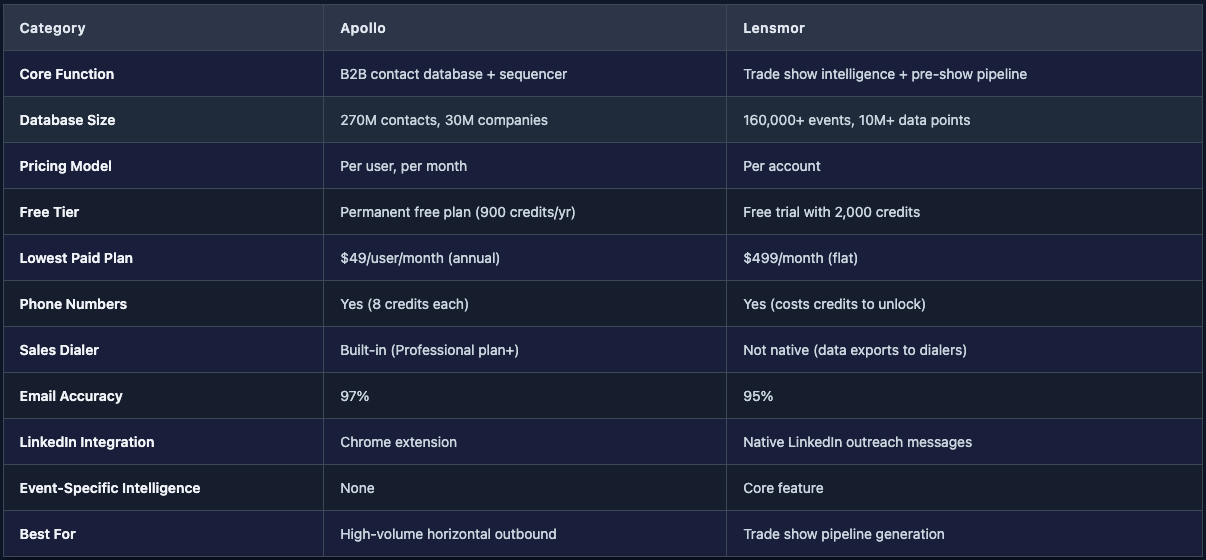
Apollo is a horizontal B2B contact database. You define your ICP, filter the database, and get a list of people who fit. The platform then helps you sequence them through email, phone, and LinkedIn. It is built for breadth: a large B2B contact database across every industry, geography, and seniority level.
Product note (checked July 2026): this guide compares workflows, not a permanent price sheet. Product packaging and availability change, so confirm current details directly with Apollo.
Lensmor is a vertical event intelligence platform for pre-show pipeline. It combines Exhibitors, Social Signal Attendees, and Visitor intelligence to reveal relevant accounts and people around a specific trade show, then adds verified decision-maker contact data. The high-value Visitor layer is especially useful because it surfaces prospects missing from static exhibitor lists and public social signals.
The most useful way to think about it: Apollo answers "who matches my ICP across the entire B2B universe." Lensmor answers "who from my ICP is going to be at this specific event next month."
The two tools live at different points in the sales workflow. Apollo is daily infrastructure. Lensmor is event-triggered intelligence.
Side-by-Side Feature Matrix
Decision Framework: Which One Fits Your Team
You Should Use Apollo If:
- Your sales motion is high-volume outbound across a broad ICP (50+ emails per rep per day)
- You have 1 to 5 SDRs and per-user pricing works in your favor
- Trade shows are not a meaningful pipeline channel for your business
- You need a built-in dialer for high-volume cold calling
- You want one tool that handles database, sequencing, and CRM enrichment
- You are an early-stage company that needs flexibility over depth
You Should Use Lensmor If:
- You attend 3 or more trade shows or conferences per year
- You have 5 or more people who need access to sales intelligence
- Trade show pipeline is at least 20% of your annual revenue plan
- You want event-context outreach (3 to 5x reply rate uplift in practice)
- You need to decide which shows are worth attending based on attendee fit
- You spend more than $10,000 annually on trade show booths or sponsorships
You Should Use Both If:
- You have an SDR team running daily outbound (Apollo) AND attend major industry events (Lensmor)
- You want to enrich event contacts with Apollo's broader firmographic data
- Your annual sales budget allows $10K+ for tooling
- Your sales motion combines steady-state outbound with event-driven pipeline spikes
Pricing and procurement
Apollo publishes plan and credit information, while event-intelligence vendors may package access differently. Compare current price, contact and enrichment allowances, export rights, integrations, and contract terms with the vendors—not a static blog table—before deciding.
The practical question is whether the team needs an everyday outbound platform, an event-specific research workflow, or both.
Data and workflow coverage
Apollo is designed for broad B2B prospecting, data enrichment, and sales engagement. Lensmor is designed for event-led account research and pre-show workflow preparation.
Neither description should be read as proof that a person is registered for an event. Confirm the source, coverage, and freshness of any event or contact record before outreach.
Use Case Deep Dive: Six Real Scenarios
Scenario 1: Solo Founder Doing Outbound
Profile: Bootstrapped founder, no SDR team, doing 30 to 50 emails per day across multiple personas.
Recommendation: Apollo Basic at $49/month. The horizontal database fits the unfocused exploration phase, and per-user pricing means you pay for one seat. Add Lensmor only if you attend a specific event that matters for your category.
Scenario 2: SDR Team Running BAU Outbound
Profile: 5 SDRs running daily outbound to mid-market SaaS companies. Average 80 emails per rep per day, occasional cold calling.
Recommendation: Apollo Professional. The dialer, unlimited sequences, and CRM integration cover the core motion. Total annual spend: $4,740. Trade shows are not the primary channel, so Lensmor is optional.
Scenario 3: Sales Team Prepping for Major Trade Show
Profile: 12-person sales team, 2 booth presences per year at industry events (e.g., CES, Inbound), $40K per show budget.
Recommendation: Lensmor Basic plus existing Apollo. Use Lensmor for 6 to 8 weeks before each show to build a target list of 200 to 400 high-fit exhibitors and attendees. Pre-book 30 to 50 meetings before doors open. Apollo continues to run daily outbound between shows.
Scenario 4: ABM Marketing Team Targeting 200 Accounts
Profile: Marketing team running account-based plays against 200 high-value target accounts. Want to find every event those companies attend.
Recommendation: Combine both. Use Apollo to identify contacts across all 200 accounts. Use Lensmor to discover which trade shows those 200 accounts will exhibit at or attend over the next 12 months. Coordinate timing of outreach to coincide with event proximity.
Scenario 5: Agency Managing Client Outreach
Profile: B2B marketing agency managing outbound for 8 to 15 client accounts. Each client has different ICP and different show calendars.
Recommendation: Lensmor Growth at $14,900 per year. The plan includes 1,500,000 Credits per annual term and a shared Workspace for up to 10 seats. Pull event-specific lists for each client based on their target shows. Use the client's own Apollo account (or shared agency Apollo) for daily outbound.
Scenario 6: Enterprise Sales Team with Field Events
Profile: 30-person enterprise sales team selling 6-figure contracts. Pipeline depends heavily on industry conferences and customer dinners around events.
Recommendation: Lensmor Enterprise plus Apollo Organization. The team uses Apollo for everyday prospecting and CRM enrichment. Lensmor handles the 10 to 15 events per year where field sales spends most of their pipeline-generating energy. Total spend: roughly $50K to $80K per year on tooling.
Integration Ecosystems Compared
Apollo Integrations
Apollo has the broader integration ecosystem, reflecting its longer time in market. Native integrations include:
- Salesforce (deep bidirectional sync)
- HubSpot (deep bidirectional sync)
- Microsoft Dynamics, Pipedrive, Zoho CRM
- Slack, Microsoft Teams
- Gmail, Outlook
- LinkedIn (Chrome extension)
- ChatGPT, Claude, Perplexity (open-by-design strategy)
- Zapier for everything else
Lensmor Integrations
Lensmor's integration strategy focuses on the outreach execution layer:
- Salesforge (native, pre-show campaign sync)
- Instantly (native, email campaign sync)
- Salesforce (push contacts and meetings)
- HubSpot (push contacts and meetings)
- LinkedIn (native outreach messages: InMail, Connection Note, Connected Message)
- Gmail, Outlook (export and send)
- CSV/Excel export to anywhere
- API for custom workflows
How to Combine Both
If you use both tools, the typical workflow is:
- Lensmor identifies event-specific contacts (exhibitor decision-makers, attendee signals)
- Export from Lensmor to CSV or push to Apollo via Salesforce
- Apollo enriches the contacts with broader firmographic data
- Apollo sequences the contacts with event-context outreach drafted in Lensmor
- Both tools push results to your CRM for pipeline tracking
This combined workflow uses each tool for its strength: Lensmor for event-specific discovery, Apollo for execution infrastructure.
AI capabilities
Evaluate AI features by the output your team needs: broad prospecting assistance, research and enrichment support, or event-focused account preparation. Feature availability changes frequently and may depend on a plan or integration.
Run a small pilot using the same ICP and a documented success metric instead of relying on claimed reply-rate benchmarks.
Migration and Switching Guide
Most teams do not switch entirely from Apollo to Lensmor or vice versa. They add the second tool to cover a gap. Here is how each transition works in practice.
Adding Lensmor to an Existing Apollo Setup
- Start with the Lensmor free trial (2,000 credits, no credit card)
- Search for your most important upcoming trade show in Lensmor Discover
- Filter to your top 30 percent ICP matches
- Export those contacts as CSV or push to Apollo via Salesforce
- Run a pre-show campaign through Apollo's sequencer using Lensmor's drafted copy
- Measure reply rates against your typical Apollo cold outreach
Most teams see 3 to 5x reply rate uplift on event-context outreach vs generic cold email. That delta justifies the Lensmor subscription within one trade show cycle.
Replacing Apollo with Lensmor (Rare)
Some teams move entirely off Apollo when:
- Their entire pipeline is event-driven (e.g., agency model serving event-led brands)
- Per-user pricing has scaled past $30K annually for a team that does not run daily outbound
- Apollo's data accuracy has degraded for their specific vertical
Migration steps:
- Export all Apollo lists and sequences to CSV
- Identify which contacts have event association (those become Lensmor primary)
- For contacts without event association, decide if you need them at all (most teams find they were never converting anyway)
- Switch sequencer to Lensmor + Salesforge or Lensmor + Instantly
- Cancel Apollo at the end of the contract term
How to Trial Both Tools Side by Side
The fastest way to know which tool fits is to run them in parallel for one outbound cycle.
Week 1: Set Up
- Sign up for Apollo Free plan (instant access)
- Sign up for Lensmor free trial (no credit card)
- Pick one upcoming trade show that matters to your business
Week 2: Build Two Lists
- In Apollo: filter for 50 ICP-fit contacts across the show's industry (without event context)
- In Lensmor: pull 50 ICP-fit attendees/exhibitors specifically from that show
Week 3: Run Two Sequences
- Apollo list: standard cold outreach
- Lensmor list: event-context outreach ("I'll be at [Show], would love 20 minutes")
Week 4: Compare Reply Rates
- Outbound results vary by list quality, message, market, and timing
- Event context can inform relevance, but it does not guarantee a reply
- Calculate cost per reply and cost per booked meeting
This 4-week trial costs nothing (both have free access) and produces direct evidence of which tool delivers more pipeline per dollar for your specific motion.
The Final Verdict
Apollo and Lensmor are not the same kind of tool. Comparing them by raw feature count or database size misses the point.
Apollo is sales infrastructure. It runs every day, in the background, supporting whatever outbound motion your team has. It does not get smarter about specific moments in your year. It is reliable, broad, and reasonably priced for small teams.
Lensmor is event intelligence. It activates around specific moments (trade shows, conferences, summits) where physical attendance creates a real and time-bound buying signal. It does not try to be everything. It tries to be the best at one specific motion.
If your team takes events seriously and has more than 5 people who need access to sales intelligence, Lensmor's combination of event-specific data and account-based pricing makes it the better economic choice, regardless of whether you also use Apollo.
If your team is small and doing general outbound, Apollo is the right starting point. Add Lensmor when you start attending events worth more than $10K in booth and travel spend.
The honest answer for most growing B2B teams: use both. They cost less combined than most teams realize, and they cover different parts of the funnel.
Related reading: Lensmor vs Vendelux comparison and best event intelligence platforms; also see the complete guide to trade show intelligence.