
Updated July 2026: InfoComm 2026 has concluded. The official results recorded 28,132 verified attendees from 94 countries and 807 exhibitors. InfoComm 2027 moves to Orlando, with education June 12-18 and exhibits June 16-18. The workflow below has been refreshed so teams can use the 2026 exhibitor landscape to prepare a cleaner 2027 target-account list.
InfoComm gives sales teams a strange problem.
The show is large enough to matter, but that scale also makes it easy to waste the weeks before the event. You can open the exhibitor directory, export or copy a pile of company names, and still have no clear answer to the question that matters most:
Who should we actually try to meet?
That is where most pre-show planning breaks. Teams treat the exhibitor list as the target account list. It is not. The exhibitor list is raw material. A target account list is the smaller, cleaner, ranked set of companies that match your sales motion, your territory, your product category, and the type of conversation your team can realistically win at the show.
InfoComm 2026 ran June 13-19 in Las Vegas, with exhibits open June 17-19. The show ultimately brought together 807 exhibitors across audio visual technology, integrated experiences, intelligent displays, AI-driven control, and related systems. For teams preparing for Orlando in 2027, that is still too wide a surface area to treat every directory entry as a sales target.
This guide walks through how to build that filter.
TL;DR
To build an InfoComm 2027 exhibitor target-account list, use the 2026 directory as a research baseline, then replace it with the official 2027 source when published. Normalize company names, remove irrelevant categories, score companies by fit and sales context, and split the final list into A, B, and C follow-up groups. Do not treat exhibitor names as contact data or claim access to attendee or registrant lists without an approved source.
A useful pre-show list should answer five questions:
- Is this company relevant to our ICP?
- What does this company likely sell, buy, distribute, or influence?
- Why would meeting them at InfoComm be worth 15 minutes?
- What proof or sample should we bring into the conversation?
- What is the next step after the show if the conversation goes well?
Why an exhibitor directory is not enough
The official InfoComm exhibitor gallery is built for event navigation. That is useful, but it is not the same as sales planning.
Directories usually help you answer:
- Who is exhibiting?
- What booth or product category are they associated with?
- Which companies should attendees save in a show planner?
Sales teams need a different answer:
- Which companies are likely to match our offer?
- Which accounts should we research before the show?
- Which ones deserve a tailored meeting ask?
- Which ones should only be watched, not contacted yet?
Those are not directory questions. They are account selection questions.
If you skip this step, your pre-show outreach starts to sound generic. The email says you "noticed they will be at InfoComm" and asks for 15 minutes. The problem is that every other vendor can say the same thing. A better approach is to show that you understand their segment and have a concrete reason to talk.
For example:
- "You sell LED display systems into corporate and live-event environments. We mapped a short list of regional integrators and venue operators that look relevant to that motion."
- "You are launching an AI-enabled control product. We pulled a sample of accounts where room-control, collaboration, and workplace modernization signals overlap."
- "You support AV integrators. We grouped the exhibitor universe by potential partner, channel, and end-customer relevance so your team does not treat all names equally."
That is a different conversation.
Step 1: Define the sales motion before touching the list
Do this before you open the exhibitor directory.
Write down the sales motion you are trying to support. Keep it simple:
We sell [product or service] to [buyer type] who needs [business outcome] before, during, or after InfoComm.A few examples:
We sell sales intelligence to AV vendors who need better pre-show account prioritization.We sell channel enablement to hardware manufacturers who need to identify relevant integrators and regional partners.We sell workplace technology services to enterprise AV and IT teams planning room upgrades.This sentence decides what stays in the list.
Without it, you will over-include. A manufacturer, distributor, integrator, consultant, media company, association, and software provider may all be present in the same event ecosystem, but they are not equal targets for the same offer.
For InfoComm, the first segmentation usually falls into a few practical buckets:
The goal is not to make a perfect taxonomy. The goal is to stop treating the show as one giant market.
Step 2: Start from official exhibitor sources
Use the official InfoComm exhibitor gallery as the starting point. If you use third-party exhibitor databases, treat them as enrichment, not as the source of truth.
For each company, capture the basics:
Company name
Official exhibitor profile URL
Website
Booth, if available
Product category or short description
Country or region, if available
Notes from the profile
Then add your own planning fields:
ICP fit
Likely role in the market
Relevant product line
Potential buying or partner angle
Why meet at InfoComm
Research confidence
Recommended action
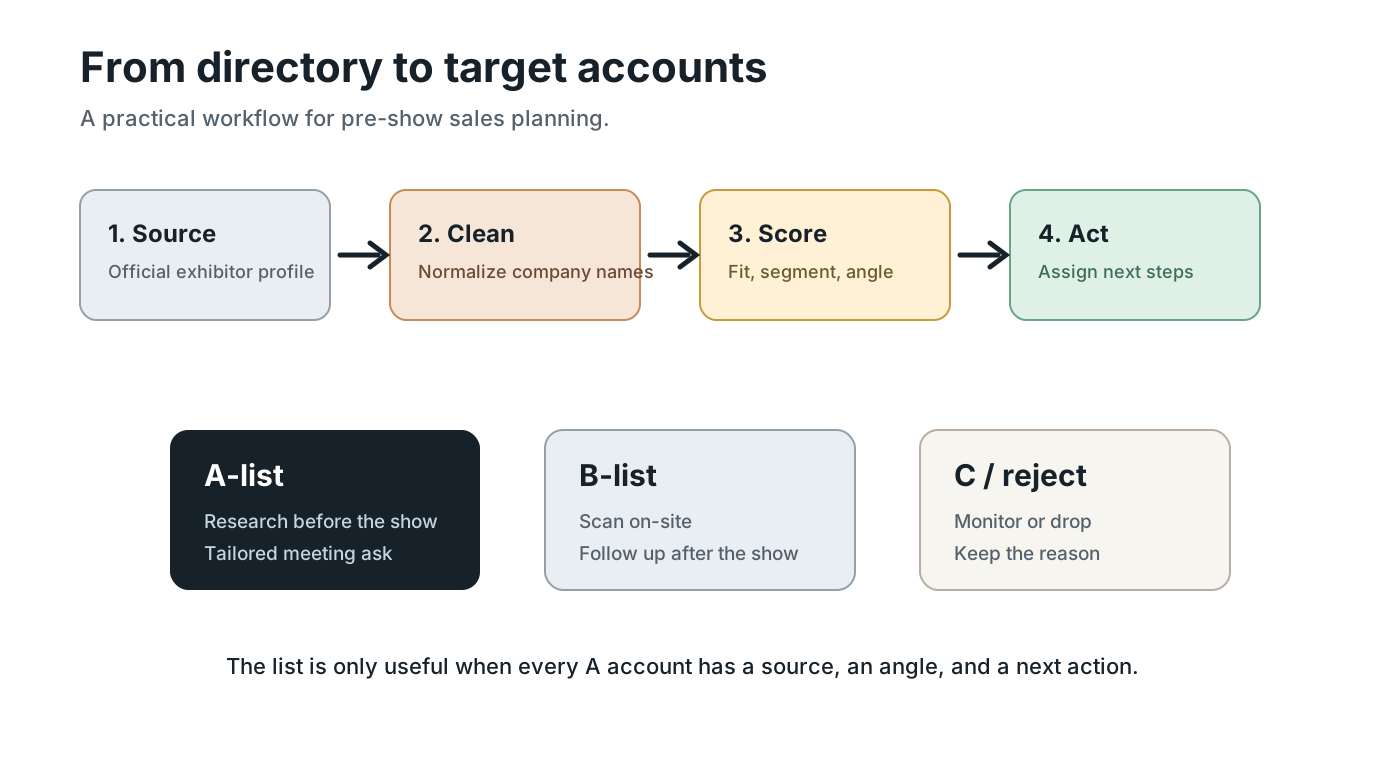
That last field matters. Every company should have one clear action:
A: research and tailor outreach before the show
B: keep for on-site scan or post-show follow-up
C: monitor only
Reject: irrelevant for this campaign
Do not leave records in a vague "maybe" state. A list full of maybes is just another directory.
Step 3: Normalize company names before scoring
Trade show data gets messy fast.
You will see parent companies, local subsidiaries, regional offices, brand names, product lines, and distributors that look like separate companies. If you score them too early, you will double-count the same account or split one opportunity into three fragments.
Normalize before you prioritize.
Check for:
- Parent company versus local branch
- Brand name versus legal entity
- Distributor versus manufacturer
- Duplicate entries with slightly different spelling
- Companies that appear under multiple categories
- Booth-share relationships
Use a canonical company field:
canonical_company_name
display_name_from_event
relationship_type
Example:
canonical_company_name: Acme AV Systems
display_name_from_event: Acme AV Systems USA
relationship_type: regional subsidiary
This makes the final list easier to review. It also avoids embarrassing outreach, like sending three different notes to three versions of the same company.
Step 4: Score for sales relevance, not brand size
The biggest names are not always the best first targets.
Large brands may be valuable, but they are often harder to reach, slower to move, and less likely to respond to a generic meeting request. Smaller or mid-market companies can be better targets if they have a clearer segment, a more urgent channel need, or a more specific reason to talk.
Use a score that reflects your sales context.
Here is a simple model:
Then add the total:
24 to 30: A target
17 to 23: B target
10 to 16: C target
Below 10: reject or monitor
The most important score is not total company size. It is whether you can explain, in one sentence, why this specific company should care.
If you cannot write that sentence, do not put them in the A group.
Step 5: Write the meeting angle before the email
Most teams jump from "good account" to "send email." Slow down.
Before writing any outreach, write the meeting angle:
Company:
Segment:
Why this account matters:
What we can show them:
What we should ask:
What we should not claim:
Here is a practical example:
Company: Example display manufacturer
Segment: LED display systems for enterprise and live-event environments
Why this account matters: Likely sells through integrators and regional partners
What we can show them: Sample account map by venue, integrator, and enterprise workplace segment
What we should ask: Which country or channel is most important for their 2026 pipeline?
What we should not claim: We do not have attendee or buyer intent data unless separately sourced and approved
This forces the outreach to become specific.
Your final email can still be short. It just needs a real reason to exist.
Step 6: Separate exhibitor intelligence from attendee-list claims
This is a critical boundary.
An exhibitor target account list is built from company-level and exhibitor-level signals. It can include public company data, official exhibitor profiles, websites, product categories, market segments, and your own account research.
That is different from an attendee list or registrant list.
Do not imply that you have:
- attendee names
- registrant lists
- private buyer lists
- personal emails from the show organizer
- hidden intent data from InfoComm
Unless you have a legitimate, approved source, leave that language out.
The safer and more useful framing is:
We help prioritize company-level targets before the show.or:
We prepare exhibitor and account intelligence so your team can decide who deserves research, outreach, or a meeting request.That is cleaner. It also matches how serious B2B teams actually use trade show data.
Step 7: Build the final list in three layers
Do not hand sales a 300-row spreadsheet and call it useful.
Give them three layers:
Layer 1: A-list accounts
These are the companies worth researching before the show.
Each A-list row should include:
Company
Website
Official exhibitor source
Segment
Why this company matters
Suggested meeting angle
Sample or proof to bring
Owner
Next action
Keep this list small. Ten to thirty accounts is usually enough for a focused pre-show push.
Layer 2: B-list accounts
These are relevant but not urgent.
Use them for:
- on-site scanning
- post-show follow-up
- category research
- content examples
- partner mapping
Do not spend the same research time on them before the show.
Layer 3: Watch or reject
This is where you put companies that appeared in the directory but do not fit the campaign.
Keep the rejection reason. It saves time later.
Examples:
Reject: media company, not a target for this offer
Reject: association, useful for context only
Watch: potential partner, no clear buying angle yet
Watch: relevant category, but source evidence is weak
Step 8: Turn the list into a pre-show operating plan
A target account list only matters if it changes behavior.
For each A-list account, decide:
- Who researches it?
- Who writes the meeting note?
- Who approves the message?
- Who sends it?
- What sample or proof will be shown?
- What is the follow-up path after InfoComm?
Use a simple meeting log:
Company:
Booth:
Met with:
Role:
Product line:
Market focus:
Pain or interest:
Sample requested:
Next step:
Owner:
Deadline:
The deadline field is the part people skip. Do not skip it.
If a conversation has no next step and no owner, it is not pipeline. It is just a nice chat at a booth.
A simple scoring worksheet
You can copy this into a spreadsheet:
The score is not meant to replace judgment. It is meant to make judgment visible.
When someone asks why a company is in the A group, the answer should be obvious from the row.
Where Lensmor fits
Lensmor is useful when a team wants to turn a show universe into a practical account plan before outreach starts.
The important word is "account." This is not about claiming access to private attendee data. It is about using public and approved company-level signals to decide which exhibitors, partners, or target accounts deserve sales attention.
For an InfoComm-style workflow, that can mean:
- grouping companies by product segment
- separating manufacturers, integrators, software vendors, and service providers
- flagging accounts that need manual review
- preparing a short list for pre-show outreach
- creating a meeting log so follow-up does not disappear after the event
The result should be smaller than the directory and more useful than a generic lead list.
Related reading: InfoComm 2026 recap and 2027 prospecting guide and how to book meetings before the show.
Final takeaway
The fastest way to waste InfoComm prep time is to treat every exhibitor as equally worth chasing.
The better move is to narrow early. Start from the official exhibitor data, clean it, score it, and hand sales a list they can actually act on.
If the list does not change who you research, who you email, what sample you bring, or what follow-up you send, it is not a target account list yet.
It is just another spreadsheet.
Build the InfoComm 2027 target-account list in Lensmor and turn the 2026 exhibitor landscape into a ranked research queue.


.avif)