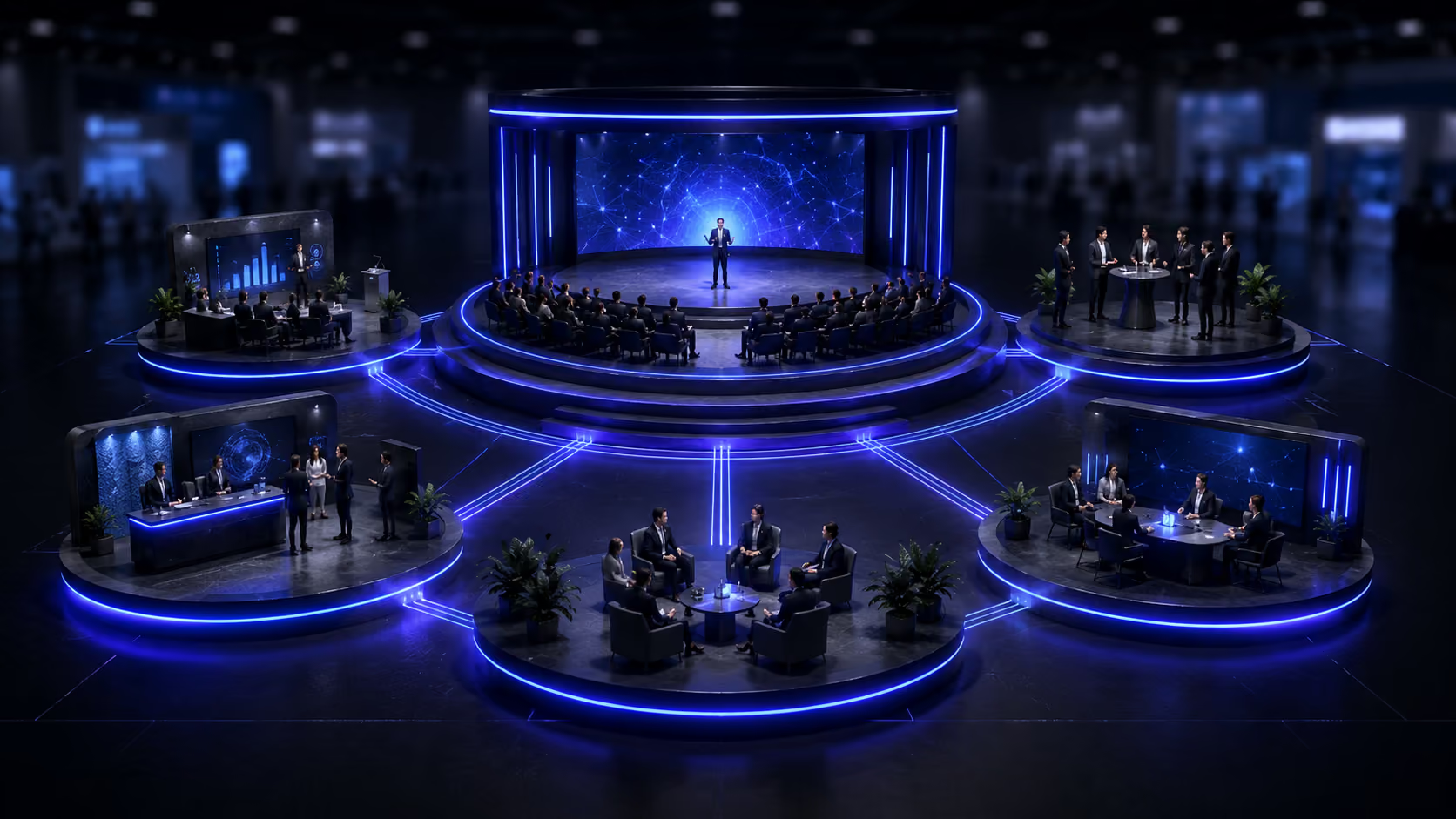
A conference is an organized, multi-session gathering where professionals in a shared field meet to learn, network, and discuss industry topics over two to four days. The difference between walking out with real pipeline and walking out with nothing but a tote bag comes down to understanding which type fits your goals and how to extract actual value from the experience.
TLDR
- Definition: A conference is an organized, multi-session gathering where professionals in a shared field meet to learn, network, and discuss industry topics over 2-4 days.
- Main types: Business, academic, trade, corporate/internal, professional development, and unconference formats each serve different goals and audiences.
- Scale: Conferences range from 50-person niche events to 10,000+ attendee mega-gatherings with exhibit halls, keynotes, and breakout sessions.
- Purpose: The three core reasons people attend are networking, knowledge acquisition, and direct business outcomes like lead generation or partnership development.
- Exhibitor edge: Teams that arrive with pre-verified attendee intelligence convert significantly more conversations into pipeline than those relying on random badge scans.
This article explains the definition, types, and examples of conferences. If the format is already clear and the next task is execution, use the conference planning checklist and timeline. To compare formats, read trade show vs conference.
What Is a Conference?
Conference meaning in plain terms
A conference is a formal, organized meeting where people with shared interests, professions, or industries gather to discuss specific topics, learn about new trends, and network. These events typically feature expert speakers, interactive workshops, panel discussions, and educational sessions built around collaborative problem-solving.
The word "conference" comes from the Latin "conferre," meaning to bring together. That origin still captures what makes a conference different from other event types: the structured bringing-together of people who share a professional or intellectual domain.
What is a conference in business?
In a business context, a conference is a multi-day event where companies, industry leaders, and professionals gather to share trends, announce products, build relationships, and close deals. Think Salesforce's Dreamforce (170,000+ attendees), HubSpot's INBOUND (11,000+ attendees), or the Consumer Electronics Show (100,000+ attendees).
Business conferences serve dual purposes. For attendees, they offer education and networking. For sponsoring companies and exhibitors, they function as concentrated lead generation environments where hundreds of qualified prospects occupy the same physical space for 2-4 days.

What is the difference between a conference and a meeting?
A meeting is a single-session gathering with a defined agenda, typically involving 2-20 people who already know each other. A conference is a multi-session, multi-day event with dozens to thousands of attendees, many of whom are meeting for the first time.
Key differences:
- Scale: Meetings involve a small group; conferences range from 50 to 10,000+ attendees.
- Duration: Meetings last 30 minutes to a few hours; conferences run 2-4 days.
- Structure: Meetings follow one agenda; conferences run parallel tracks with keynotes, breakouts, and networking sessions.
- Relationship context: Meetings happen between known parties; conferences bring together strangers with shared professional interests.
Practical next step: Researching conferences for pipeline, not just attendance? Lensmor helps teams discover relevant events, identify target accounts, and prepare contact lists before registration decisions are made. Find conferences matched to target accounts.
What Are the Main Types of Conference?
Business conferences
Business conferences focus on industry trends, company strategy, and professional networking. They attract executives, managers, and individual contributors who want to stay current in their field, discover new vendors, and build relationships that lead to deals.
Examples include SaaStr Annual (B2B SaaS), Web Summit (tech), and Money20/20 (fintech). Attendees pay $500-$3,000+ for tickets and expect a return through knowledge, contacts, or direct business outcomes.
Academic and research conferences
Academic conferences center on research presentations, peer review, and scholarly discourse. Researchers submit papers months in advance through a Call for Papers (CFP) process. Accepted papers are presented in sessions where peers ask questions and debate findings.
These events drive career advancement for academics. Presenting at a top-tier conference (NeurIPS for AI, ASCO for oncology, APA for psychology) builds citation counts and reputation. Most academic conferences run 3-5 days with poster sessions, oral presentations, and keynote lectures from leading scholars.
Trade conferences and exhibitions
Trade conferences combine education with exhibition floors where companies display products and services. Attendees walk between educational sessions and an expo hall filled with vendors demonstrating solutions. The result is a hybrid environment where learning and buying happen in the same building, often in the same afternoon.
Large trade shows and exhibitions like CES, NRF (retail), and HIMSS (healthcare IT) attract 20,000-100,000+ attendees and hundreds of exhibitors. The exhibit floor becomes a marketplace where buyers evaluate vendors and sellers generate pipeline in concentrated bursts.
Corporate and internal conferences
Corporate conferences are company-hosted events for employees, partners, or customers. Sales kickoffs, annual leadership meetings, customer advisory boards, and company-wide training events all fall into this category.
These events range from 50-person executive retreats to 5,000-person global sales kickoffs. Unlike external conferences, attendance is usually mandatory or strongly encouraged. The goal is alignment: getting everyone on the same page about strategy, priorities, or product direction.
Professional development conferences
Professional development conferences exist to help attendees build specific skills, earn certifications, or advance their careers. PMI Global Summit (project management), SHRM Annual (HR), and ATD (talent development) all fit this category.
Attendees often receive continuing education credits (CEUs or PDUs) for attending sessions. Companies send employees to these events as a form of investment in talent development, and individuals attend to stay competitive in their field.
Unconference
An unconference flips the traditional conference model. There are no pre-scheduled speakers or fixed agendas. Instead, attendees propose topics the morning of the event, vote on what interests them, and self-organize into discussion groups.
BarCamp, Open Space Technology events, and many startup community gatherings follow this format. Unconferences cost less to produce (no speaker fees, simpler AV needs) and often generate more authentic knowledge exchange because participants drive the content rather than passively consuming it.
Conference vs Symposium, Summit, Seminar and Workshop
Understanding how a conference compares to related event formats helps you choose the right one for your goals.
Symposium vs conference
A symposium is a smaller, more focused gathering where experts present and debate a narrow topic. While a conference might cover "the future of healthcare technology" across 200 sessions, a symposium on the same theme might bring 50 researchers together to discuss a single advancement in genomic sequencing.
Symposiums are common in academic and scientific communities. They produce deeper discussion on fewer topics, while conferences offer breadth across many subjects.
Summit vs conference
A summit targets senior decision-makers and focuses on strategic topics. Attendee lists are often curated or invitation-only. The Forbes Under 30 Summit, the World Economic Forum, and industry-specific CEO summits all fit this model.
Conferences are open to broader audiences and cover tactical as well as strategic content. Summits assume everyone in the room operates at a strategic level and skip foundational material entirely.
Seminar vs conference
A seminar is a single-topic educational session, typically lasting a half-day to one full day. One instructor or small panel teaches a specific skill or subject to a group of 10-100 attendees.
Conferences contain many sessions that resemble seminars, but they bundle dozens of these into a multi-day program alongside networking events, exhibitions, and social activities.
Workshop vs conference
A workshop is a hands-on, participatory session where attendees practice a skill under guidance. Group sizes stay small (10-50 people) because facilitators need to give individual attention.
Many conferences include workshops as part of their programming, often on the first or last day as "pre-conference" or "post-conference" add-ons with separate fees. The workshop itself is one format; the conference is the container.
What Is the Purpose of a Conference?
Networking and relationship-building
Networking is consistently rated as the top reason people attend conferences. Across multiple years of post-event surveys, 70-80% of attendees rank "meeting new people" and "reconnecting with peers" as their primary motivation.
Networking breaks make up 30-40% of most conference schedules by design. Organizers know that hallway conversations, lunch tables, and evening receptions produce as much value as main-stage content. The structured proximity of hundreds of people in your field for 2-4 days creates relationship opportunities that would take months to replicate through one-off meetings.
Knowledge sharing and learning
Conferences compress months of learning into days. A thoughtfully programmed conference gives you access to 50-200+ sessions covering the latest research, best practices, and emerging trends in your field.
The format also matters. Hearing a practitioner describe how they solved a problem you face, then asking them follow-up questions in the hallway afterward, transfers knowledge more effectively than reading their blog post. That immediacy is something no async format replicates.
Business objectives
For many attendees and most exhibitors, conferences exist to drive revenue. Exhibitors generate leads. Sponsors build brand awareness. Attendees evaluate vendors. Speakers establish authority that converts to consulting or software deals.
Smart teams approach conferences with specific event marketing strategies tied to measurable business outcomes. The conference is not the goal; pipeline, deals, and partnerships are.
Key Characteristics of a Conference
Format and duration
Most conferences run 2-4 days. A typical structure includes an opening keynote on day one, breakout sessions and parallel tracks during the middle days, and a closing keynote or summary session on the final day.
Conferences often include pre-conference workshops (day before), an exhibit hall open during core hours, evening networking receptions, and awards ceremonies. Virtual and hybrid formats became common after 2020, though in-person attendance has rebounded strongly.
Attendee profile
Conference attendees tend to be mid-career to senior professionals with decision-making authority or strong influence over purchases. Registration fees ($500-$3,000+), travel costs ($1,000-$3,000), and time away from work create natural filters that skew attendance toward committed professionals.
This is why conferences are valuable for B2B companies. The audience self-selects for seniority, budget authority, and active interest in the conference's subject matter.
Session types
A typical conference offers several session formats. Keynotes are 45-90 minute presentations delivered to the full audience from a main stage, usually one or two per day. Breakout sessions run 30-60 minutes in parallel rooms with smaller groups. Panel discussions bring 3-5 experts together with a moderator and often include audience Q&A.
Workshops provide hands-on practice with limited capacity so facilitators can give individual attention. Lightning talks are rapid 5-10 minute presentations, sometimes scheduled back-to-back. Poster sessions display visual presentations in a hall where researchers stand nearby to discuss their work. Roundtables gather 8-15 people around a specific topic with a facilitator guiding the conversation.
How Does Conference Planning Work?
Timeline: 12 months to event day
Large conferences need 12-18 months of lead time. Smaller events (under 300 attendees) can work with 6-9 months. The planning phases break down predictably.
At 12+ months out, you secure the venue and book keynote speakers. These two items have the longest lead times because top venues and speakers book far in advance.
At 9 months out, you open sponsorship sales and launch the Call for Papers or Call for Speakers. Sponsors need time to budget and plan their presence.
At 6 months out, you open registration and begin marketing. Early-bird pricing creates urgency and helps forecast attendance.
At 3 months out, you finalize the session schedule, confirm all speakers, and publish the agenda. Attendees use the published schedule to plan their time and justify the trip to their managers.
At 1 month out, you confirm all vendors (AV, catering, signage, badge printing), finalize floor plans, and begin on-site logistics coordination.
Budget breakdown
Conference budgets typically follow a predictable allocation. Venue and catering consume 40-50% of the total budget, making it the largest line item and the least flexible once contracted. Speaker costs account for 15-20%, with keynotes commanding $10,000-$100,000+ in fees while breakout speakers often present for free in exchange for exposure.
Marketing takes 10-15% of the budget across paid advertising, email campaigns, website, social promotion, and PR. Technology and production costs run 10-15%, covering AV equipment, livestreaming, event apps, registration platforms, and Wi-Fi infrastructure. Staff and operations account for the remaining 10-15%, including event coordinators, temporary staff, security, and on-site support.
A 500-person business conference in the United States typically costs $200,000-$500,000 to produce. Costs scale significantly with attendee count, venue quality, and speaker caliber.
Technology and tools
Modern conference planning relies on a tech stack that spans the entire event lifecycle. Registration and ticketing platforms like Eventbrite, Cvent, or Bizzabo handle sign-ups, payments, and attendee data. Event apps (custom or third-party) give attendees mobile access to scheduling, maps, speaker info, and networking features.
AV and production teams handle stage design, lighting, sound, and video for main stages and breakout rooms. Lead capture tools, including badge scanners and lead retrieval apps, integrate with CRM systems so exhibitors can track conversations. Post-event analytics platforms report on attendance, session popularity, engagement metrics, and ROI.
Here's what actually works for most mid-size conferences: pick one integrated platform rather than stitching together five point solutions. The data flows better, your team spends less time on manual syncing, and attendees get a smoother experience.
How to Get the Most From a Conference as an Attendee
Before the conference
Your conference ROI is largely determined before you arrive. Start with clear goals: Are you there to learn a specific skill, meet specific people, evaluate vendors, or find your next job? Each goal requires different preparation.
Research the attendee list and speaker roster. Identify 10-15 people you want to meet and reach out before the event. A brief LinkedIn message saying "I see we are both attending [Conference]. Would you have 15 minutes to connect?" has a surprisingly high acceptance rate when sent 2-3 weeks before an event.
Pro Tip: Most conferences publish at least a partial attendee list or use an event app with attendee profiles. Spend 30 minutes filtering that list by title and company before the event. The people you identify in advance become your priority targets on the floor, and you will avoid wasting time on conversations that go nowhere.
If you are exhibiting, use a platform like Lensmor to turn exhibitor directories and public event signals into a prioritized list of likely-fit accounts and contacts before you walk the floor.
During the conference
Skip sessions you can watch on video later. Prioritize sessions with live interaction: Q&A panels, roundtables, and workshops where you can ask questions and make connections.
Spend 40-50% of your time in networking environments rather than sitting in sessions. The hallway, the coffee line, and the evening reception are where relationships form. Take notes immediately after meaningful conversations (name, company, what you discussed, any follow-up promised).
After the conference
Follow up within 48 hours. Every day you wait reduces response rates. Send personalized messages referencing your specific conversation, not generic "nice to meet you" templates.
Compile your notes into a post-event summary: key insights learned, contacts made, follow-ups required, and measurable outcomes. Share this with your team or manager. This documentation justifies future conference attendance and ensures you act on every opportunity you created.
How to Generate Leads at a Conference as an Exhibitor
Pre-show attendee intelligence
The biggest mistake exhibitors make is arriving blind. Most conferences publish partial attendee lists, but few exhibitors use them strategically. Without knowing who is attending, your team defaults to hoping the right people walk by your booth.
Conference exhibitors face the same problem trade show exhibitors do: arriving without knowing who is in the room. Lensmor helps combine exhibitor directories and public event signals into a prioritized pre-show account and contact list, so your team can focus research and outreach before the conference opens.
Pre-show intelligence changes your entire conference strategy. Instead of staffing a booth and waiting, your team books meetings with qualified prospects before the doors open. Every hour on the floor has a plan.
On-floor qualification
Once the conference starts, speed and qualification accuracy determine how many leads turn into pipeline. Your team needs a consistent scoring framework for every conversation.
Build a simple qualification checklist: Does this person match your ICP? Do they have budget authority? Is there an active need? What is their timeline? Train booth staff to qualify in under 3 minutes and route hot leads to senior team members immediately.
Pro Tip: The 3-minute rule is not arbitrary. After three minutes of conversation, you should know whether this person is worth a senior rep's time. If you cannot determine fit in that window, your qualification questions need tightening. Script the first three questions your team asks and practice until the flow feels natural.
Use badge scanning tools that sync with your CRM in real time so you collect leads at a trade show or conference without losing data to handwritten notes and forgotten business cards.
Post-show follow-up
The average exhibitor takes 7-14 days to follow up after an event. By then, attendees have forgotten half their conversations. The companies that follow up within 24-48 hours with personalized, relevant messages win disproportionate pipeline.
Pro Tip: The 48-hour window is real. After two days, your prospect has returned to their normal workflow, processed hundreds of emails, and lost the emotional momentum from your conversation. Draft your follow-up templates before the conference so your team can personalize and send within hours of each conversation, not days.
Segment your leads by qualification tier and customize outreach accordingly. Hot leads get a phone call and calendar link. Warm leads get a personalized email referencing your conversation. Cool leads enter a nurture sequence.
Track everything back to the event so you can measure event ROI in terms of pipeline generated, deals closed, and cost per acquisition. This data informs your decision to attend or skip next year.
Conference Variations You Will Encounter
What is a conference in school or education?
In education, a conference typically refers to one of two things: a parent-teacher conference (a scheduled meeting between parents and teachers to discuss a student's progress) or an academic conference where educators and researchers present findings and share pedagogical methods.
Parent-teacher conferences happen 2-4 times per year and last 15-30 minutes per family. Educational conferences like ISTE (International Society for Technology in Education) or SXSW EDU bring thousands of educators together for multi-day professional development events.
For students, academic conferences offer early-career presentation opportunities. Many conferences have dedicated student tracks or poster sessions where graduate students share thesis research and receive feedback from established scholars.
What is a conference call?
A conference call is a phone call or video meeting with three or more participants. The term predates video conferencing and originally referred to multi-party telephone calls connected through a bridge line.
Today, "conference call" is used loosely to describe any multi-person call on platforms like Zoom, Microsoft Teams, or Google Meet. The term persists in business language even though modern tools look nothing like the dial-in phone bridges of the 1990s and 2000s.
A conference call is not the same as a conference (the event). The shared word causes occasional confusion, but context makes the distinction clear.
What is a conference in sports (NFL, NBA)?
In professional sports, a conference is a grouping of teams within a league. The NFL has two conferences: the American Football Conference (AFC) and the National Football Conference (NFC). The NBA has the Eastern Conference and Western Conference.
Conferences exist to organize competition. Teams within the same conference play each other more frequently during the regular season. Conference winners meet in championship games (the AFC and NFC champions play in the Super Bowl; the Eastern and Western Conference champions meet in the NBA Finals).
The word "conference" in sports has no connection to the event/meeting definition. It simply means a division or grouping of teams, derived from the idea of teams "conferring" or joining together in an organized structure.
What is a conference in church?
In religious contexts, a conference is a formal gathering of church leaders, clergy, or members to discuss doctrine, governance, or community matters. The Catholic Church uses "conference" to describe national or regional gatherings of bishops (like the United States Conference of Catholic Bishops).
The Church of Jesus Christ of Latter-day Saints holds General Conference twice a year, broadcasting addresses from senior leaders to millions of members worldwide. Many Protestant denominations hold annual conferences where local churches send delegates to vote on organizational matters.
Church conferences function similarly to secular conferences: they bring people with shared beliefs together for a defined period to learn, make decisions, and strengthen community bonds.
Conclusion
A conference is more than a large meeting. It is a structured environment built to concentrate knowledge, relationships, and opportunities into a 2-4 day window. Whether you attend, speak, sponsor, or exhibit, your results depend on preparation and intentional participation.
The type of conference matters. Business conferences drive deals. Academic conferences advance research. Trade conferences generate leads. Internal conferences align teams. Pick the format that matches your specific objective.
For exhibitors and B2B teams, conferences represent concentrated access to qualified buyers. The companies that invest in pre-show attendee intelligence, train their teams on rapid qualification, and follow up within 48 hours consistently outperform those who show up and hope for the best.
Whatever your role at a conference, approach it with a plan, execute that plan with discipline, and measure results so you know whether to come back next year.