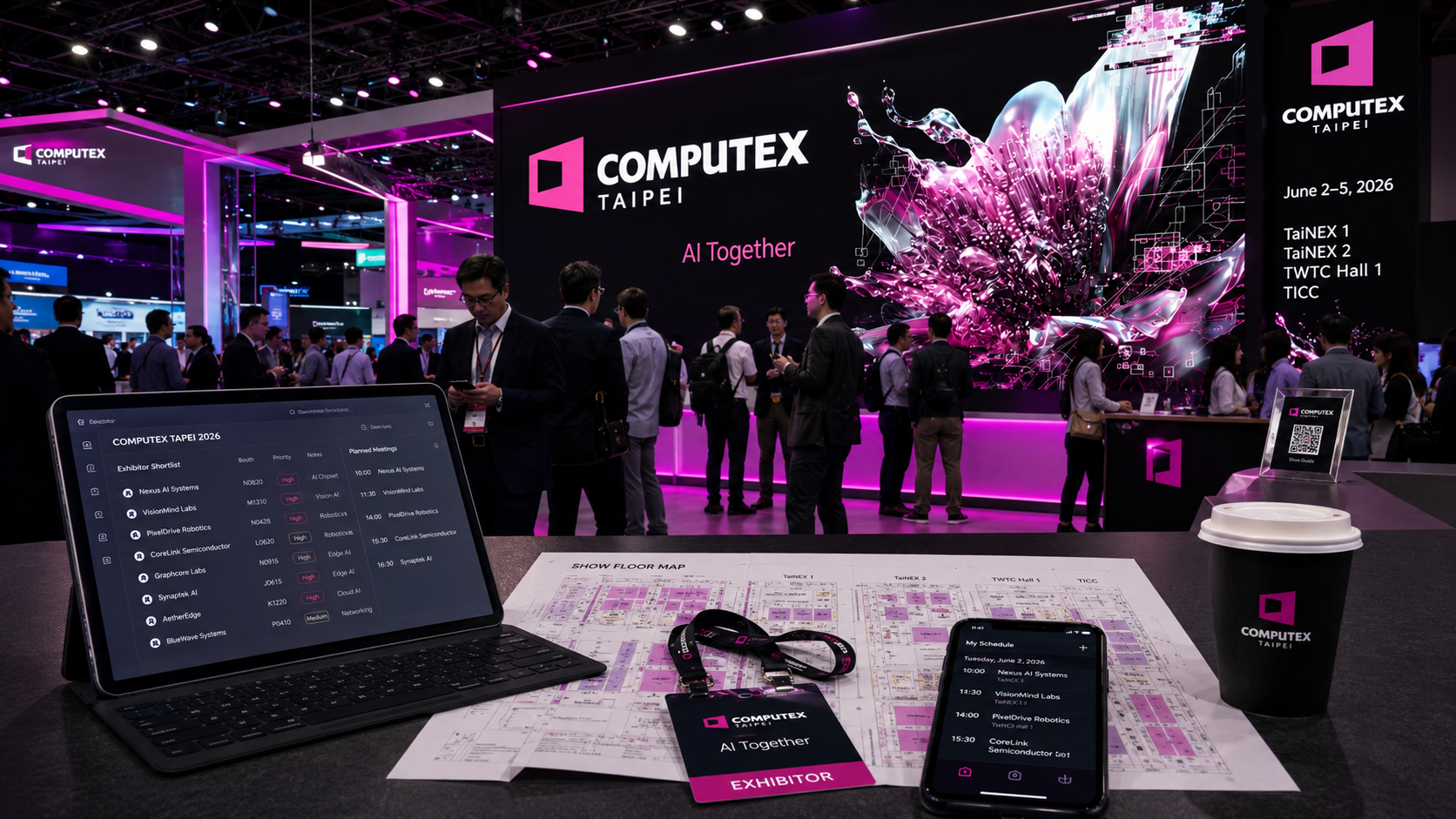

Your $30K Trade Show Booth Just Became a Very Expensive Coffee Station
You've spent six figures on your annual event marketing budget. Your team flew across the country, set up an impressive booth, smiled at hundreds of badge-scanners — and came home with a spreadsheet of names that your SDRs can barely use.
Sound familiar? You're not alone. According to CEIR data, the average cost per qualified lead at a major B2B trade show ranges from $800 to $3,000, and that's assuming you can even identify who was worth talking to in the first place. The problem isn't that events don't work — it's that most B2B teams are still operating blind, relying on static attendee lists and post-show business card piles instead of real-time intelligence.
That gap between "attended an event" and "closed a deal from an event" is exactly what a new category of tools — event intelligence platforms — is designed to close.
What Is Event Intelligence (and Why Does It Matter Now)?
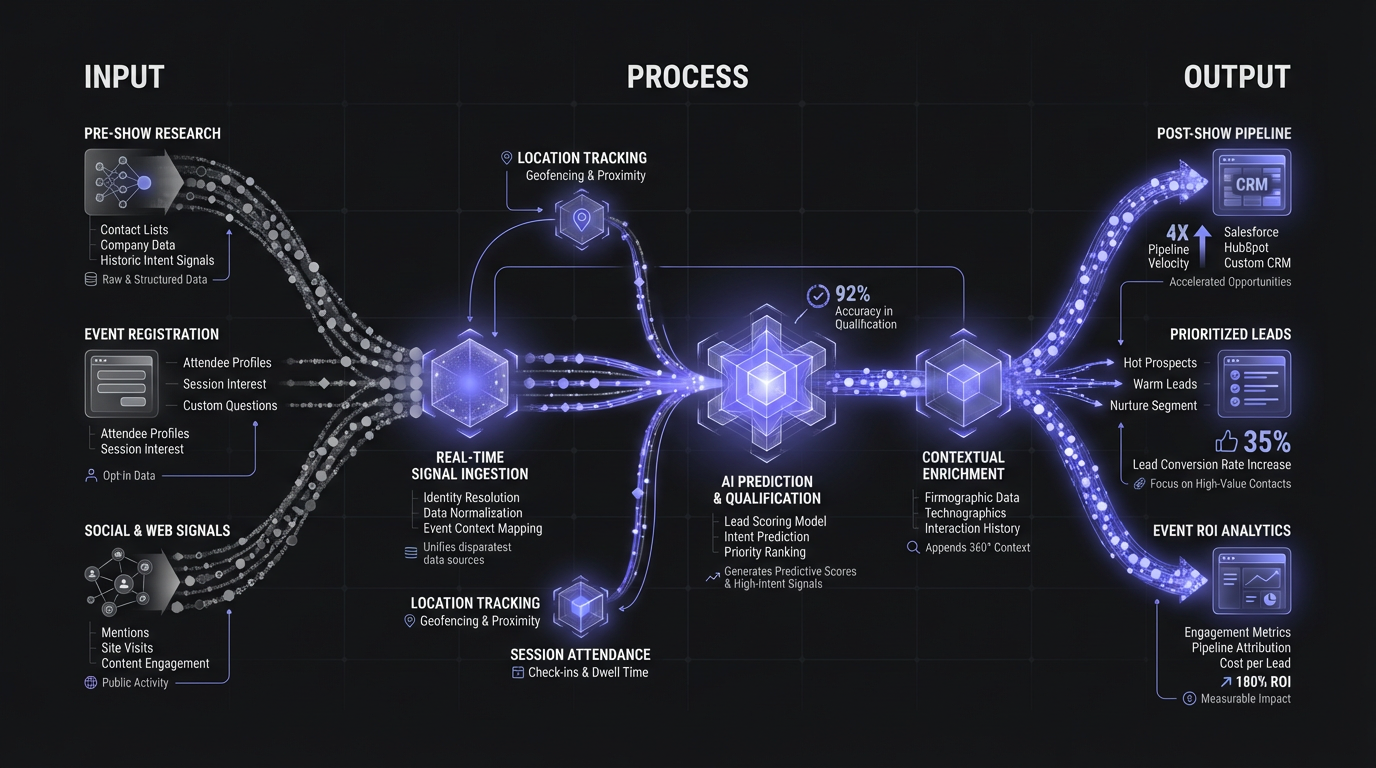
Event intelligence is the practice of using data, AI, and real-time signals to understand who attends trade shows, why they're there, and whether they're actually in-market for what you sell. It goes far beyond the basic exhibitor directory or badge-scan CSV that event organizers hand out.
Think of it as the difference between showing up to a party and hoping to bump into someone interesting versus walking in with a guest list, knowing exactly who's arrived, what they care about, and which conversations will move a deal forward.
The category has exploded in the past two years for a straightforward reason: B2B companies are spending more on events post-pandemic, but CFOs are demanding harder ROI numbers. In 2025, global B2B event spending crossed $40 billion. Yet most marketing teams still can't answer a basic question: "Which of the 200 people who stopped by our booth had actual buying intent?"
Event intelligence tools answer that question — before the event even starts.
How We Evaluated These Tools
Before diving into the list, here's what we looked for. Not every tool does the same thing, and "event intelligence" means different things to different vendors. We weighted our evaluation across five dimensions that actually matter for B2B revenue teams:
Data freshness — Does the tool update in real time, or are you working with a list that was pulled three months ago? In event marketing, stale data is worse than no data because it gives false confidence.
Intent signal depth — Can it tell you more than just "this person registered"? The best tools layer hiring signals, tech stack data, social activity, and expansion news on top of attendance data to surface genuine buying intent.
Ease of activation — How quickly can your sales team actually use the data? If it takes two weeks to export, clean, and import contacts into your CRM, you've already missed the window.
Pricing transparency — Event tools have a reputation for opaque enterprise pricing. We rewarded tools that publish clear pricing or at least give you a realistic range without requiring a 45-minute demo.
Coverage breadth — How many events, geographies, and data points does the platform actually cover? A tool that only works for 50 US conferences won't help a team with a global event strategy.
The 8 Best Event Intelligence Tools in 2026
1. Lensmor — Best for Pre-Show Intent Signals and Attendee Prediction
Lensmor takes a fundamentally different approach to event intelligence. Instead of waiting for event organizers to publish attendee lists (which often arrive too late or not at all), Lensmor's prediction engine forecasts who will attend based on historical patterns, social signals, and exhibitor data. The result: your sales team gets actionable intelligence weeks before the event, not days after.
How it works. You start by searching Lensmor's database of 160,000+ global events or use reverse discovery — input a target company and see every event they've exhibited at or attended. Once you've identified your priority events, the platform surfaces predicted attendees with enriched contact data, including verified emails and LinkedIn profiles. The real differentiator is the intent layer: Lensmor's AI agents continuously monitor hiring signals, expansion news, and social conversations to flag which attendees are actively in-market.
Strengths. The attendee prediction engine is genuinely unique in this space — no other tool we evaluated attempts to forecast attendance before official lists are published. The 24/7 watchlist monitoring with Slack and email alerts means your team gets notified the moment a high-value prospect triggers a buying signal. Data freshness is excellent, with updates running continuously rather than on a weekly or monthly cadence.
Limitations. Lensmor is currently in open beta, which means access is by invitation. The platform is still expanding its event coverage, particularly for smaller regional events in Asia-Pacific and Latin America. If you need a tool you can sign up for today with zero wait, this is worth starting a free trial while evaluating other options in parallel.
Pricing. Single Event Pass starts at $499 (one-time). Growth plan at $899/month includes 3 events and CRM sync. Enterprise pricing is custom.
Best for: B2B sales teams that want pre-show intelligence and real buying signals — not just a list of names. Teams spending $50K+ annually on events will see the clearest ROI.
Pro Tip: Lensmor's reverse event discovery feature is a hidden gem for annual planning. Instead of browsing event directories, input your top 20 target accounts and instantly see every trade show they participate in globally. This alone can reshape your event calendar.
2. Vendelux — Best for Enterprise Event Portfolio Management
Vendelux has positioned itself as the enterprise-grade event intelligence platform, and for large organizations managing 20+ events per year across multiple regions, it delivers. The platform's strength lies in its breadth of event data and its ability to help marketing leaders make portfolio-level decisions about which events deserve budget.
How it works. Vendelux aggregates data from event websites, social media, and public sources to build profiles of trade shows and conferences worldwide. You can filter by industry, geography, company attendance, and estimated audience size. The platform also tracks competitor event activity, showing you where rivals are investing their event marketing dollars.
Strengths. The event recommendation engine is solid for discovery — it surfaces events you might not have considered based on your target account overlap. Competitor tracking is particularly useful for enterprise marketing teams that need to justify event spend to the C-suite. The UI is polished and the reporting dashboards translate well into board-level presentations.
Limitations. The biggest drawback is pricing. Vendelux typically starts at $20,000+ per year, which puts it out of reach for most mid-market companies. The platform is stronger on event-level analytics than on individual attendee intelligence — you'll know which events matter, but you may still need supplementary tools for pre-show outreach data. Data updates can also lag behind real-time changes, particularly for events with dynamic exhibitor rosters.
Pricing. Enterprise pricing only, typically starting above $20,000/year. No self-serve option.
Best for: Large enterprises (500+ employees) with dedicated event marketing teams and the budget to match. If you're managing a global event portfolio and need executive-level reporting, Vendelux is purpose-built for that use case.
3. ZoomInfo — Best for General B2B Data with Event Context
ZoomInfo is the 800-pound gorilla of B2B data, and while it's not an event intelligence tool per se, its recent additions of event-related signals make it worth including. If your team already lives in ZoomInfo for prospecting, the event data layer adds context without requiring another platform.
How it works. ZoomInfo's core product is a massive B2B contact and company database. On the event intelligence side, it tracks which companies are exhibiting at or sponsoring major trade shows, and surfaces this as an intent signal within its broader platform. You can build lists filtered by event participation, then layer on ZoomInfo's firmographic and technographic data for a richer prospect profile.
Strengths. The contact database is unmatched in scale — over 100 million business profiles with generally strong accuracy. If you're already paying for ZoomInfo, the event data comes as a natural extension of your existing workflows. The CRM integrations (Salesforce, HubSpot, Outreach) are mature and well-documented. For teams that need event intelligence as one signal among many, this is the least disruptive option.
Limitations. ZoomInfo's event data is broad but shallow. It can tell you that Company X is exhibiting at Event Y, but it won't predict attendees, surface buying intent signals specific to events, or monitor real-time changes. The event coverage skews heavily toward North American conferences — international coverage is inconsistent. And the pricing is steep: most teams end up paying $15,000-$30,000/year, and event-specific features may require add-on modules.
Pricing. Starts around $15,000/year for professional plans. Event-specific features may require additional licensing. No transparent self-serve pricing.
Best for: Teams that already use ZoomInfo for general prospecting and want to add event context without adopting a new tool. Not ideal as a standalone event intelligence solution.
4. Grip — Best for Event Organizer-Side Intelligence
Grip approaches event intelligence from the organizer side rather than the attendee side, which creates a fundamentally different value proposition. If you're running events (not just attending them), Grip's AI-powered matchmaking and engagement analytics are hard to beat.
How it works. Grip provides event organizers with an AI recommendation engine that matches attendees with relevant exhibitors, sessions, and networking opportunities. For exhibitors and sponsors, this translates into warm introductions — the platform suggests which attendees should visit your booth based on mutual relevance. Post-event, Grip provides detailed engagement analytics showing which connections were made and which content was consumed.
Strengths. The matchmaking algorithm is genuinely useful when it works well — it turns passive attendance into directed engagement. The attendee engagement data (who viewed your profile, who bookmarked your session) gives exhibitors a signal layer that pure attendance data doesn't provide. For companies that sponsor or exhibit at events using Grip's platform, the data is rich and actionable.
Limitations. Here's the fundamental constraint: Grip only works at events that use Grip's platform. You don't get intelligence about events in general — you get intelligence about Grip-powered events specifically. This severely limits coverage. The platform also doesn't provide pre-show attendee prediction or the kind of broad market intelligence that tools like Lensmor or Vendelux offer. It's a point solution, not a comprehensive event intelligence platform.
Pricing. Pricing is event-based and typically negotiated with event organizers. Exhibitor access is often bundled into sponsorship packages. Direct pricing for attendees/exhibitors is not publicly available.
Best for: Companies that frequently exhibit at events running on Grip's platform. If your key conferences use Grip, the engagement data is valuable. Otherwise, look elsewhere.
5. Demandbase (One) — Best for Account-Level Event Signals within ABM
Demandbase isn't an event intelligence tool in the traditional sense, but its account-based marketing platform has evolved to include event intent signals that are genuinely useful for teams running ABM-driven event strategies.
How it works. Demandbase aggregates thousands of intent signals across the web — content consumption, search behavior, and third-party data — to identify which accounts are "in-market" for your solution. On the event side, it can flag when target accounts show event-related intent (searching for specific conferences, visiting event registration pages, engaging with event-related content). Some integrations also pull exhibitor list data to enrich account profiles.
Strengths. If you're already running an ABM strategy, Demandbase weaves event signals into a much larger intent picture. You're not just seeing "Company X registered for Event Y" — you're seeing "Company X registered for Event Y, increased web traffic to your pricing page by 300% this week, and just posted a job for the exact role your product serves." That composite signal is powerful for prioritization.
Limitations. The event-specific functionality is a small part of a much larger (and more expensive) platform. Demandbase is not designed for event discovery, attendee prediction, or the kind of granular event intelligence that purpose-built tools provide. Event data is treated as one intent signal among hundreds, which means it can get lost in the noise. Pricing typically exceeds $50,000/year for meaningful functionality, making it overkill if events are your primary use case.
Pricing. Enterprise pricing, typically $50,000-$100,000+/year for the full platform. Event intelligence is not available as a standalone module.
Best for: Enterprise ABM teams that want event signals as part of a broader intent-driven strategy. Not practical as a standalone event intelligence solution.
6. Swapcard — Best for Exhibitor Lead Management and Full-Cycle CRM Sync
Swapcard has evolved from an event networking app into one of the most complete exhibitor workflow platforms on the market. Its Exhibitor Management Portal handles the full lead lifecycle: scanning badge contacts at the booth, enriching those contacts with profile data, syncing to your CRM in real time, and delivering post-show analytics on engagement quality.
The 2025 launch of the Exhibitor Marketplace changed the value proposition significantly. Exhibitors can now self-serve upgrade their data capture capabilities — purchasing lead enrichment add-ons, analytics packages, and networking tools directly within their Swapcard account, independent of what the event organizer provisioned. For teams at large trade shows where Swapcard powers the official event app, this is a meaningful competitive edge over the booth next door.
Swapcard's Sherlock AI layer analyzes attendee behavior — sessions attended, products viewed, meetings requested — and surfaces engagement scores that help prioritize which leads your reps should contact first. This transforms post-show follow-up from a timing lottery into a prioritized sequence.
Strengths. Strong CRM integrations (Salesforce, HubSpot, Marketo); real-time lead sync during the event; self-service upgrade model gives exhibitors control without organizer dependency; solid post-show analytics with engagement scoring.
Limitations. Swapcard's intelligence capabilities only activate at events that use Swapcard as their platform — it is not a standalone prospecting tool like Lensmor or Vendelux. If an event does not run on Swapcard, these features are not available.
Pricing. Bundled with event organizer licensing; exhibitor upgrade packages available via the Exhibitor Marketplace (pricing varies by event and organizer).
Best for: Exhibiting teams that want to extract maximum value from shows already running on Swapcard — especially for CRM sync, lead qualification, and post-show analytics.
Pro Tip: Pair Swapcard with a pre-show intelligence tool like Lensmor. Lensmor identifies which attendees are in-market before you arrive; Swapcard tracks which ones engaged with your booth during the show. Together they give you a before-and-after picture of prospect intent that neither platform delivers alone.
7. Cvent iCapture — Best for On-Site Lead Capture and Badge Scanning
Cvent iCapture solves a specific but critical problem: capturing trade show leads in a way that actually makes it into your CRM with qualification context intact. The platform combines hardware (QR code, barcode, and NFC badge scanners), a mobile app for booth reps, and backend CRM sync — all in one system.
What separates iCapture from the generic badge scanners that event organizers rent out is the qualification layer. Reps attach notes, custom survey questions, and prospect ratings at the moment of capture — during the conversation, while context is fresh. By the time a lead hits your CRM, it carries the answers to your qualification questions, a priority rating, and the rep's notes. Not just a name and an email from a badge swipe.
For organizations already on Cvent's broader event management platform, iCapture integrates natively — connecting lead data to session attendance records. You can see not just that a prospect stopped at your booth, but which sessions they attended and which products they browsed. That behavioral context sharpens post-show personalization.
Strengths. Reliable hardware for high-volume booth scanning; custom qualification questions at point of capture; native Cvent integration for full-platform users; strong CRM sync for Salesforce and Marketo.
Limitations. iCapture is an on-site execution tool, not a pre-show intelligence platform — it does not help with attendee prediction, show selection, or competitive positioning. It complements pre-show tools, it does not replace them.
Pricing. Part of Cvent's broader event management platform; contact Cvent for exhibitor-specific pricing. Generally bundled into enterprise contracts.
Best for: Enterprise exhibitors running high volumes of trade show activations who need a standardized, CRM-integrated lead capture workflow across their entire field team.
Pro Tip: Build iCapture's custom survey questions before each event — not the morning of setup day. Pre-loading your qualification criteria (company size, buying timeline, current tech stack) ensures every rep asks the same questions, and that sales ops does not spend two days cleaning up inconsistent post-show data.
8. 10Times — Best for Global Event Discovery and Competitor Show Research
10Times is the world's largest commercial event database, covering 8 million+ registered members and trade shows, conferences, and industry events across 50+ countries. For B2B sales teams, its value is primarily in the research phase: finding relevant events your target accounts attend that are not yet on your radar, and tracking where competitors are directing their event spend.
The platform lets you search by industry, geography, and audience type to surface relevant events, then browse exhibitor lists for upcoming shows. The competitive geo-tracking use case is particularly underutilized: a competitor that consistently skips European shows and then appears at three regional events in Germany and France within a single quarter is communicating a strategic shift. 10Times surfaces that pattern before you hear about it secondhand.
The discovery workflow pairs well with Lensmor's reverse event search: use 10Times to identify event categories and geographies worth monitoring, then use Lensmor to go deeper on specific shows with attendee prediction, exhibitor history, and outreach automation.
Strengths. Broadest global event coverage of any platform reviewed; useful for competitive geo-tracking and international expansion signals; free tier available for basic research; good starting point before committing to deeper intelligence.
Limitations. 10Times is a discovery and directory tool — it does not provide attendee prediction, intent signals, or CRM integration. Data freshness on smaller regional events can lag.
Pricing. Free tier available. Premium features (exhibitor data, deeper analytics) require a paid plan. Contact for enterprise pricing.
Best for: Field marketing and competitive intelligence teams that want global event coverage and competitive show-tracking without enterprise platform costs.
Pro Tip: Run a 10Times competitor search 90 days before your annual event planning cycle. Pull every event where your top three competitors exhibited in the past 12 months, then map it against your own calendar to find strategic white space — shows where you would have category presence without a direct competitor on the floor.
Head-to-Head Comparison
| Feature | Lensmor | Vendelux | ZoomInfo | Grip | Demandbase | Swapcard | Cvent iCapture | 10Times |
|---|---|---|---|---|---|---|---|---|
| Attendee Prediction | Yes (AI-powered) | No | No | No | No | No | No | No |
| Real-Time Intent Signals | Yes (hiring, social, tech stack) | Limited | General B2B intent | Event engagement | Broad web intent | Post-show scoring | No | No |
| Event Coverage | 160,000+ global | Strong US/EU | Major conferences | Grip-powered events only | No event database | Organizer-dependent | Any event | 8M+ events globally |
| Pre-Show Intelligence | Yes | Partial | Basic exhibitor data | Limited | Account-level signals | No | No | Discovery only |
| On-Site Lead Capture | No | No | No | Yes | No | Yes | Yes (hardware) | No |
| CRM Integration | Salesforce, HubSpot, Slack | Enterprise CRMs | Extensive | Event platform only | Full ABM stack | Salesforce, HubSpot | Salesforce, Marketo | No |
| Reverse Event Discovery | Yes | Yes | No | No | No | No | No | Partial |
| Starting Price | $499 one-time | ~$20,000/year | ~$15,000/year | Bundled with event | ~$50,000/year | Bundled with event | Enterprise | Free tier available |
| Best For | Pre-show targeting & signals | Enterprise portfolio mgmt | General B2B + event context | Organizer-side matching | ABM + event signals | Lead mgmt & CRM sync | On-site lead capture | Global discovery |
How to Choose the Right Event Intelligence Platform
The right tool depends on three factors that have nothing to do with feature checklists.
First, where does your event strategy break down? If your problem is "we don't know which events to attend," you need discovery and portfolio tools (Vendelux, Lensmor's reverse discovery). If your problem is "we attend the right events but talk to the wrong people," you need attendee intelligence and intent signals (Lensmor, Demandbase). If your problem is "we have the data but can't activate it fast enough," you need better CRM integration and workflow automation.
Second, what's your realistic budget? This category has massive price disparity. A team spending $30K/year on events shouldn't spend $50K on an intelligence tool to optimize that spend. Match the tool investment to the event budget it's protecting. As a rough benchmark, event intelligence should cost 5-15% of your total event marketing spend.
Third, how many events do you run per year? If you attend 2-3 events, a single-event tool or pay-per-event model makes sense. If you're managing 10+ events annually, a platform with portfolio-level analytics and annual pricing becomes essential.
Pro Tip: Before committing to any annual contract, run a pilot on your next upcoming event. Most vendors will offer a trial or single-event option. Measure two things: (1) how many incremental meetings did the tool help you book pre-show, and (2) how many hours of manual research did it replace. If the math doesn't work on one event, it won't work on ten.
The Future of Event Intelligence
The event intelligence category is moving fast, and three trends will reshape these tools by 2027.
AI-native workflows are replacing dashboards. The next generation of event tools won't just show you data — they'll take action on it. Imagine a system that automatically identifies high-intent attendees, drafts personalized outreach, and schedules meetings on your calendar, all before you've booked your flight. Lensmor's watchlist alerts and Slack integrations are early signals of this shift.
Intent signals are getting event-specific. Generic "intent data" (someone visited a pricing page) is table stakes. The real value is event-contextualized intent: this prospect is attending your competitor's session, just posted about evaluating new vendors, and their company is hiring for the exact role your product serves. Tools that can layer these signals will win.
Post-event intelligence will close the loop. Most tools today focus on pre-show and at-show intelligence. The next frontier is connecting event engagement data to pipeline outcomes — proving that the conversation at Booth #347 turned into a $200K deal six months later. Attribution modeling for events is the missing piece that will justify even larger event budgets.
Conclusion
Event intelligence is no longer a nice-to-have for B2B teams that rely on trade shows. The gap between "showing up and hoping for the best" and "arriving with a pre-qualified target list and booked meetings" is the difference between $3,000 per lead and $800 per lead. That math adds up fast when you're managing a six-figure event budget.
The tools in this guide cover different parts of the problem. For most mid-market B2B teams, the highest-leverage starting point is pre-show intelligence — knowing who's attending, whether they're in-market, and having their contact data before the event opens. That's where the ROI is most immediate and measurable.
To see event intelligence applied to specific upcoming shows, explore our in-depth guides: RSA Conference 2026 Exhibitor Intelligence Guide and NAB Show 2026 Exhibitor Intelligence Guide — two major B2B events where pre-show research creates a measurable pipeline advantage.
Start Free Trial — Start using Lensmor's event intelligence platform. who want to turn their next trade show into a pipeline machine.