
Updated July 2026: NAB Show 2026 has concluded. The official wrap-up reports more than 58,000 registrants from 146 countries, with 22% international participation and 48% first-time attendees. The show floor featured more than 1,100 exhibitors. NAB Show 2027 returns to Las Vegas April 3-7, with exhibits April 4-7.
NAB Show 2026 showed a media technology market expanding beyond traditional broadcasting. AI, cloud workflows, streaming, the creator economy, enterprise media, and sports production all shaped the event's product and buyer landscape.
For B2B teams, the 2026 exhibitor universe remains valuable after the show: it provides a market map for identifying active vendors, technology categories, partners, and potential accounts before planning begins for 2027.
This refreshed guide combines the 2026 results with a practical 2027 prospecting workflow: understand the technology shifts, segment the exhibitor ecosystem, and build a ranked outreach plan before arriving in Las Vegas.

The Media Tech Shift: What NAB Show 2026 Revealed
To effectively prospect at NAB Show 2026, you first need to understand the macro trends shaping the budgets of the companies exhibiting and attending. The broadcast and media industry has fundamentally transitioned from hardware-centric workflows to software-as-a-service (SaaS) and cloud-native operations.
If you are selling enterprise software, infrastructure, or services into this market, the exhibitors leaning into the following three trends are your highest-value targets.
Generative AI & Automated Post-Production
Artificial intelligence is no longer a buzzword or a novelty demo; it is the core infrastructure of modern content creation. At NAB Show 2026, generative AI is moving out of the "experimental" phase and into mature, enterprise-grade production pipelines.
Exhibitors in this space are showcasing tools that automate color grading, generate localized audio dubbing in real-time, and create photorealistic background plates for virtual production. More importantly, AI is fundamentally changing asset management. Media Asset Management (MAM) vendors are integrating multimodal AI to automatically tag, log, and retrieve video clips based on natural language queries, turning massive media archives into highly monetizable datasets.
For B2B teams, these AI-driven exhibitors are prime targets. They are highly funded, aggressively seeking market share, and constantly looking for infrastructure partners—whether that means cloud storage, GPU computing providers, or data security compliance platforms.
Cloud-Native Broadcast & FAST Channels
The traditional broadcast control room is rapidly migrating to the cloud. Broadcasters and media conglomerates are realizing that maintaining heavy, on-premise hardware is no longer financially viable. At the same time, the explosion of FAST (Free Ad-supported Streaming Television) channels has created a massive demand for lightweight, scalable playout solutions.
NAB Show 2026 featured a large group of exhibitors offering cloud playout, remote live production, and IP-based signal routing such as SMPTE ST 2110. Many operate like SaaS companies inside the media market, with complex software supply chains and demand for monitoring, cybersecurity, and DevOps tooling.
If you sell enterprise IT solutions, the companies exhibiting in the cloud broadcast sector are your ideal prospects. They are dealing with massive data egress challenges, ultra-low latency requirements, and the need for zero-trust security architectures.
The Creator Economy Meets Enterprise
The line between a "YouTuber" and a "Broadcast Network" has effectively vanished. Top-tier digital creators are now operating with enterprise-level budgets, managing teams of editors, and requiring sophisticated media supply chains.
Conversely, traditional broadcasters are adopting creator-style workflows to produce digital-first content rapidly. This convergence is a major theme at NAB Show 2026. Exhibitors are catering to this middle ground with collaborative editing platforms, decentralized storage solutions, and cross-platform publishing tools.
For B2B sales teams, this means the definition of a "media company" has broadened. You no longer just target the legacy studios; you target the software vendors that are enabling the next generation of digital-first media conglomerates.
Decoding the NAB Show Exhibitor List & Floor Plan
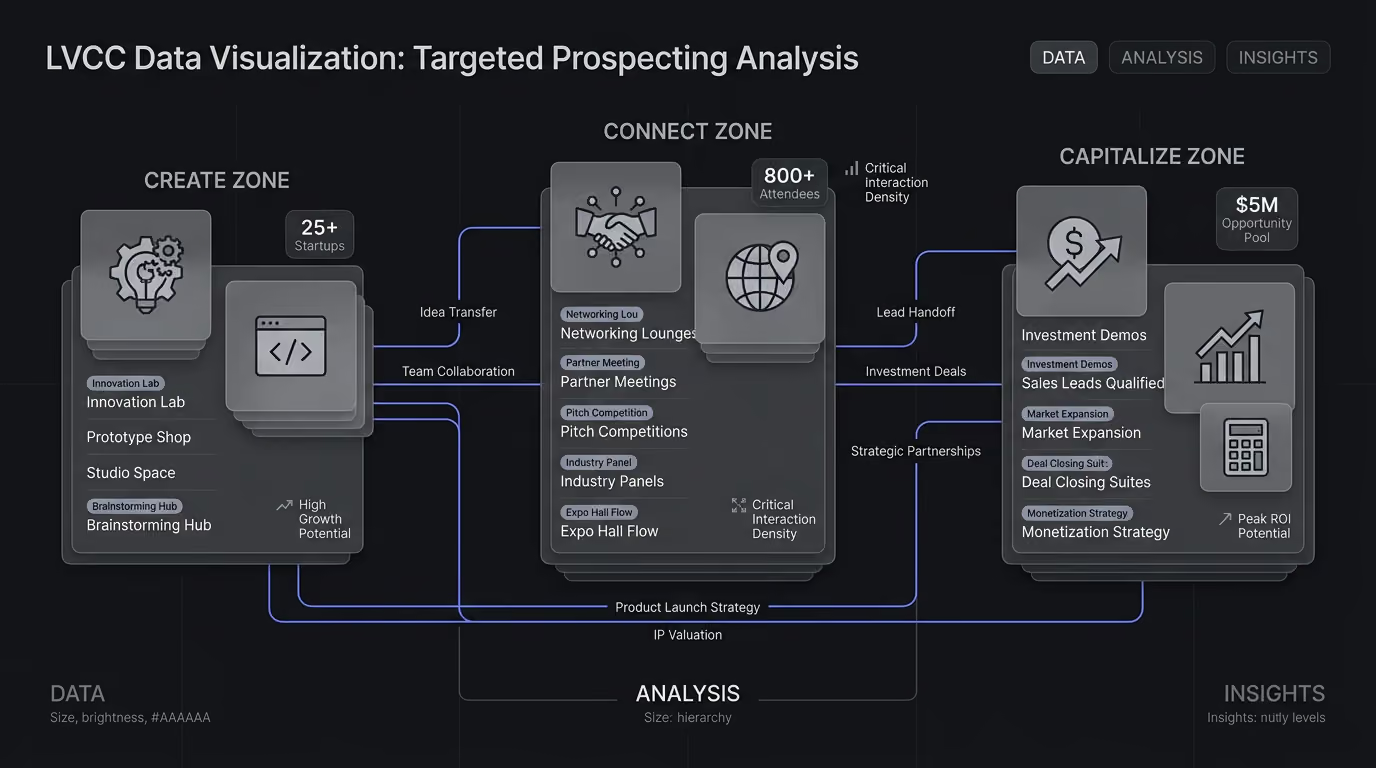
Navigating the Las Vegas Convention Center (LVCC) during NAB requires a tactical map. The show is divided into distinct thematic pillars. Understanding this layout is crucial for segmenting the NAB Show exhibitors and planning your team's physical movement across the floor.
The event is typically organized into four main collections: CREATE, CONNECT, CAPITALIZE, and INTELLIGENT CONTENT.
CREATE (Central & South Halls)
The CREATE pillar is the visual heart of NAB Show. This is where content origination happens. It spans pre-production, production, and post-production.
Here you will find the manufacturers of high-end cinema cameras, lenses, lighting grids, and audio recording gear. But beyond the hardware, the CREATE zone is heavily populated by post-production software, visual effects (VFX) plugins, and Extended Reality (XR) virtual production stages.
Prospecting Angle: If your product involves massive local storage, high-performance computing, or creative collaboration software, the exhibitors in the CREATE halls are your primary targets. These companies build the tools that generate petabytes of data, and they need infrastructure partners to help their end-users manage it.
CONNECT (West Hall)
Content is useless if it cannot be delivered. The CONNECT pillar focuses entirely on distribution, delivery, and broadcast infrastructure.
The West Hall is dominated by cloud service providers, Content Delivery Networks (CDNs), 5G infrastructure vendors, satellite operators, and IP routing software companies. This is the most "enterprise IT" focused section of the NAB Show floor.
Prospecting Angle: The exhibitors here are deeply technical. They care about latency, packet loss, uptime, and cybersecurity. If you sell DevOps tools, network monitoring, cloud optimization software, or enterprise security solutions, you should spend the majority of your time engaging with the exhibitors in the West Hall.
CAPITALIZE (West Hall)
The CAPITALIZE pillar is where media turns into money. It covers the business side of content, focusing on monetization, audience engagement, and advertising technology (AdTech).
Exhibitors in this zone include programmatic advertising platforms, subscription management software, audience measurement tools, and rights management systems.
Prospecting Angle: This is a goldmine for B2B teams selling Go-To-Market (GTM) software, CRM integrations, billing infrastructure, or data privacy compliance tools. The companies in the CAPITALIZE zone are essentially B2B SaaS businesses themselves, making them highly receptive to modern enterprise software pitches.
INTELLIGENT CONTENT
Often woven throughout the halls or given a dedicated showcase area, INTELLIGENT CONTENT focuses exclusively on data, AI, and automation.
This includes data governance tools, automated metadata tagging, personalization engines, and predictive analytics for media consumption.
Prospecting Angle: Exhibitors here are at the bleeding edge of media tech. They are likely heavily invested in machine learning infrastructure and data engineering. If you provide AI infrastructure, vector databases, or data pipeline tools, these exhibitors are your highest-priority targets.
Pro Tip: The LVCC is massive, and walking from the South Hall to the West Hall can take 25 minutes. Do not zigzag across the campus. Group your target accounts by hall and dedicate specific half-days to each zone to maximize your face-to-face meeting time.
The Exhibitor Ecosystem: Legacy Giants vs. SaaS Disruptors
To successfully mine the NAB exhibitor list, you must understand the two distinct tiers of companies operating within this ecosystem. They have vastly different buying cycles, pain points, and partnership models.
The Legacy Broadcast Giants
These are the titans of the industry—companies like Sony, Panasonic, Ross Video, Grass Valley, and Avid. They have been exhibiting at NAB for decades and typically occupy the largest island booths on the floor.
Historically, these companies sold proprietary hardware boxes. Today, they are undergoing massive internal transformations, desperately trying to rewrite their legacy codebases into cloud-native microservices.
How to approach them: Do not try to sell to the people working the demo stations at these mega-booths; they are product specialists focused on end-users. Instead, you need to identify their VP of Cloud Strategy, Head of Partnerships, or Chief Technology Officer. Your pitch should focus on accelerating their cloud transition, securing their new SaaS offerings, or providing white-labeled infrastructure so they don't have to build it from scratch.
The Agile SaaS Disruptors
Contrasting the giants are the hundreds of mid-market SaaS companies and well-funded startups. These exhibitors typically have 10x10 or 20x20 booths. They are cloud-native from day one, move incredibly fast, and are aggressively looking to steal market share from the legacy players.
These disruptors are building specific point solutions: a better way to stream remote video feeds from an iPhone, a faster AI transcription tool, or a more intuitive ad-insertion software.
How to approach them: The founders and C-suite executives of these companies are almost always standing right there in the booth. They make decisions quickly and are highly open to partnerships that can give them a competitive edge. This is where your B2B sales team can generate immediate pipeline. Pitch them on how your tool can help them scale faster, reduce their AWS bills, or integrate into their existing modern tech stack.
Just like we noted in our recent RSA Conference 2026 exhibitor intelligence guide, the highest ROI at massive industry shows rarely comes from the biggest booths; it comes from targeting the mid-market disruptors who are actively in growth mode.
How B2B Teams Can Mine the NAB Exhibitor List for Leads
Knowing the layout and the ecosystem is just the foundation. The actual work lies in turning the raw NAB Show exhibitor list into a prioritized, actionable hit list before you arrive in Las Vegas.
If you wait until you are on the show floor to figure out who to talk to, you have already lost.
Look Beyond the "Category" Tags
The official NAB Show exhibitor directory allows you to filter by categories like "Audio Production" or "Streaming." While helpful for a broad overview, these tags are self-selected by the vendors and are often overly generic. A company might tag themselves as "Cloud Computing," but that tells you nothing about whether they are a competitor, a potential partner, or a highly qualified prospect.
To build a real intelligence list, you have to look deeper at the firmographic data behind the booth.
You need to know: - Employee Headcount: Are they a 10-person startup or a 5,000-person enterprise? - Funding Stage: Did they just raise a $20M Series B (meaning they have budget to spend), or have they been bootstrapped for ten years? - Recent Product Launches: What press releases have they issued in the last three months? This tells you exactly what messaging they will be pushing at their booth.
Pro Tip: Export the raw exhibitor list and enrich it with firmographic data using tools like Apollo, ZoomInfo, or a dedicated event intelligence platform. Filter out the companies that fall outside your target revenue or employee count parameters immediately. This will usually shrink the list of 1,000+ exhibitors down to a highly manageable 150-200 qualified targets.
Identifying Tech Stacks
One of the most powerful ways to qualify an exhibitor as a prospect is by analyzing their current technology stack.
If you are selling a cybersecurity compliance tool designed specifically for AWS environments, you do not want to waste time talking to exhibitors whose entire infrastructure is built on Google Cloud. Similarly, if you sell a Salesforce integration, you want to specifically target exhibitors who use Salesforce as their CRM.
Pre-show tech stack analysis allows your sales team to walk up to a booth and say, "I see you're currently using [Competitor Tool] for your cloud storage. Many media tech companies are migrating to us because of X, Y, and Z. Are you the right person to speak with about your infrastructure roadmap?"
That is not a cold pitch; that is a highly contextual, intelligence-driven conversation.
Pro Tip: Map your top 20 competitors. Then, run a tech stack analysis on the entire NAB exhibitor list to see which companies are currently using your competitors' products. These are your "Tier 1" targets for the show floor. Your goal is to intercept them, plant seeds of doubt about their current vendor, and book a post-show discovery call.
Once you have identified these targets and captured their attention, ensuring that data flows seamlessly back into your CRM is critical. For the mechanics of on-site execution, review our comprehensive playbook on trade show lead capture.

Stop Scrolling, Start Engaging
The traditional method of preparing for a major trade show like NAB involves an SDR or a marketing manager spending weeks manually clicking through the online exhibitor directory, visiting hundreds of individual company websites, copying data into a spreadsheet, and trying to guess who the right contact person might be.
This manual process is slow, prone to human error, and virtually guarantees that you will miss hidden opportunities.
Modern B2B teams use automated event intelligence to skip the research phase and jump straight to engagement. Here is how the two approaches compare:
If your team is preparing for NAB Show 2027, relying on an unranked manual spreadsheet is still a costly risk. Start from the 2026 exhibitor landscape, update it as official 2027 sources appear, and give sales a research queue before travel and meeting calendars are locked.
Event intelligence platforms like Lensmor are designed specifically for this workflow. We transform opaque event directories into actionable pipeline data, allowing you to instantly identify your ICP, analyze their tech stack, and uncover the specific decision-makers who will be walking the floor.
Planning cybersecurity event coverage too? See our RSAC 2026 recap and 2027 exhibitor planning guide.
Turn the 2026 exhibitor landscape into a current research plan. Build the NAB Show 2027 target-account plan in Lensmor using exhibitor and public event signals.