
An exhibitor list is valuable because it shows which companies have already committed budget, staff, and market attention to a specific event. In event intelligence, that list is not a static directory. It is a dated GTM signal: a company has a reason to be visible, a deadline, and a cluster of needs around the show.
That is the part most teams miss.
When I look at an exhibitor list, I do not see a spreadsheet of company names. I see a map of companies that have decided to show up in public. They paid for space. They are sending people. They have a market message. They may be launching something, defending a category, entering a region, or trying to meet buyers and partners.
Those facts matter.
In the last few months, as I have spent more time talking with B2B teams about Lensmor, I keep noticing the same blind spot. Everyone knows exhibitors are important at the event. Far fewer teams treat exhibitor data as intelligence before the event.
That is strange, because exhibitors are some of the clearest commercial signals in the whole trade show ecosystem.
What is an exhibitor list?
An exhibitor list is a public or semi-public roster of companies exhibiting at a trade show, conference, expo, or industry event. It usually includes company names, booth numbers, categories, descriptions, sponsorship status, and sometimes links to company profiles or contact paths.
The basic use case is simple: attendees use the list to decide which booths to visit.
But for a GTM team, the exhibitor list can do much more. It can show which companies are investing in a market, which segments are crowded, which vendors are trying to reach the same buyers, and which companies may have near-term needs around the event.
This is why I think the term "list" undersells the asset.
A list sounds passive. Exhibitor data is active.

Why exhibitor data is more valuable than it looks
Exhibitor data is valuable because it combines budget, timing, intent, and context in one signal.
Most B2B data tools separate those pieces.
A company database tells you a company exists. A contact database tells you who works there. Intent data may tell you someone consumed content. A funding database may tell you who raised money. Useful, but often disconnected from a real-world moment.
An exhibitor signal is different.
If a company is exhibiting next month, it has already made several decisions. It chose a market. It allocated budget. It assigned people. It accepted a deadline. It created a reason for suppliers, partners, customers, and competitors to pay attention.
That is not the same as a cold account record.
Cvent's trade show statistics roundup shows why this matters. Exhibitors care deeply about quality conversations, sales outcomes, and industry visibility. The same roundup notes that 93% of exhibitors rank prospect quality as the most important event outcome, 67% see trade shows as effective for sales, and 81% of attendees have buying authority.
The budget side is just as important. Cvent's trade show budget guide places the average cost to exhibit at a trade show in the $10,000 to $30,000 range, before considering how costs vary by event scale, team size, and booth ambition.
So when a company appears on an exhibitor list, it has already crossed a meaningful threshold.
It is not browsing.
It is acting.
Pro Tip: Treat an exhibitor list as a budget signal first, not a directory. The company has already chosen to spend money in that market.
What exhibitors have in common
Exhibitors share a few commercial traits that make them unusually useful for B2B targeting.
The first trait is spend. Exhibiting is rarely accidental. Even a modest booth requires event fees, travel, logistics, collateral, staff time, and follow-up work. Bigger booths often involve agencies, builders, freight vendors, content teams, product marketers, executives, and partner managers.
The second trait is urgency. The show date creates a real deadline. Booth graphics need to be ready. Demos need to work. Giveaways need to arrive. Calendars need to fill. Meeting targets need to be hit. If a vendor can solve a relevant problem before the show, timing is no longer abstract.
The third trait is public positioning. Exhibitors expose what they want the market to know. Their categories, booth size, sponsorship level, co-exhibitors, product demos, and speaker presence all tell a story about how they want to be perceived.
The fourth trait is repeat behavior. Companies that exhibit once often exhibit again, especially in categories where events drive channel partnerships, enterprise deals, analyst conversations, recruitment, and product launches. Historical exhibitor behavior can reveal how serious a company is about a market.
The fifth trait is ecosystem need. Exhibitors do not operate alone. They need booth builders, event staffing, promotional products, freight, signage, hospitality, PR, photography, sales development, badge capture, appointment setting, local services, technical support, and sometimes legal or IP help.
This is why the same exhibitor list can be valuable to very different companies.
A booth builder sees upcoming installation demand. A custom gift supplier sees merch deadlines. An IP law firm sees hardware companies launching new products. A recruiting agency sees companies hiring around a category. A partnership team sees companies investing in the same market. A founder sees the shape of an ecosystem.
The data is the same.
The interpretation changes by business model.

Why most teams ignore exhibitor data
Exhibitor data is ignored because it sits between event operations and revenue operations.
That is the structural problem.
Event teams use exhibitor lists to understand the show. Sales teams use account lists to run outreach. Marketing teams use audience lists to run campaigns. Partnerships teams use ecosystem maps to find strategic relationships. But the exhibitor list often lives in a separate place, with no owner responsible for turning it into GTM action.
There are five reasons this keeps happening.
First, the data is messy. Every event website structures exhibitor pages differently. Some lists are searchable. Some are inside PDFs. Some hide important fields behind profile pages. Some update daily. Some disappear after the event ends.
Second, the data is not normalized. Company names vary. Categories are inconsistent. Booth numbers are not always useful. Descriptions are written for attendees, not sales teams. A human can understand the pattern, but a CRM does not automatically know what to do with it.
Third, most sales tools are not event-native. They are built around companies and contacts, not event participation. You can find a VP at a company, but you may not know that the company is exhibiting at a specific show in 31 days.
Fourth, teams overvalue post-show capture. Badge scans feel concrete. They are easy to report. They make the event look measurable. But they often arrive after the best timing has passed.
Fifth, exhibitors are sometimes treated only as competitors or booths to visit. That is too narrow. Exhibitors can be prospects, partners, suppliers, customers, peer signals, category signals, and market maps.
This is why I believe exhibitor data is underused. The value is visible, but the workflow is missing.
CEIR, the research division of IAEE, exists because exhibitions are measurable business environments, not just gatherings. Their research categories cover areas like exhibitor engagement, sponsorship sales, marketing spend, and exhibition performance. That alone tells us something: the industry already knows exhibitor behavior is meaningful. GTM teams just need to operationalize it earlier.
Pro Tip: If your exhibitor research is stored in a spreadsheet no one touches after the show, the problem is not research quality. It is workflow ownership.
The difference between company data and exhibitor data
Static company data answers who exists. Exhibitor data answers why this company matters right now.
That difference is easy to underestimate.
A static company database may tell you a robotics manufacturer has 300 employees, a headquarters location, and a VP of Marketing. Useful, but incomplete.
If the same company is exhibiting at Automate next month, the context changes. Now you know it is investing in the manufacturing market, preparing a public presence, and likely coordinating people, demos, meetings, partners, and follow-up around a deadline.
The account did not change.
Your timing did.
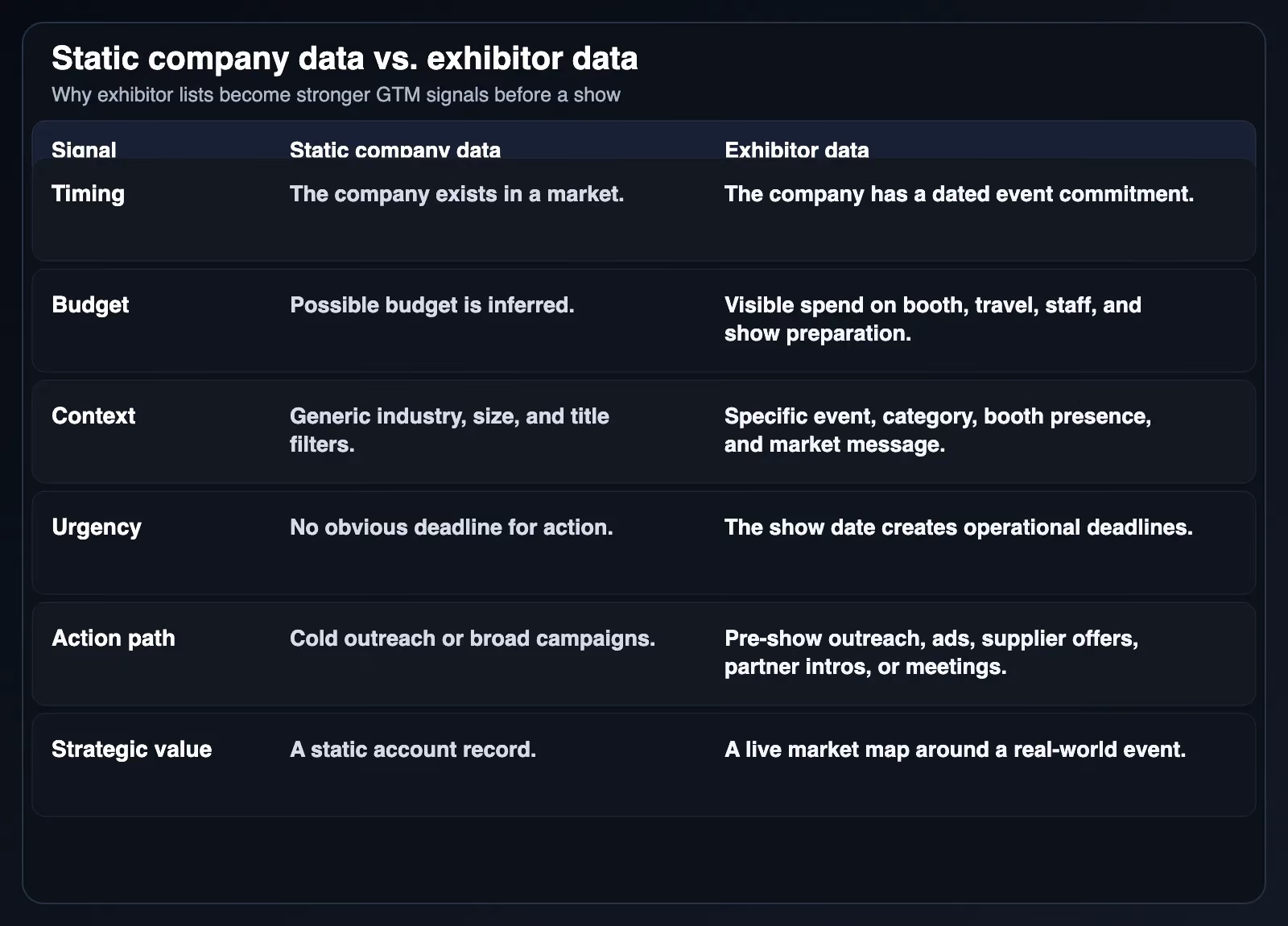
This is why exhibitor data belongs inside event intelligence.
It is not only about "who is at the show." It is about what the show reveals about the company.
How to use an exhibitor list before a trade show
The best use of an exhibitor list starts weeks before the booth opens.
The workflow does not need to be complicated. It does need to be deliberate.
1. Normalize the companies first
Start by cleaning the exhibitor list into real account records.
Remove duplicates. Match company names to domains. Preserve the original event category. Keep booth numbers, sponsorship status, and description fields. Add country, headquarters, industry, employee count, and any useful fit criteria.
This step sounds boring, but it is where most teams lose the value. If the list stays as raw event data, it remains hard to route, score, or connect to CRM history.
Pro Tip: Keep the original exhibitor category even if you add your own segmentation. The event organizer's category can reveal how the company wants the market to see it.
2. Segment by why they are exhibiting
Do not segment only by industry.
Ask what the company is likely trying to accomplish at the show. Some exhibitors are launching products. Some are recruiting partners. Some are defending an existing category. Some are entering a new geography. Some are looking for channel relationships. Some are using the booth as a credibility signal.
Those motivations change the message.
For example, a company launching a new hardware product may care about press, IP protection, demos, meetings with distributors, technical staffing, and buyer introductions. A mature SaaS vendor may care more about executive meetings, customer dinners, field marketing coverage, and competitive visibility.
Same event. Different needs.
3. Identify the people who feel the deadline
An exhibitor account is useful only if you can map it to the right people.
The person who cares about the booth is not always the same person who cares about partnerships, legal, procurement, sales meetings, or post-show pipeline. Before outreach, identify which role feels the event deadline.
For event services, that may be field marketing, event marketing, operations, or procurement. For professional services, it may be the founder, general counsel, product leader, or regional GM. For software, it may be revenue leadership, partner leadership, or marketing operations.
The event gives you timing. The role gives you relevance.
4. Build pre-show touchpoints, not generic campaigns
Once the accounts and people are mapped, create touchpoints that fit the show timeline.
That might include LinkedIn outreach, email, retargeting audiences, partner introductions, founder-to-founder notes, local meeting offers, or event-specific content. The best channel depends on your market. The point is to use the exhibitor signal as the reason for timing.
Bad outreach says, "I saw you are exhibiting at the show."
Good outreach explains why that matters.
If you sell booth services, the message should reflect installation timelines. If you sell custom gifts, it should reflect giveaway deadlines and booth traffic goals. If you sell IP services, it should reflect product launches and public disclosure risk. If you sell event analytics, it should reflect meeting quality and post-show attribution.
The event is not a personalization token.
It is the business context.

5. Decide whether to attend, advertise, or stay remote
The most underrated use of exhibitor data is event selection.
You do not need to attend every event where target companies exhibit. Sometimes the right move is to run pre-show outreach, build an advertising audience, and skip the trip. Sometimes the exhibitor density is strong enough to justify travel. Sometimes the list reveals that the event is wrong for your ICP.
I like this simple decision frame:
- Attend when target-account density is high and in-person meetings materially change conversion.
- Advertise when the audience is strong but travel is not justified.
- Outreach remotely when exhibitors are relevant but the show itself is not worth a trip.
- Ignore when the list is noisy, low-fit, or too far outside your buying context.
This is where exhibitor data becomes strategy.
It helps you stop treating events as binary decisions. The question is not only "Should we go?" The better question is "What action does this event signal deserve?"
Why this matters for founders and GTM teams
Exhibitor data helps founders see market movement before it becomes obvious elsewhere.
As a founder, I care about this because events compress a market into a physical place.
A trade show exposes who is spending, who is showing up repeatedly, which categories are crowded, which companies are moving into adjacent markets, which vendors appear near each other, and which business problems become urgent around the same deadline.
That is not easy to see from a static database.
It is also not something you get by walking the floor casually. Walking the floor is useful, but it is biased toward what you physically notice. Event intelligence lets you prepare the map before you arrive.
For a startup, that matters.
You may not have the biggest brand, the largest booth, or the largest sales team. But if you understand the event map earlier than competitors, you can pick better conversations, write sharper outreach, and decide where to spend founder time.
That is the advantage I want Lensmor to create.
Not more random names.
Better timing.
How Lensmor fits into this workflow
Lensmor turns exhibitor and attendee signals into pre-show GTM workflows.
The product is built around a simple belief: trade shows should not be treated as expensive guesses.
With Lensmor, teams can search events, discover exhibitors, understand which companies are connected to a show, predict relevant attendee signals, enrich contacts, and export the right accounts and people before the event starts. The goal is not to replace human judgment. The goal is to give GTM teams a better starting point.
For this article, the important idea is the exhibitor-first mindset.
If you can start with an exhibitor list and turn it into account context, role context, and timing context, you can build a much more precise event motion. You can also avoid shows that look impressive but do not contain the right market.
That is why I think exhibitor data deserves more attention.
It is one of the few public signals where budget, timing, and market intent appear together.
Related reading: what to do with an exhibitor list and trade show exhibitor list cleanup guide.
Conclusion
The exhibitor list is one of the most overlooked assets in B2B event marketing because it looks too ordinary. It is usually presented as a directory, so teams treat it like a directory.
But behind every exhibitor entry is a company making a public investment in a market at a specific moment. That is exactly the kind of signal GTM teams should care about.
In this Event Intelligence category, I will keep writing from that lens: how trade shows reveal market timing, how B2B teams can use event data before the show, and why the future of events is less about collecting contacts after the fact and more about understanding the market before everyone arrives.
Start Free — Start using Lensmor's event intelligence platform today. Predict attendee lists, discover relevant events, and enrich contact data for your next trade show.