
Most teams ask for the attendee list because they want to know who will be in the room.
That makes sense. If you knew every buyer attending a trade show, your sales plan would be easier.
But in real pre-show work, the phrase "attendee list" can mean several different things. Sometimes it means an organizer-provided registration list. Sometimes it means booth scans, app activity, sponsor data, exhibitor contacts, speaker names, or prospects identified from public event signals.
Those are not the same thing.
The exhibitor list is different. It is usually public, company-level, and available earlier. It does not tell you every buyer who will walk the floor, but it gives your team a reliable starting point for pre-show account planning.
The mistake is treating the exhibitor list like a finished lead list.
It is not.
It is raw material.
Short answer
An exhibitor list is the safest first layer for pre-show planning. It shows which companies are officially showing up, and it is usually public, company-level, and available before the event.
An attendee list can be useful, but the label needs context. It may refer to people registered for the event, people scanned at a booth, people active in an event app, or contacts and prospects identified through other signals.
For Lensmor, the practical workflow is to start with confirmed exhibitor data, then expand the view into relevant people and prospects where the source is clear. Lensmor's Attendees view includes exhibitor contacts and additional prospects identified from public event signals. That gives sales a more useful pre-show working list without pretending every person came from a private official attendee export.
Why exhibitor lists are easier to use before the show
Exhibitor lists usually appear weeks or months before the event.
That matters for shows like IMTS 2026, Automation Taipei 2026, SEMICON Taiwan 2026, PPMA Show 2026, and PACK EXPO International 2026, where the account universe gets big fast.
If your team starts early, you can use the exhibitor list to answer practical questions:
That is useful even before you have a clean person-level view.
Why raw attendee lists are not a safe default
Attendee data can help, but teams need to be careful about what they mean by "attendee list."
Some event organizers do not share attendee exports. Some only share partial app activity. Some attendee access is tied to sponsorship packages. Some teams mix together badge scans, booth visitors, speaker lists, exhibitor staff, LinkedIn activity, and registration data as if they are one clean source.
That creates two problems. First, the list may not be complete. Second, usage rights may not be clear.
A safer approach is to label the source. Is this person connected to an official exhibitor? Was the company confirmed from the event directory? Was the prospect identified from public event signals? Is the contact path LinkedIn, company website, or a verified business email workflow?
That source clarity matters more than the label "attendee."
Where Lensmor's Attendees view fits
Lensmor does not treat "attendees" as a magic private buyer list. The Attendees view is a working prospect layer built from clear sources.
For example, a sales team can start with the official exhibitor list, then review people connected to those companies and additional prospects identified from public event signals. The team can filter by source, job title, management level, department, LinkedIn activity, contact availability, and confidence.
That makes the list more useful without overstating the data. Sales can see who may be relevant, why they were included, and which path is appropriate for review.
The useful question is not "Do we have every attendee?" It is "Which companies and people are credible enough for sales to review before the show?"
The real problem is prioritization
Most teams do not fail because they have zero data.
They fail because the list is too broad to act on.
An exhibitor directory can include:
If all of those rows sit in one spreadsheet, sales will either overwork the wrong accounts or ignore the list completely.
The goal is not to make the spreadsheet bigger.
The goal is to make it usable.
What to do with an exhibitor list in the first week
Most teams do not need a bigger export.
They need a first pass that sales can react to.
The first week should usually look like this:
1. Pull the official exhibitor list. 2. Narrow it to one product lane, region, or buyer motion. 3. Mark ICP fit, match score, buying signals, and data completeness for the first review batch. 4. Return a 10 to 30 company shortlist with a suggested contact path instead of handing sales the whole directory.
That is the point where the list stops being event admin data and starts becoming GTM material.
A better workflow: turn the list into a pre-show target account list
Start with the official exhibitor list, then review it through five filters.
1. ICP fit
Does the company match the customer profile you are trying to reach for this event?
For a manufacturing sales team, that might mean machine tool companies, automation integrators, packaging equipment vendors, motion control suppliers, machine vision firms, or regional distributors.
For a semiconductor team, it might mean equipment, materials, testing, inspection, factory automation, or advanced packaging vendors.
If the ICP is not clear, the event list will stay noisy.
2. Match score
A match score should not be magic.
It should explain why a company belongs near the top of the list.
Useful scoring inputs include product relevance, industry fit, region, company type, event role, public source quality, and whether the account has a plausible buying or partner path.
If a score cannot be explained in plain English, sales will not trust it.
3. Buying signals
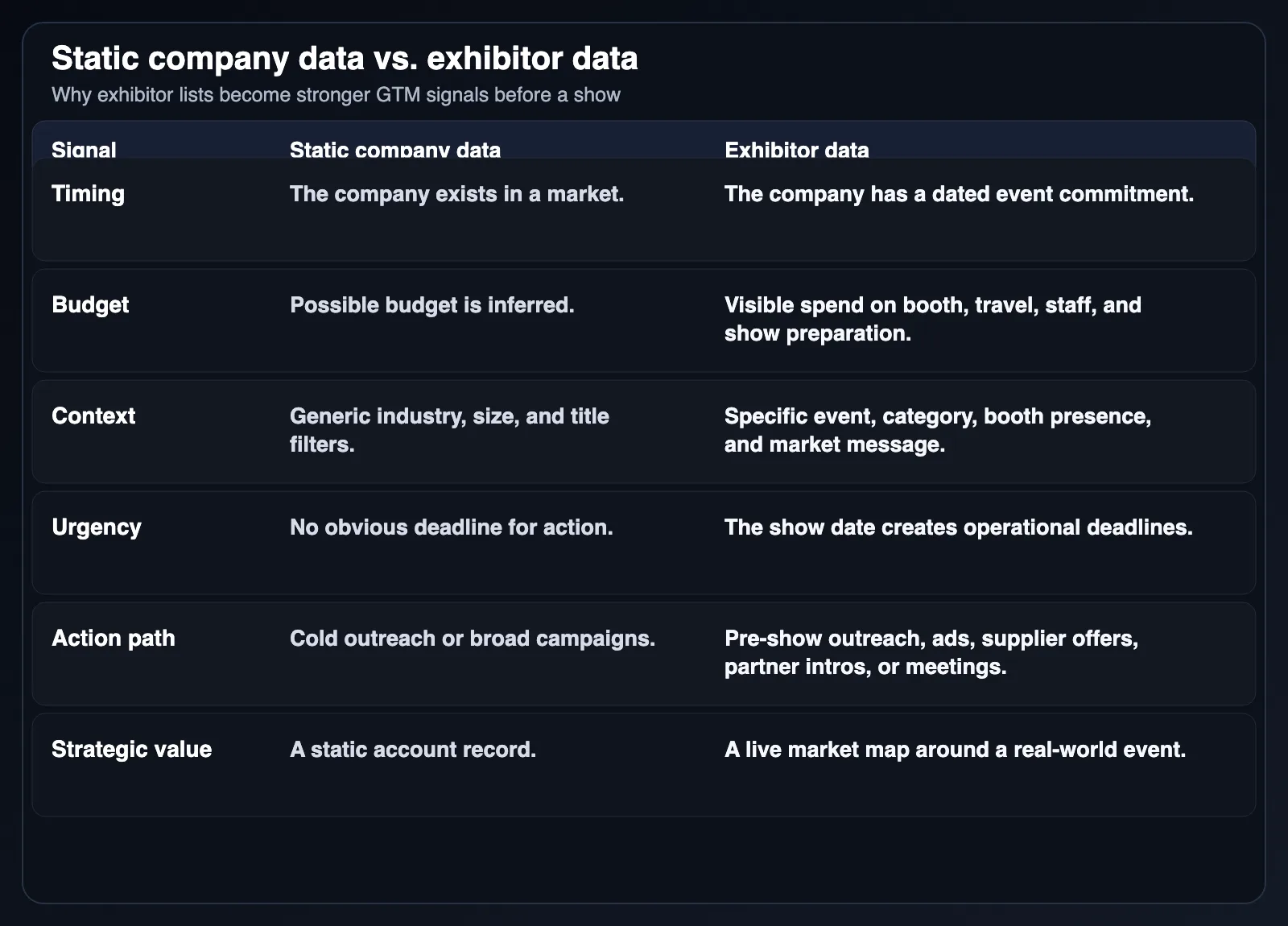
Exhibiting is already a signal. The company is spending money to be visible in a specific market.
But not all exhibitors have the same value for your motion.
Look for signals such as:
These signals do not prove intent by themselves. They help decide which accounts deserve review first.
4. Data completeness
Some rows are too thin to use immediately.
Before sales touches the list, mark what is missing:
This is boring work, but it prevents a lot of bad outreach.
5. Contact path
The right output is not "email this person now."
The better output is:
For example:
> Regional sales or channel lead. Fit reason: packaging inspection and traceability product line overlaps with food and pharma manufacturers. Contact path: company contact page or LinkedIn company page. First angle: post-show shortlist for packaging line upgrade accounts.
That is more useful than a raw row with a company name and no context.
Exhibitor list vs attendee list
QuestionExhibitor listAttendee listWhat does it show?Companies exhibiting at the eventPeople registered, attending, scanned, connected to exhibitors, or identified from event signalsWhen is it usually available?Often before the showOften restricted, partial, sponsor-gated, or assembled from multiple sourcesBest usePre-show account research and prioritizationMeeting planning, booth follow-up, contact review, and CRM matching when source and rights are clearMain riskTreating every exhibitor as a leadAssuming person-level data is complete, official, or allowed to useLensmor stanceBest starting point for company-level research and account prioritizationUseful when the source and usage rights are clear. Lensmor's Attendees view includes exhibitor contacts and additional prospects identified from public event signals, not a guaranteed private organizer export
What this looks like in practice
Imagine your team is preparing for a manufacturing or automation event.
The raw list has hundreds or thousands of companies. Instead of asking sales to start from the whole directory, you build a reviewed shortlist:
Then you can add a people layer where the source is clear:
Now the team can make decisions.
Who goes into the first review batch?
Who belongs in the sample?
Who should be held for a later segment?
Who is not worth the team's time?
That is the difference between a list and a pre-show pipeline.
Where Lensmor fits
Lensmor helps sales teams turn event data into a pre-show working list.
The workflow starts with confirmed exhibitor data, then adds structure: ICP fit, match score, buying signals, company type, source, contact path, and confidence notes. From there, Lensmor can surface relevant people through its Attendees view, including exhibitor contacts and additional prospects identified from public event signals.
That means the team is not stuck with two bad options: waiting for a perfect attendee list, or handing sales a giant exhibitor spreadsheet. They get a reviewed account and prospect view that is clear enough to act on.
Lensmor's value is not claiming to own every attendee at an event. The value is helping the team decide which companies and people are worth reviewing before the show, while there is still time to plan outreach, meetings, and follow-up.
If you want to see what this looks like for one upcoming event, request a sample and Lensmor can turn one exhibitor list into a reviewed account and prospect view.
Related reading: what to do with an exhibitor list and how to find buyers before a trade show.