You spent two weeks reaching out to a VP of Sales at your target account. They confirmed they'd be at the show. You booked a 30 minute slot. You flew across the country. You stood at the booth. They never showed up.
If this hasn't happened to you yet, give it a few more shows.
The Phantom Attendee Problem Nobody Talks About
Trade show organizers love to publish big attendance numbers. 10,000 attendees expected. 5,000 already registered. But here's the thing the marketing materials don't tell you.
Registration counts should not be treated as guaranteed attendance. No-show rates vary by event format, ticket price, travel requirements, timing, and organizer policies.
Free or low-friction registration generally creates weaker commitment than paid or invite-only formats, so outreach teams should prioritize recent engagement signals instead of assuming every registration will convert into attendance.
Many teams discover the gap only after building outreach lists and pre-booking meetings. Some carefully targeted contacts will not materialize, so the plan needs backup accounts and confirmation signals.
The operational lesson is simple: treat registration as one signal, not proof of attendance. Reconfirm meetings close to the event and maintain a ranked backup list for cancellations and no-shows.
Why So Many Registrations Turn Into Ghosts
Four things explain most of the no-show pattern.
Registration Is Almost Free
For most B2B shows, registering takes 90 seconds and costs nothing. There's no real commitment. People register because a vendor sent them a free code, or because a colleague mentioned it in Slack, or because they were curious about the speaker lineup. None of that means they're actually planning to attend.
Work Gets in the Way
Even people who fully intended to go often can't make it. A board meeting moves. A customer escalation lands on Monday morning. A family thing comes up. Trade shows are usually the first thing to drop when something else lands on the calendar.
Employer Mandates Don't Equal Engagement
A lot of registrations come from people whose company bought a booth or sponsored a session, so the manager said "go register." These attendees often skip half the days, leave early, or just stop by their own booth and never walk the floor where you're set up.
Hybrid Events Made It Worse
After 2020, a lot of shows started offering hybrid attendance. People register to keep their options open and then opt for the virtual stream once they realize they can't justify the travel. From a booth perspective, those people might as well not exist.
How to Tell Who's Actually Going to Show Up
You can't predict perfectly. But there are signals that separate real attendees from ghosts.
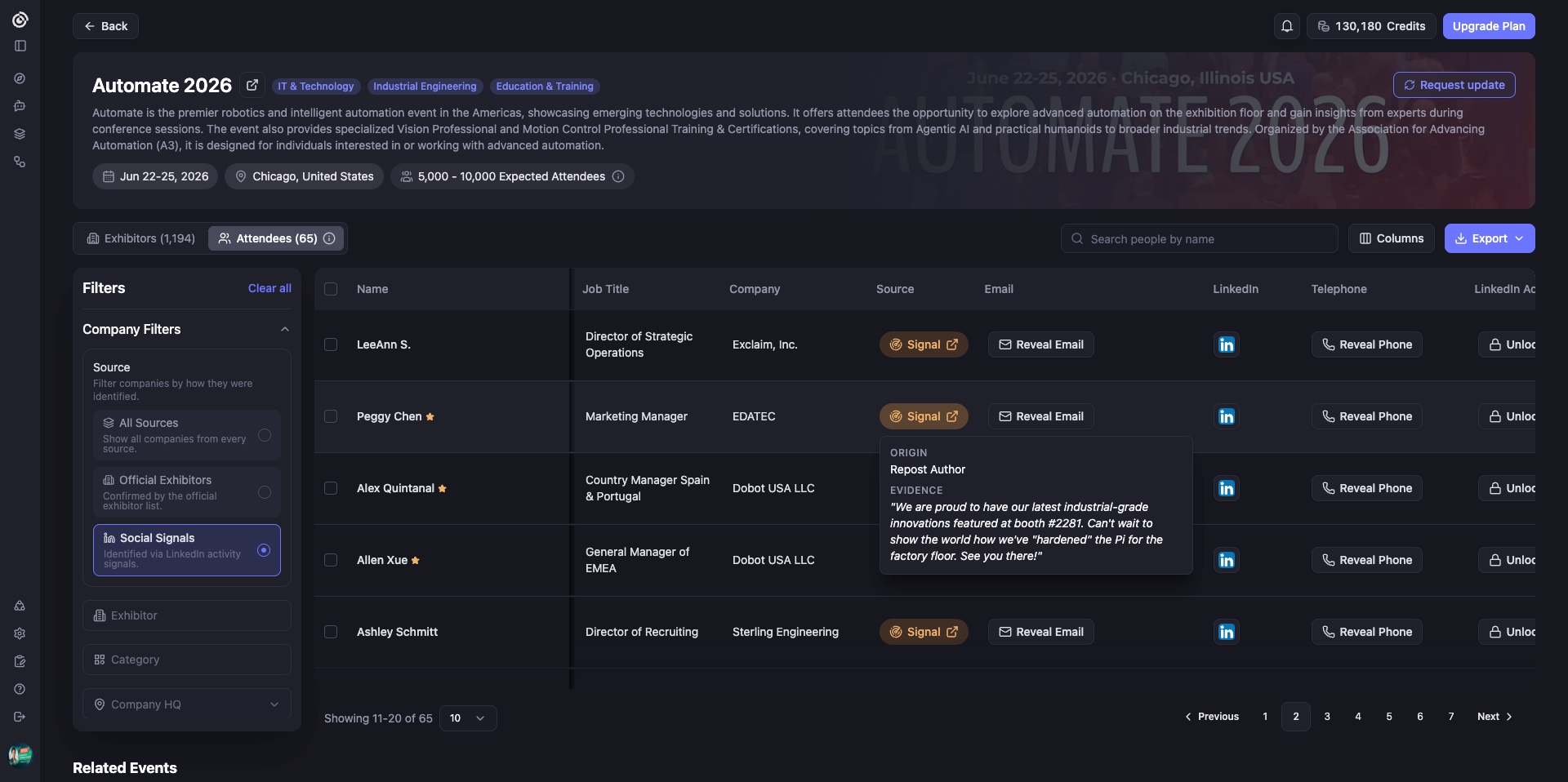
Recent LinkedIn Activity About the Event
People who are genuinely planning to attend usually mention it somewhere. They post about looking forward to a session. They comment on the show's announcement post. They share the schedule with a "see you there" caption. If someone registered six months ago and has said nothing about the event since, that's a weak signal.
Travel Patterns From Past Shows
If someone attended the same show last year, or attended similar industry events in the past 12 months, they're significantly more likely to actually show up this year. A first-time registrant from a company that's never sent anyone before is much more likely to be a phantom.
Title and Travel Reality
Senior people can actually be more reliable attendees in some cases, but only when they have clear business reasons to be there. A VP of Sales attending a customer-facing event in their territory? Probably going. The same VP registered for a general industry conference across the country with no scheduled speaking role? Coin flip.
Booth Engagement Pre-Show
Some shows let you see who's bookmarked your booth, requested meeting slots through the official app, or registered for specific sessions. These are warm signals. Someone who took the time to add your booth to their schedule is far more likely to show up than someone who didn't.
What to Actually Do About Phantom Attendees
You have three options. Most teams pick the wrong one.
Option 1: Ignore It and Hope for the Best
This is what most teams do. They build their pre-show list assuming everyone on it will show. Then they're shocked when half their meetings fall through. They have no backup plan for the gaps in their schedule, no way to recover that booth time, and no insight into why their trade show ROI is so unpredictable.
Don't do this.
Option 2: Over-Book Aggressively
Some teams build a target list two to three times larger than they can realistically meet, assuming half won't show. The problem is when the no-show rate is lower than expected, you end up double-booked and ghosting half the people who did show up. That's worse than the original problem because now you're burning relationships with people who actually made the effort to attend.
Option 3: Verify and Prioritize
The teams getting consistently strong ROI from trade shows do something different. They take their initial pre-show target list and run a second pass for show-up signals. They flag the high-confidence attendees and book confirmed meetings with those people first. They flag the low-confidence ones and send a different kind of outreach, something like "are you still planning to attend? Let me know if your plans have changed."
A simple LinkedIn message two weeks before the show often shakes out the phantoms. The ones who reply with enthusiasm are showing up. The ones who go silent or say "actually, I'm not sure I can make it anymore" are phantoms you would have flown across the country to miss.
The Real Cost of Not Filtering Phantom Attendees
Let's run the math on a typical $10K trade show investment.
You build a pre-show target list of 50 high-fit attendees. You spend roughly 6 hours per team member on personalized outreach. You book 18 meetings going into the show.
If 35% of your booked meetings are phantom attendees, which is the realistic rate without verification, you actually have 12 real conversations. That's 6 wasted meeting slots, each representing 30 to 40 minutes of dead time on your booth schedule, plus the email cycles and prep work that went into setting them up.
Those 6 dead meetings represent maybe 4 to 5 hours of wasted effort across your team. Time you could have spent on additional walk-up conversations or on warmer prospects who actually showed up.
If you verify before the show and filter your list to high-confidence attendees only, you might book fewer meetings, say 14 instead of 18. But 12 of them happen. Your effective meeting count is identical, and you've recovered hours of pre-show prep time and on-the-floor scheduling flexibility.
The Bigger Lesson
Trade show ROI isn't about how many people you contacted before the show. It's about how many real conversations you had during the show. Phantom attendees inflate your pre-show metrics while quietly killing your actual results.
Most teams optimize for the wrong number. They report "we reached out to 200 people" or "we booked 20 meetings" without ever checking how many of those people physically walked into the building.
The teams that win trade shows learn to ignore the raw registration list and pay attention to the attendance signal instead. That shift, from "who's registered" to "who's actually coming," is one of the most underrated levers in B2B trade show strategy.
Related reading: how to prioritize likely trade show attendees and trade show intelligence guide; also see the complete trade show ROI framework.