
Trade show ROI usually does not break at the booth.
It breaks weeks earlier, when the team still has a long exhibitor list, no ranked account queue, no clear meeting targets, and no CRM fields that explain why each conversation matters.
By the time the show opens, the damage is already visible. Sales walks the floor cold. Marketing waits for badge scans. Follow-up gets pushed into the week after the event. Leadership asks what came from the spend, and the team has activity, names, and anecdotes, but not enough proof.
The problem is not that events are useless. A good trade show still puts buyers, partners, distributors, suppliers, competitors, and market signals in one physical space. That is hard to replace with ads or cold email.
The problem is narrower.
Many teams do not have a pre-show sales motion. They have lists. They do not have a reviewed queue of the 10 to 30 accounts that deserve real attention before the floor opens.
That is the pre-show pipeline gap.
The list is not the plan
Most event preparation starts with a list.
It might come from an exhibitor directory, sponsor page, conference app, floor plan, internal CRM, LinkedIn search, distributor database, or a manually built spreadsheet. Those sources are useful. They are not a sales plan.
A list tells the team who exists.
A plan tells the team who deserves time.
That difference matters because trade shows compress attention. Sales only has a few days on site. Executives have limited calendar slots. Founders cannot chase every promising name. Field marketers cannot fix weak account selection after the booth is already busy.
When the list stays unranked, teams usually fall into one of three patterns.
They walk the floor and hope the right people appear.
They send generic outreach to too many companies too late.
Or they wait for badge scans and try to sort the mess after the event.
All three create activity. None of them reliably create a defensible pipeline story.
The better pre-show question is simple:
Which companies should we review before the show, and what is the reason to contact each one?
Once a team can answer that, the event starts to look less like a booth expense and more like a focused sales campaign.
Where trade show ROI breaks
Trade show ROI rarely fails because one single thing went wrong. It usually breaks across a chain of small misses.
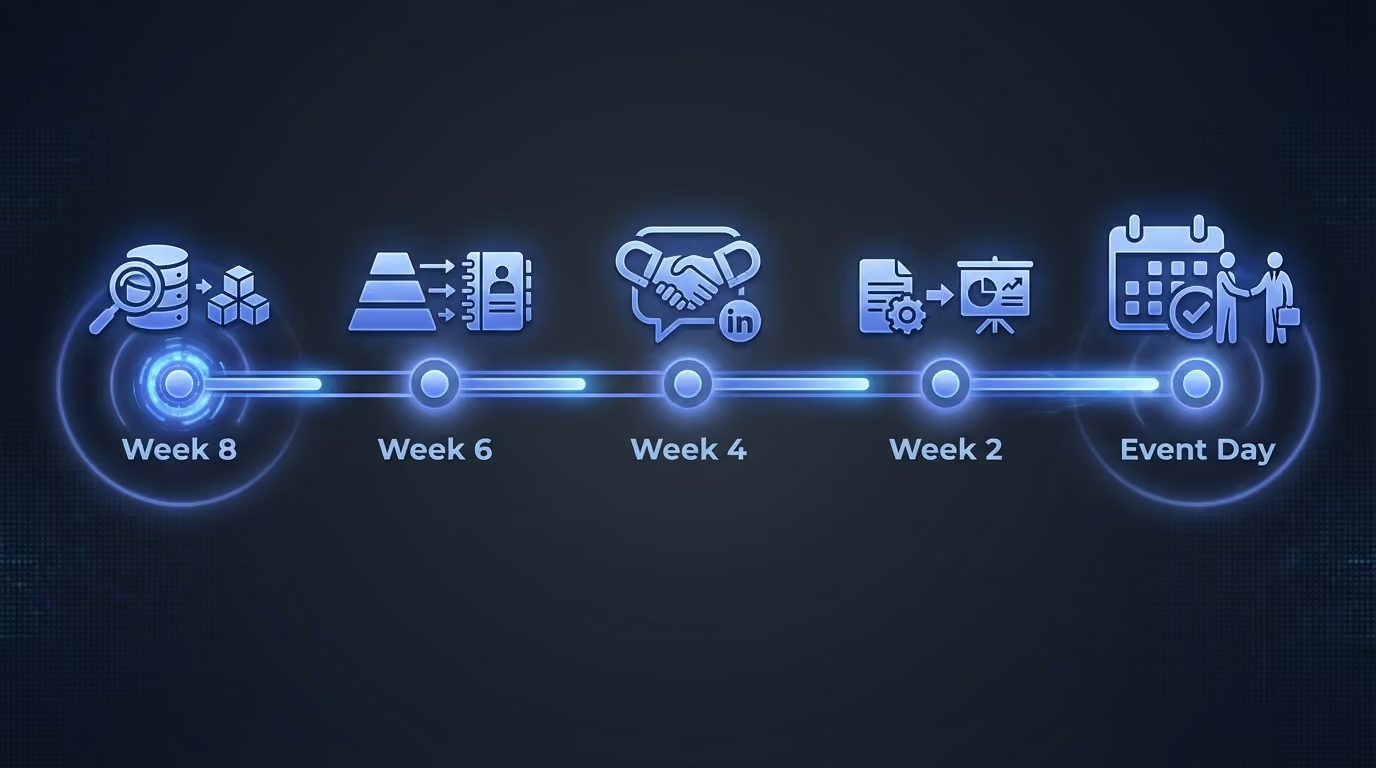
The event was selected because it was familiar, not because the target account pool was clear.
The exhibitor list was collected, but not scored.
Sales was asked for input, but too late.
Outreach started close to the event, so messages sounded generic.
Booth conversations were logged, but not connected to the pre-show account logic.
The CRM received leads, but not enough context.
By the time leadership asks what came from the event, the team has names, stories, and maybe a few meetings. What it often lacks is a clean record of intent:
- We selected these accounts before the show.
- We selected them for these reasons.
- We tried these contact paths.
- These rows were blocked because the evidence was weak.
- These meetings, samples, proposals, or follow-ups came from that original queue.
That record is what makes event ROI easier to defend.
Without it, the team is left reconstructing value from memory.
Start with accounts, not attendees
Many event teams want better attendee visibility. That is understandable. If you know which people will attend, you can plan meetings earlier and forecast more clearly.
But most teams should not wait for perfect attendee-level data before they build a pre-show motion.
In many industries, the account layer is enough to start.
For manufacturing, packaging, semiconductor, medical technology, industrial automation, food processing, and B2B equipment markets, public company-level signals can already answer useful questions:
- Is this company relevant to the event?
- What does it sell, buy, distribute, or influence?
- Which product line or market segment makes it interesting?
- Is it more likely to be a buyer, supplier, distributor, integrator, OEM, or partner?
- Is there a public route to start a conversation?
- Is the evidence strong enough for sales to act?
This account-level work is not glamorous. It is where a lot of event value is won.
If a team can turn 500 raw names into 30 reviewed accounts, it has already made a sales decision before anyone arrives at the venue.
Meetings are the cleanest output
Trade shows can create many kinds of value: brand visibility, competitive learning, partner discovery, customer trust, analyst conversations, and market education.
Those are real. They are also hard to measure cleanly.
For sales-led and founder-led teams, meetings are the cleanest output.
A meeting has an account, a person or role, a reason, a time, an owner, and a next step. It can be reviewed before the show and followed after the show. It can also be separated from weaker activity like casual booth traffic or low-intent badge scans.
That is why pre-show preparation should optimize for reviewed meeting opportunities, not raw contact volume.
A team does not need every possible account. It needs a short queue of accounts where the meeting ask makes sense.
For each account, the team should be able to say:
- Why this company?
- Why this event?
- Why now?
- Why would this person or role care?
- What is the next step if they say yes?
If the answer is vague, the account should not be in the first wave.
What a pre-show account queue should include
A useful pre-show account queue is small, specific, and reviewable.
It should include enough context for sales to act, but not so much that the team gets buried in research.
At minimum, each row should include:
This structure forces discipline.
If the fit reason is weak, the row gets downgraded. If the contact path is unclear, the row becomes verify-first. If the first angle sounds like a template, it needs more work. If the risk note is serious, the row should not be pushed into an outreach sequence.
That is how a team keeps speed without pretending every record is ready.
Example: ProPak Asia as a manufacturing workflow
ProPak Asia is a useful example because the event brings together companies with clear B2B sales motions: packaging machinery, processing equipment, filling and capping lines, inspection systems, weighing equipment, coding and traceability, adhesive systems, and end-of-line automation.
For a packaging or manufacturing equipment company, the raw event surface is large. The practical sales queue should be much smaller.
The first question is not: Who is attending?
The first question is: Which companies should we review before the show because they match our buyer, distributor, integrator, or partner motion?
A pre-show queue for this type of event might separate accounts into practical groups:
The output is not a claim that every account will reply.
The output is a reviewed first wave: 10 to 30 companies where the meeting ask has a reason behind it.
That is a better starting point than a huge list that nobody trusts.
The CRM problem starts before the CRM
Many event attribution problems start before anything enters the CRM.
If the team only adds trade show as a lead source after the event, it loses the details that explain why the account mattered.
The CRM should capture event context early:
- event name
- event year
- source list
- ICP segment
- fit tier
- fit reason
- recommended role
- contact path
- outreach status
- booth visit status
- sample requested
- next step
- owner
- risk note
This does not require a complex system. A spreadsheet, HubSpot list, or CRM import can handle the first version if the fields are clear and the team uses them consistently.
The point is not to create more admin work.
The point is to stop the event from disappearing into a generic lead source after the team has already done the account work.
What high-readiness teams do differently
High-readiness teams do not wait for the show floor to decide who matters.
They separate jobs that often get mixed together:
- Data gathering
- Account prioritization
- Outreach or meeting execution
That separation matters.
A raw list is not a priority list.
A priority list is not an approved outreach campaign.
An approved outreach campaign is not a promised meeting outcome.
Good teams build review gates:
- Research gate: Is the account real and relevant?
- Fit gate: Does it match the ICP for this event?
- Contact gate: Is the route usable and approved?
- Message gate: Is the angle specific enough?
- Approval gate: Has a human approved external action?
- CRM gate: Will the event context survive after the show?
This may sound slower than pushing every row into a sequence.
In practice, it saves time because sales spends less energy on bad-fit accounts and post-event reporting becomes less chaotic.
What not to claim
The event intelligence category has an obvious risk: overclaiming.
Teams should avoid saying:
- We have the attendee list, unless they truly have an approved, lawful source.
- We can promise meetings, unless the business model actually supports that promise.
- We can identify every buyer at the show, because that is almost never true.
- We automate outreach end to end, if human approval is still required.
- This list proves ROI, before replies, meetings, proposals, or revenue exist.
The stronger claim is simpler:
We can help turn one event into a reviewed pre-show account queue.
That is believable. It is useful. It is also much easier to deliver.
How Lensmor handles it
Lensmor's single-show ICP meeting package is built for teams preparing for one important event.
For one show, Lensmor can help prepare:
- 50 to 100 scored target companies
- 10 to 30 priority accounts
- fit reasons for each priority row
- recommended roles or contact paths
- first outreach angles
- QA notes for weak or risky rows
- HubSpot-ready fields
- a walkthrough before the team acts
This is not an attendee list.
It is not a promise of replies or meetings.
It is not an auto-send workflow.
It is a way to turn an event into a reviewed sales queue that the team can use before, during, and after the show.
Try it on one show
If your team is preparing for one important trade show, start with one scoped package.
First event: $199
Second and later events: $499 per event
Typical output:
- 10 to 20 account sample for the first review
- 50 to 100 scored target companies in the full version
- 10 to 30 priority accounts
- fit reasons
- recommended contact roles or paths
- first outreach angles
- QA notes
- HubSpot-ready fields
- walkthrough before external action
Request a sample review or send one show you care about.
The teams that get more from events are not always the teams with the biggest booth or the longest list.
They know which accounts matter before the event starts.
Related reading: how to prove trade show ROI before the event and trade show ROI measurement framework.