3D visualization providers can find relevant trade show prospects by starting with industrial exhibitors, checking whether their products need visual explanation, and identifying the sales or marketing leaders responsible for that explanation. The event provides a reason to start a conversation. Product fit determines whether the conversation is worth having.
This anonymized case follows a 3D product visualization provider that had tried Lensmor, filtered contacts, and found a useful shortlist. Its next question was practical: what should the team do with those contacts?
The company, people, events, commercial terms, and identifying schedule details have been removed. The record supports a trial experience and a demonstrated outreach workflow—not a claim about purchases, booked meetings, revenue, or improved conversion. The operating recommendations below are identified separately from what the team reported.
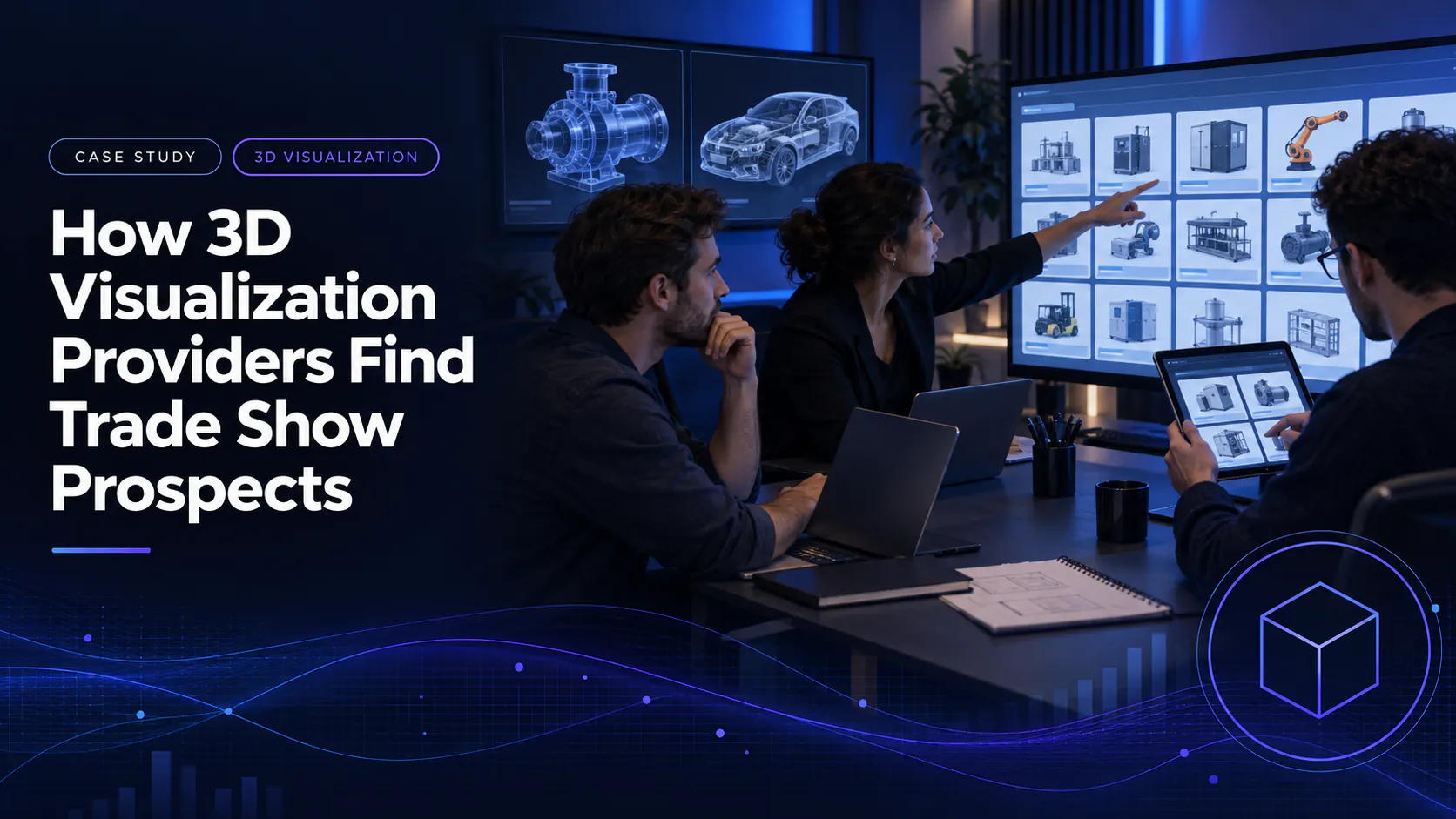
Images illustrate the workflow; they do not depict the company or its employees.
What made this provider's prospecting problem different?
The team needed buyers with a complex product to explain. Its offer used existing 3D assets to help manufacturers present products through interactive experiences. Sales enablement and marketing were the main applications discussed.
That creates a narrower prospect profile than “any company with a booth.” The team described manufacturing and automotive businesses as relevant targets, with senior sales and marketing leaders as the people it wanted to reach. A broad exhibitor export would still require substantial qualification.
The team already sourced email contacts elsewhere and had email outreach underway. It was evaluating an additional route to relevant exhibiting-company representatives through LinkedIn. In its experience, that channel helped people identify one another and discuss meeting at an event. That was the team's reported experience, not a benchmark for every visualization provider.
The cost of an unfocused list is easy to model without inventing case results. For an illustrative planning example, 12 hours of research at an assumed internal cost of $50 per hour equals $600. If only six accounts qualify, research costs $100 per qualified account; if 12 qualify within the same effort, it costs $50. Neither scenario was measured in this case. Use your own labor cost and qualification definition before deciding whether a workflow is economical.
How do you identify manufacturers that fit a 3D visualization offer?
Qualify the product before enriching the person. In this case, complex products and existing 3D assets were part of the stated target profile. Those conditions help separate a plausible buyer from a company that simply happens to exhibit.
An industrial assembly, configurable machine, or product with hidden internal components gives a seller a concrete reason to investigate. But an interesting product does not prove an available project. The account still needs a relevant communication problem, a person responsible for it, and a workable next step.
Treat the following as an editorial qualification framework derived from the stated requirements, not as a checklist the company is documented to have completed:
Don't infer asset availability just because a manufacturer uses engineering software. Ask whether suitable assets can be shared for a commercial demonstration. That question belongs in discovery, not in a claim that a research tool has already verified readiness.
Pro Tip: Record “asset readiness unknown” as a valid status. It is more useful than quietly treating every technically sophisticated manufacturer as ready to buy.

How do you turn an exhibitor contact into a relevant conversation?
A relevant role is the starting point for contact selection. The demonstrated workflow began with an event, then narrowed exhibitor-associated contacts by seniority, title, and keywords. Relevant profiles could be reviewed individually or exported with available LinkedIn URLs.
For this provider, senior sales and marketing roles mattered because the commercial use case was explaining complex products. A technically impressive contact might understand the product well without owning its sales presentation. Conversely, a senior marketing title alone would not establish a need for 3D visualization.
The demonstration also included checking recent LinkedIn activity to help prioritize outreach. Use that signal narrowly. Recent activity can suggest that a channel is worth trying; it cannot establish project intent, budget, or attendance. An inactive profile is not proof that the person is unreachable through another appropriate channel.
Our recommended record connects the contact to the account-level hypothesis: what the company makes, why visual explanation might matter, which role is relevant, and what still needs confirmation. That gives the seller something better than an isolated name and URL.
The distinction between a company exhibiting and a person attending matters here. A manufacturer's presence at a show does not prove that its marketing director will be onsite. Ask about plans rather than opening with an unsupported statement about the recipient's calendar.
Pro Tip: Write the reason for contacting an account in one sentence before drafting the message. If that sentence could apply to every exhibitor, the research is not specific enough.

Why does manual message review matter?
Generated copy still needs a seller's judgment. In the demonstration, message generation used inputs such as company activity, outreach purpose, tone, and an optional meeting link. The workflow included reviewing supporting sources and editing the draft before sending.
The team specifically asked whether LinkedIn outreach and follow-ups were automatic. The answer in the recorded demonstration was no: sending connection requests, messages, and follow-ups remained manual. This case does not establish automated LinkedIn sending, a live browser extension, or a completed CRM integration.
A useful message connects a verified company fact to a modest question. For example, a seller could refer to a publicly described industrial product and ask whether explaining its internal operation is part of an upcoming demonstration. That is an editorial example, not a message from the source record.
Avoid claiming to know a prospect's budget, dissatisfaction, attendance, or technical assets. Even a plausible assumption can make an otherwise relevant message feel careless. A short question is a better way to confirm the missing fact.
Choose the product example carefully too. A generic showreel may demonstrate visual quality without answering whether the provider understands the manufacturer's selling problem. A relevant example should make the intended use easy to discuss without implying an existing client relationship.
Pro Tip: Keep two separate fields in your outreach notes: “verified context” and “question to validate.” Use the first to establish relevance and the second to invite a response.

How should the shortlist move into the existing sales process?
Preserve the reason an account was selected. The team already had a CRM and a separate email-sourcing workflow. The case was therefore about adding useful event context, not proving that every existing system needed replacement.
Export was part of the discussion. A specific CRM integration remained a request for technical review, rather than a verified live capability. The practical lesson is to test the handoff itself before relying on a promised integration: can the seller retain the event, account fit, contact role, source, and next action?
For a first test, choose a small enough set of accounts that a person can inspect every record. Check for duplicates against ongoing outreach so that a LinkedIn conversation does not collide with an unrelated email sequence. Assign an owner before anyone starts sending.
Then update the record when the prospect responds. A reply confirming interest in a product demonstration is different from a polite connection acceptance. A meeting request is different from a meeting held. Useful stage definitions stop a promising conversation from becoming an exaggerated result in the next report.
What should another 3D visualization provider measure?
Measure whether research produces qualified conversations. The source record does not supply campaign results, so the right takeaway is a testable workflow rather than a performance promise.
Begin with the number of accounts reviewed and the share that pass your product-fit check. Track whether relevant roles can be identified, whether asset readiness is confirmed, and whether prospects agree to discuss a specific commercial use. These are recommended measurements, not reported achievements.
Keep effort visible alongside activity. A large list is not valuable if the team cannot inspect or follow up with it. Nor is a fast export valuable if the contacts have no responsibility for product communication.
For outcome measurement, distinguish responses, qualified discussions, meetings held, proposals, and won work. Record the actual project economics before calculating ROI. Do not count the full value of every tentative project as revenue attributable to an event.
Start with a product-fit hypothesis, not a larger list
This case began with a useful shortlist and an unanswered question about the next action. Its strongest lesson is to connect event context, product complexity, the right commercial role, and a manually reviewed conversation.
For your next event, select a small group of manufacturers and document why each could need your offer. Validate the missing facts with the prospect before scaling outreach. Lensmor can support the event and contact research; the sales team still has to establish project fit.
Start Free Trial — Start using Lensmor's event intelligence platform today. Predict attendee lists, discover relevant events, and enrich contact data for your next trade show.