
A trade show report claims $200,000 in influenced pipeline. A dinner report claims $260,000. The quarterly presentation adds them together and announces $460,000. Yet the CRM contains only $260,000 in distinct opportunities connected to those events. Both event reports can be correct; the portfolio total is wrong.
Event marketing attribution assigns credit for a defined outcome to recorded event interactions under a stated set of rules. For a B2B team, the outcome might be opportunity creation, progression, or a closed-won deal. Before choosing a first-touch or multi-touch model, decide what qualifies as an interaction, which opportunity it belongs to, and how overlapping claims will be counted.
The worked example below reconciles those three totals. Its numbers are hypothetical, so you can audit the arithmetic and apply the same method to your own CRM.
Separate opportunity coverage from allocated credit
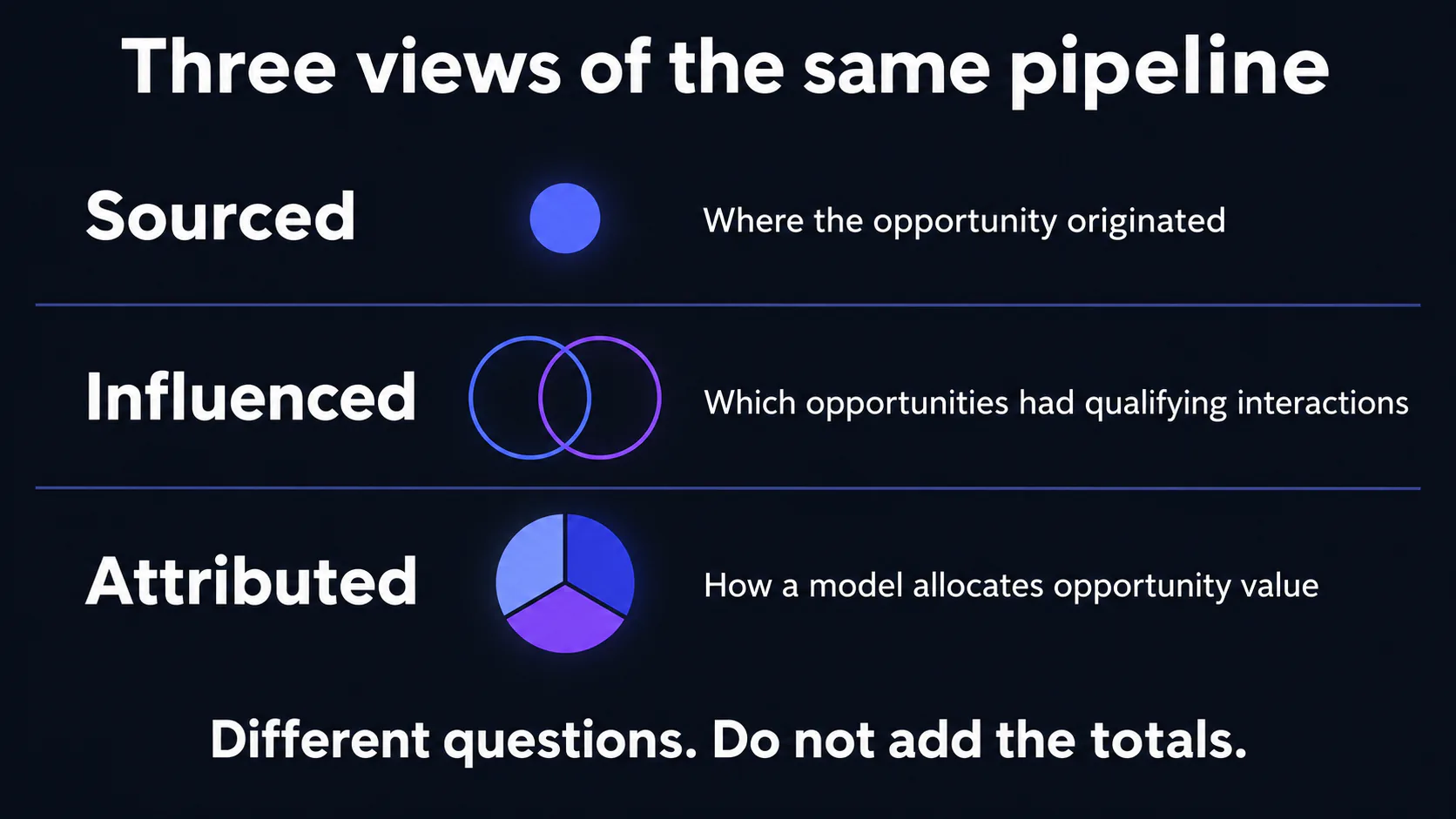
The phrase “event pipeline” often hides several different measures. Put the definition beside the number before comparing events or requesting next year's budget.
Here, “influenced” means an eligible, documented relationship. It does not establish that the event caused the opportunity. Similarly, attributed closed-won value is a marketing reporting measure; it is not automatically recognized accounting revenue.
Sourced and influenced measures can overlap. A trade show that originates a deal may also qualify as an influence on it. Keep both views if they answer useful questions, but do not add sourced pipeline to influenced pipeline and call the result total contribution.
Start with the business decision. A new-market program may be evaluated on qualified opportunities it originates. A customer dinner may aim to advance an existing buying process. The same source-only score would miss that dinner's purpose. Define the outcome when setting trade show goals, before anyone sees the results.
Capture the opportunity baseline before the event
A post-event CRM export tells you what exists now. It may not tell you whether an opportunity was already in negotiation before the booth opened.
Save a dated baseline of relevant opportunities before the event: opportunity ID, account ID, product or buying initiative, creation date, stage, amount, currency, expected close date, accepted source, and associated buying contacts. If several events run close together, keep a baseline for each one. That makes it possible to distinguish a new opportunity from an existing opportunity that progressed after a meeting.
At the event, record what happened separately from when someone entered it. A conversation on September 10 uploaded on September 17 is a September 10 interaction. Preserve both timestamps so a late import does not rewrite the buyer journey.
The minimum useful interaction record connects an event ID, a person, an account, an interaction type, its actual date, and evidence. A completed meeting with an owner and notes offers different evidence from a registration. Add an opportunity ID when the buying initiative is identifiable; otherwise leave the interaction available for review rather than attaching it to every open deal at that account.
Registration is not proof of a sales conversation
CRM associations need to be checked against your reporting policy. Salesforce documents that Customizable Campaign Influence considers campaign members regardless of member status. It also describes a Primary Campaign Source model that assigns all credit to the campaign in that opportunity field. Those are system rules, not a finding that a participant attended or that the campaign caused the deal. Salesforce's model documentation is useful when investigating an unexpectedly large total.
HubSpot likewise allows registered and attended marketing event interactions to be enabled for attribution. Its documentation says marketing event revenue attribution requires Marketing Hub Enterprise and describes credit for event interactions by contacts associated with closed-won deals. Check which interaction types your portal includes before presenting the output as evidence of attendance. See HubSpot's marketing event guidance.
For an in-person sales program, a reasonable starting policy is to require a held meeting or a documented conversation relevant to the opportunity. Registrations and badge scans can remain engagement measures without automatically earning pipeline credit. This is a proposed operating rule, not a universal CRM default.
Practical tip: Keep an exception queue for interactions missing a contact association, buying initiative, or event timestamp. Fix the underlying record instead of assigning credit to whichever account match appears first.
Reconcile two events against one opportunity list
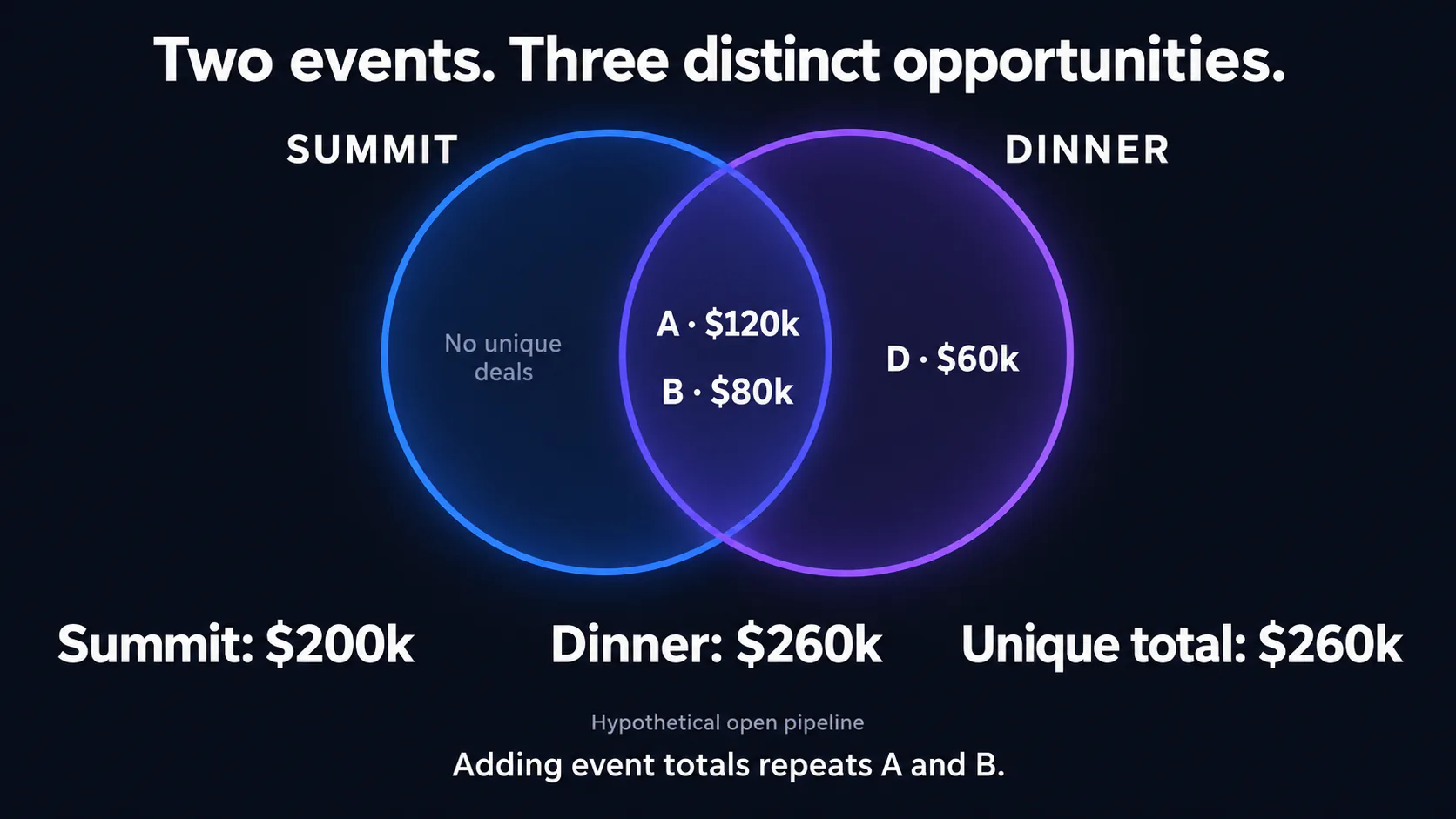
Imagine a team reviewing a summit and an executive dinner at the same reporting cutoff. All amounts below are open pipeline in US dollars, using the same opportunity-value snapshot. Neither event report includes won revenue.
The team has agreed that a qualifying held meeting can establish influence. An event is accepted as the source only when the owner confirms it originated the buying conversation for that opportunity and the evidence predates opportunity creation. An opportunity created after an event does not qualify on timing alone.
The summit influences A and B: $120,000 + $80,000 = $200,000. The dinner influences A, B, and D: $120,000 + $80,000 + $60,000 = $260,000. Opportunity C fails the agreed eligibility rule and stays outside both event totals.
Adding the two event reports produces $460,000 because A and B appear twice. The portfolio contains three distinct eligible opportunities, A, B, and D, worth $260,000. The $200,000 difference is overlap, not additional pipeline.
The sourced view is narrower: B and D total $140,000. That amount is already inside the $260,000 influenced portfolio. It is not another $140,000 to add.
Allocate credit without inflating the opportunity
Suppose the team also wants a fractional attribution view. The following shares are illustrative policy choices, not recommended weights or measured causal effects. Non-event activity remains eligible; the report does not redistribute all credit to events simply because this is an event dashboard.
The portfolio therefore has $144,000 in attributed event pipeline and $116,000 allocated to other activity. It still has $260,000 in distinct influenced pipeline. Neither figure replaces the other: one measures eligible coverage, the other applies a credit policy to that coverage.
For an allocation model, make the shares reconcile to 100% per opportunity, including any explicit unassigned share. A report that grants each campaign full influence can still be a useful coverage report, but its campaign amounts are not additive credit allocations.
Fix the three joins that usually inflate the total
The numerical example assumes the underlying records are already clean. In practice, duplication can enter before attribution weights are applied.
Several contacts, one opportunity
Three people from the buying group attend the summit. Joining campaign members to opportunities can produce three rows carrying the same $120,000 amount. Those rows document three people; they do not represent three opportunities.
Maintain a person-level interaction log for engagement analysis and a separate event–opportunity relationship for pipeline coverage. At that relationship level, A appears once for the summit regardless of how many associated contacts attended. Keep all three contacts as evidence behind that one relationship.
Several events, one opportunity
Deduplicating inside each event is insufficient for the portfolio total. A and B survive once in each event's report, so they still appear twice when the reports are combined. Recompute the portfolio from distinct opportunity IDs instead of summing event subtotals.
Do not deduplicate by account alone. One account may have a renewal and a separate new product evaluation. Merging those opportunities erases legitimate value; attaching a conversation about one buying initiative to both overstates coverage. Resolve the opportunity relationship before aggregation.
A parent campaign and its children
A trade show parent campaign might contain a booth campaign, a dinner campaign, and a meeting campaign. If the parent already rolls up its children, adding the parent and child amounts repeats the same activity.
Choose the reporting level for the decision: individual activations for program design, or the parent event for overall investment. Reconcile the underlying opportunity set when moving between them. Never assume the campaign hierarchy makes its dollar amounts additive.
Practical tip: Build a reconciliation view with one row per opportunity and columns for eligible events, source, event credit, other credit, and unassigned credit. A marketing total that cannot be traced back to that row is not ready for a budget decision.
Set the reporting clocks before comparing events
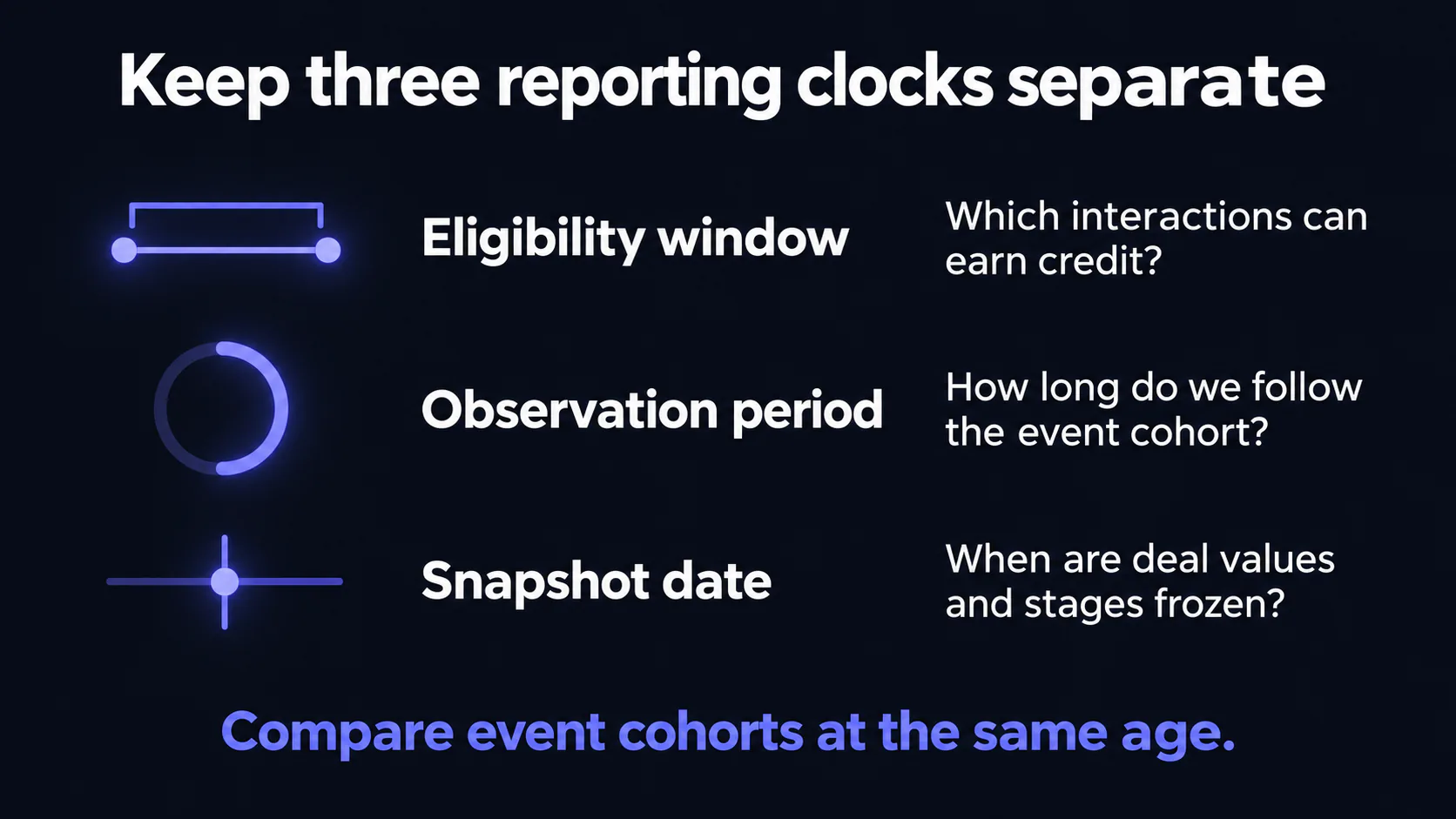
An attribution window is not the same thing as a reporting cutoff. Record three separate decisions.
The eligibility window determines which interactions can earn credit relative to the outcome. The observation period determines how long the team follows an event cohort. The snapshot date freezes opportunity amounts and stages for a particular report. Use buying-cycle evidence to choose these periods; there is no single window that fits every B2B program.
A dinner from last week has had less time to produce opportunities than a summit from three months ago. Compare cohorts at the same age for an operational review, then retain a separate longer-term view. Do not silently change the window to improve one event's ranking.
Also distinguish a calendar close-date report from an event cohort report. HubSpot's attribution report filters illustrate the difference: deal-create reports can filter on creation date, while revenue attribution reports filter on closed-won close date. The deals included in those two reports need not be the same.
If A grows from $120,000 to $150,000 after the summit, a current-value influence report may increase by $30,000 without another event interaction. Preserve the original snapshot and explain the change. Do not automatically describe the increase as value created by the event.
Practical tip: Put the model version, cutoff date, value basis, currency, cohort rule, and inclusion criteria directly in the report description. Re-run previous cohorts under a changed model before comparing them with new ones.
Use attribution to make a decision, then test the decision
The reconciled example supports different questions. The summit originated $80,000 of open pipeline. The dinner originated $60,000 and touched more existing pipeline. Choosing between them still requires cost, account fit, sales capacity, and eventual outcomes. The larger influenced total alone cannot settle the budget decision.
First-touch, last-touch, and fractional models emphasize different parts of a recorded journey. Select one primary model for the decision and keep alternative views as sensitivity checks. If an event ranks first only when the model heavily rewards its preferred interaction, investigate that dependency before increasing investment.
Attribution also cannot establish what would have happened without the event. Google distinguishes attributed conversions from incremental conversions measured using treatment and control groups in its Conversion Lift documentation. That documentation concerns advertising; the distinction is still useful for planning an event experiment.
For example, a team could randomly assign eligible accounts to receive an additional dinner invitation or its usual outreach, then compare outcomes for the assigned groups. That tests the invitation program. It does not automatically isolate the causal effect of attending: attendance is self-selected, invitations may spill across accounts, and other outreach must be considered. Define the question, sample requirements, observation period, and analysis before launch. With too few opportunities, report the uncertainty rather than presenting a precise lift claim.
Upstream research improves the inputs to this process. Lensmor helps teams research events and their participant companies, then organize relevant prospects into Target Groups for outreach. Carry the selected event and account identifiers into your CRM workflow so the later interaction can be matched to the intended buying audience. The credit rules and opportunity reconciliation still belong in the team's reporting process.
Before approving another event, agree with sales and finance on qualifying evidence, the source rule, the reporting windows, and the person responsible for exceptions. Once those definitions hold, a pipeline report can explain both where the numbers came from and what decision they support. Research your next event in Lensmor with that measurement plan in place.