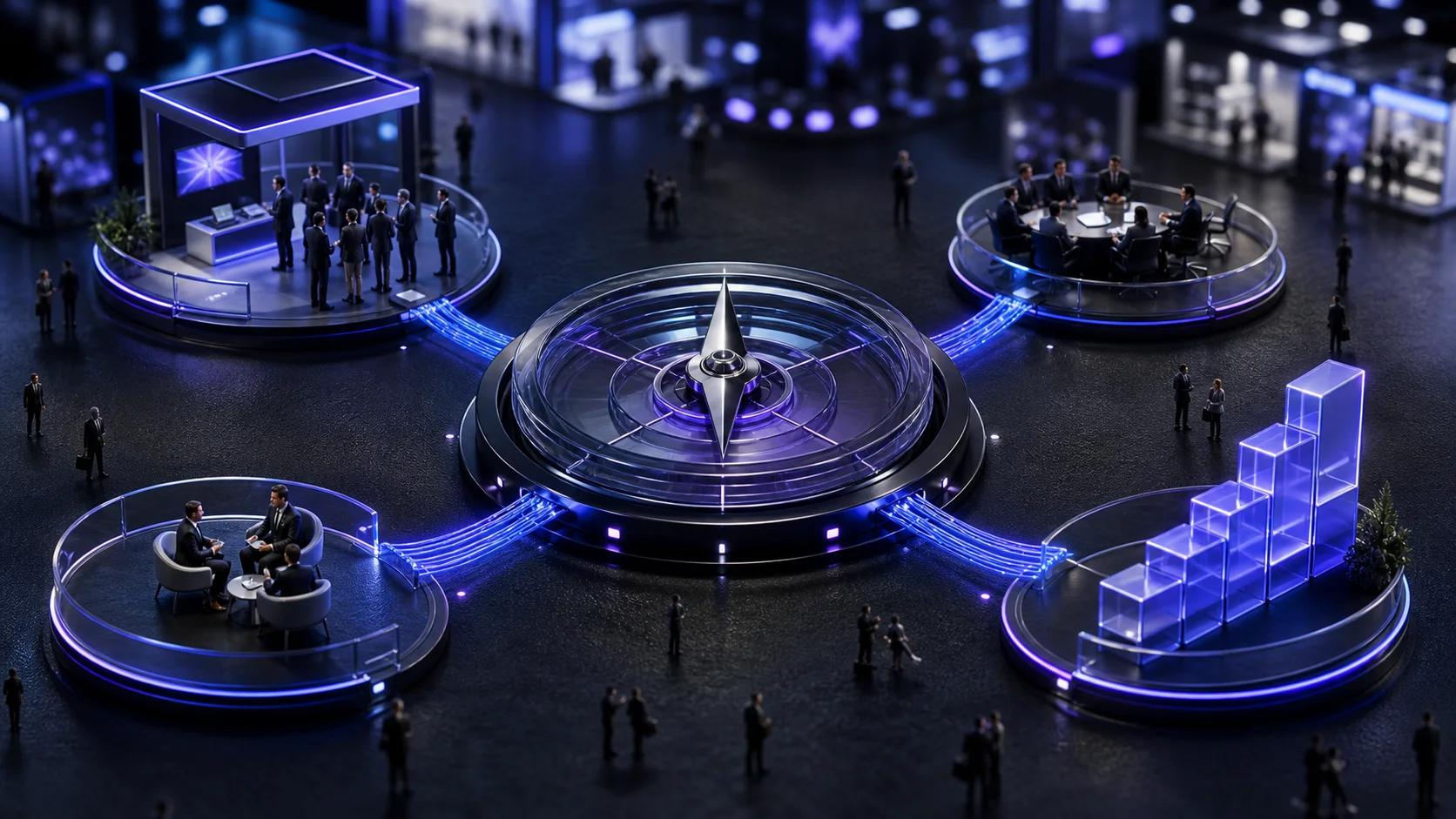
Trade show goals should translate one business outcome into measurable targets for account coverage, scheduled meetings, qualified conversations, follow-up, and pipeline. If the team cannot trace a booth metric to a business decision, it is an activity count—not a useful goal.
That distinction matters before the budget is approved. “Generate awareness,” “drive booth traffic,” and “scan 500 badges” may sound reasonable in a planning deck, but they do not tell sales who to meet, tell booth staff which conversations matter, or tell leadership whether the event earned another year of investment.
A stronger plan works backward. Start with the change the business wants, define the few outcomes the event can influence, and then set leading indicators the team can act on before the show opens.
What are trade show goals?
Trade show goals are specific business outcomes an organization intends to influence through an event. They explain why the company is exhibiting, sponsoring, or attending and create a basis for deciding what the team should do before, during, and after the show.
Goals are not the same as objectives, KPIs, or tactics. A goal describes the destination. An objective defines a measurable result and deadline. A KPI tracks progress. A tactic is an action taken to improve that KPI.
This hierarchy prevents a common planning failure: choosing tactics first. A larger booth, a prize drawing, or a scanner rental may be useful, but none of them explains what success means.
Why booth traffic and badge scans are weak goals
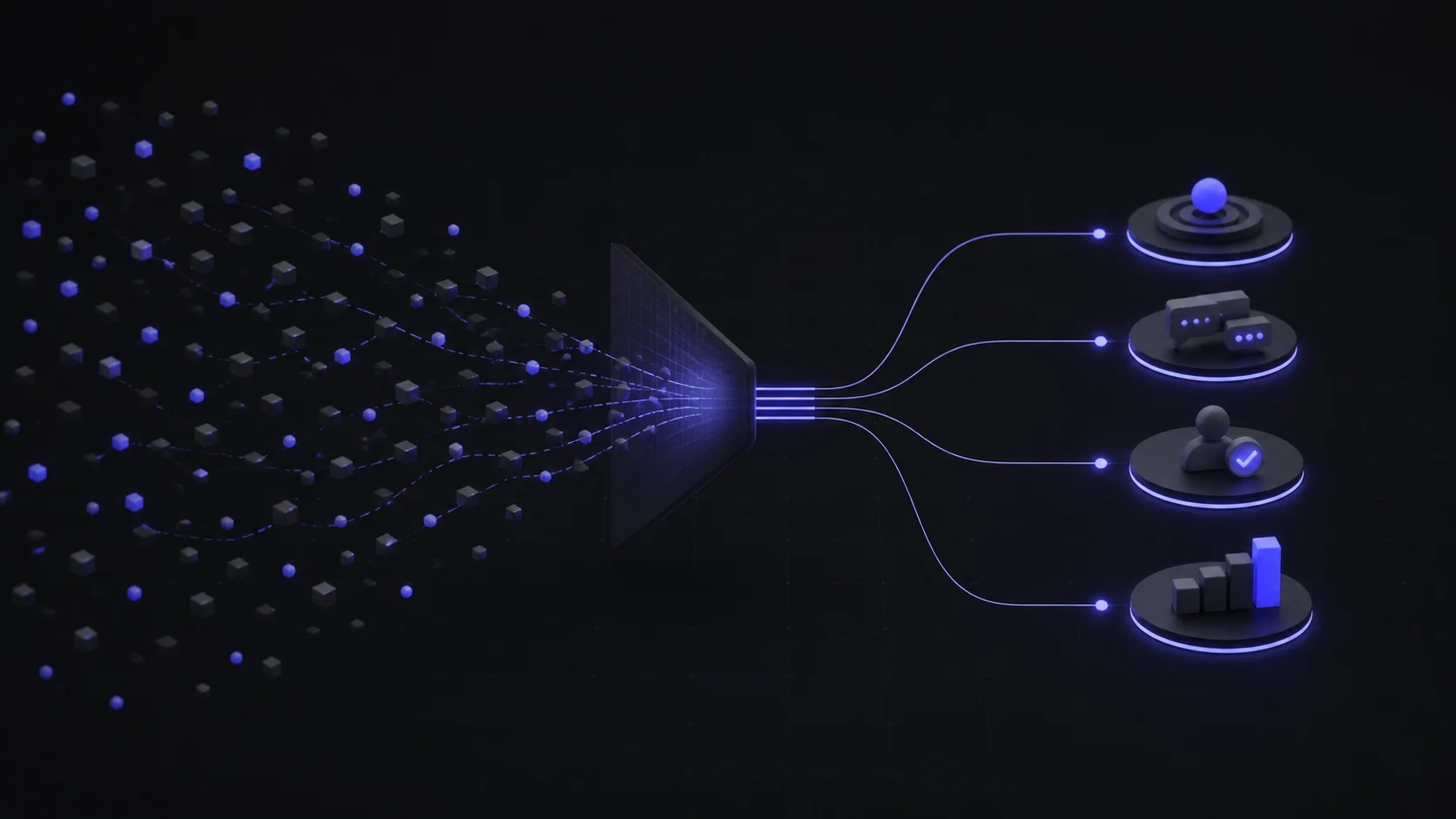
Vanity metrics measure motion without measuring progress. They are easy to count, which makes them tempting, but they often combine people with very different relevance and intent.
A booth visitor may be a target buyer, a student, a vendor, a competitor, an existing customer, or someone looking for a giveaway. A badge scan records that an interaction happened. It does not prove that the person fits the ideal customer profile, has a relevant problem, agreed to a next step, or should enter a sales sequence.
The same problem appears with “brand awareness.” Awareness can be a legitimate goal, but it needs an observable definition. Is the team trying to increase recognition among a named account set? Earn conversations with analysts? Introduce a new category to existing customers? The answer changes the audience, message, staffing, and follow-up plan.
Compare the two planning approaches:
Pro Tip: Keep badge scans as an operational count, but never let them become the headline result. Report the share that became qualified conversations and agreed next steps.
How to set trade show goals in seven steps
A useful trade show goal can be derived before the event and tested after it. The seven steps below create that chain without pretending the event controls the entire sales cycle.
Step 1: Choose one primary business outcome
Start with the decision that justified the event budget. Most teams can name several desirable outcomes: pipeline, customer expansion, partner development, product learning, competitive intelligence, or market entry. Choose one as primary.
Secondary outcomes can still be measured. They simply should not compete for the same resources. A team optimizing for customer expansion will invite different people, staff different experts, and design different conversations than a team entering a new market.
Write the primary outcome in plain language: “Create qualified pipeline with North American manufacturers,” “Advance expansion conversations with current customers,” or “Validate whether healthcare operations leaders have this problem.” Each statement identifies a business change and an audience.
Avoid claiming revenue as the event goal when the event cannot reasonably own the close. The event can influence account engagement, meetings, opportunity creation, and progression. Revenue depends on pricing, product fit, procurement, sales execution, and time.
Step 2: Define the target account universe
Account coverage is the bridge between strategy and execution. Without a named or rule-based account universe, meeting goals become a volume contest.
Define which companies count before setting a meeting target. Use criteria your sales and marketing teams already understand: industry, geography, company size, business model, current relationship, priority segment, or known initiative. Then identify the buying roles or specialist roles that make an event conversation useful.
The result can be a named account list, a set of filters, or both. What matters is that the team can explain why an account belongs in scope.
Account coverage should also distinguish evidence levels. An official exhibitor list, a speaker announcement, public event engagement, and a modeled attendance signal do not carry the same certainty. Record the source and confidence instead of collapsing every signal into “attending.”
Pro Tip: Build the target-account definition with sales before researching contacts. Agreement on fit is more valuable than a larger list that sales will reject later.
Step 3: Convert the outcome into a measurable event objective
An objective needs a number, a deadline, and an acceptance rule. “Create opportunities” is incomplete. “Create six sales-accepted opportunities from target accounts within 60 days of the show” is testable.
The acceptance rule is the part teams often skip. Define what makes an opportunity sales-accepted: a confirmed problem, the right account type, a credible buying process, an agreed next step, or another internal threshold. The exact criteria depend on your business, but they must be decided before the event.
For non-pipeline goals, use the same structure. A customer-expansion objective might count executive reviews completed and expansion plans opened. A research objective might count interviews with qualified practitioners and the decisions those interviews inform.
Step 4: Work backward with transparent assumptions
Backward planning turns an outcome into a capacity plan. Use your own historical conversion rates where possible. When no history exists, use explicit assumptions and label them as planning estimates.
Consider this hypothetical example. These figures are illustrative, not Lensmor results or industry benchmarks:
- Desired event-sourced pipeline:
$300,000 - Assumed average opportunity value:
$50,000 - Required qualified opportunities:
$300,000 ÷ $50,000 = 6 - Assumed meeting-to-opportunity rate:
30% - Required qualified meetings held:
6 ÷ 0.30 = 20 - Assumed scheduled-meeting show rate:
80% - Required meetings booked:
20 ÷ 0.80 = 25
The model does not predict what will happen. It exposes the operating requirement. If the event team cannot identify enough relevant accounts, earn 25 credible meetings, or staff 20 qualified conversations, the pipeline target may be inconsistent with the current plan.
Run a conservative, base, and strong scenario rather than hiding uncertainty in one precise number. For example, test meeting-to-opportunity assumptions of 20%, 30%, and 40%. If the event only works in the strongest case, leadership should see that risk before approving the spend.
Step 5: Set leading indicators for each stage
Leading indicators reveal problems while the team can still change the plan. Lagging indicators such as opportunity value and revenue arrive later.
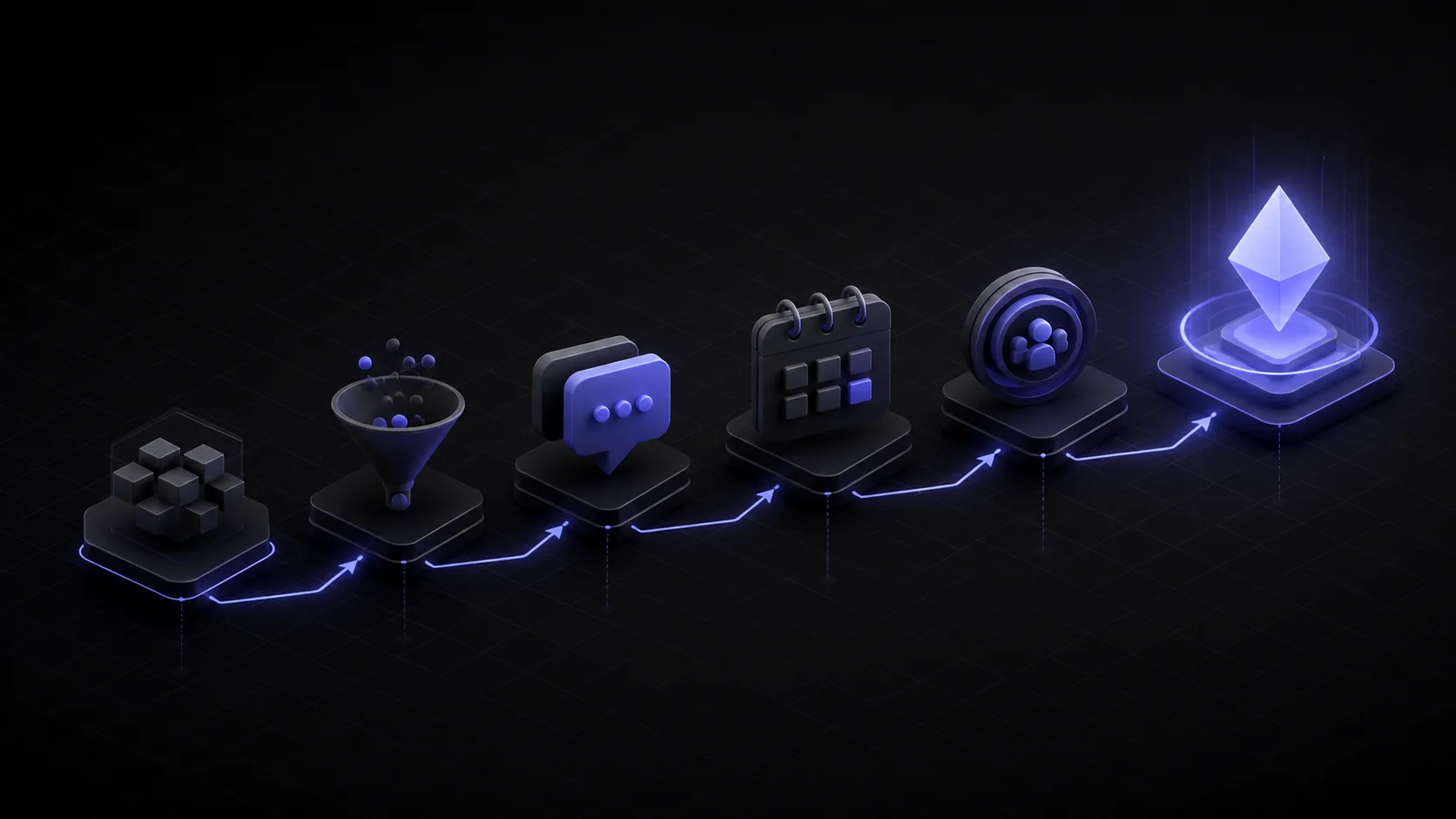
A practical event goal chain can use five stages:
Assign a target, owner, source, and deadline to every KPI. “Twenty-five meetings” is weaker than “The demand generation manager owns 25 confirmed target-account meetings by seven days before the show, recorded in the CRM with an agenda and attendee.”
Targets should also fit physical capacity. A two-person booth team cannot hold simultaneous deep conversations, run demos, greet visitors, and capture notes without tradeoffs. Calculate available meeting slots, staffing coverage, and follow-up capacity before increasing the target.
Step 6: Design onsite qualification around the goal
The booth conversation should collect the information required by the objective—not every field the scanner can store.
For a pipeline goal, the team may need to capture account fit, problem relevance, current approach, timing, stakeholders, and next step. For customer research, it may need workflow details, unmet needs, current alternatives, and permission for a follow-up interview. For partnerships, it may need audience overlap, commercial model, and the right internal owner.
Create a short qualification guide and train the team to use it naturally. The guide should improve judgment, not turn every conversation into an interrogation.
Require an explicit disposition at the end of each meaningful interaction: meeting scheduled, information promised, nurture, partner review, customer follow-up, not a fit, or no action. “Follow up” by itself is not a next step.
Pro Tip: Make the next-step field required before a contact can be marked qualified. This forces clarity while the conversation is still fresh.
Step 7: Define the post-show decision before the event
The goal-setting process should end with a decision rule. Leadership needs to know what the evidence will change.
Decide in advance when the team will review results and which questions it will answer. Should the company repeat the show, change its participation level, target a different segment, start earlier, bring different specialists, or stop investing?
Separate execution quality from event quality. A strong event can underperform because outreach started late. A weak event can produce one large opportunity by chance. Review both the market signal and the team’s execution.
For a broader retrospective measurement model, use the trade show ROI framework. For cost planning before approval, pair the goal chain with an event budget plan.
Which trade show KPIs should you track?
The best trade show KPIs map to the goal chain and have an owner. A compact scorecard is easier to act on than a dashboard with dozens of disconnected counts.
Pre-show KPIs
Track target accounts researched, relevant contacts identified, invitation acceptance, meetings booked, meeting confirmation, and agenda completion. These metrics tell you whether the event has a real pre-show pipeline or only a booth reservation.
Do not merge modeled attendance signals with confirmed meetings. Keep the confidence level visible so the team knows where follow-up is needed.
Onsite KPIs
Track meetings held, qualified conversations, priority accounts engaged, next steps agreed, customer or partner sessions completed, and strategic insights captured. Booth traffic and scans can remain diagnostic metrics for staffing and flow.
Count outcomes consistently. A two-minute greeting should not be classified as a qualified conversation simply because the visitor works at a target account.
Post-show KPIs
Track follow-up completed by deadline, meeting-to-opportunity rate, sales acceptance, opportunity progression, customer actions, partner reviews, and the decisions made from market insights.
Use time windows that match the business. A short transactional sales cycle and a long enterprise cycle should not share the same revenue deadline. The event scorecard can report early evidence without claiming final attribution too soon.
How should different event goals change the plan?
Different goals require different audiences, motions, and evidence. A single event can support more than one goal, but each goal needs its own owner and scorecard.
This is why “generate leads” is too broad. It hides the audience, the definition of quality, and the business decision.
How to align sales, marketing, and leadership
Shared definitions matter more than shared enthusiasm. Before the event, sales, marketing, and leadership should agree on the primary outcome, target-account criteria, opportunity acceptance, measurement windows, owners, and decision rule.
Marketing usually owns the audience plan, campaign, event experience, and reporting. Sales owns account judgment, meeting execution, qualification, and opportunity follow-through. Leadership owns the business priority, risk tolerance, and investment decision.
Put the agreement on one page. Include the primary goal, target audience, objective, KPI targets, assumptions, owners, deadlines, and review date. If a stakeholder disputes a metric after the show, return to the pre-approved definition.
The plan should also name what the event will not optimize. A team focused on executive meetings may accept lower booth traffic. A research team may accept no immediate pipeline if it obtains qualified interviews that change product or market decisions.
What should a trade show goal worksheet include?
A trade show goal worksheet should make assumptions and ownership visible. Use these fields:
- Primary business outcome: the change the event should influence
- Target audience: account criteria, roles, and evidence level
- Event objective: measurable result, deadline, and acceptance rule
- Backward model: required outcomes and explicit conversion assumptions
- Leading indicators: account, contact, meeting, conversation, and follow-through targets
- Owners and deadlines: one accountable owner for each stage
- Capacity check: available meeting slots, booth coverage, and follow-up bandwidth
- Data sources: CRM, meeting calendar, notes, finance records, and event intelligence
- Decision rule: continue, change, increase, reduce, or stop
- Review dates: pre-show checkpoint, immediate debrief, and later outcome review
Use the worksheet while deciding which trade shows belong in the portfolio, not after contracts are signed. A clear goal can reveal that a different event, participation level, or audience would better support the business outcome.
Pro Tip: Review the backward model two weeks before the show. If meetings or account coverage are behind target, change the plan while there is still time—do not wait for the recap deck.
What is the practical takeaway?
Trade show goals work when they create a chain from business intent to team behavior. Choose one primary outcome, define the target accounts, set an accepted objective, work backward with transparent assumptions, and assign leading indicators that can change the plan before the floor opens.
The final question is not “How many people visited the booth?” It is “What did the event help the business decide or advance, and what evidence supports that answer?”
Start Free Trial — Start using Lensmor's event intelligence platform today. Predict attendee lists, discover relevant events, and enrich contact data for your next trade show.