

Event risk management is the process of identifying what could prevent an event from meeting its objectives, deciding which risks need controls, and defining who acts when a trigger appears. A useful plan connects each risk to an owner, an early warning, a preventive control, a fallback, and a clear decision right.
That is broader than an emergency plan. A B2B event team also has to protect the program, venue access, speakers, vendors, data, scheduled meetings, reputation, and committed budget. Life-safety, fire, medical, security, and legal requirements still need qualified professionals, the venue, insurers, and local authorities. The framework below helps the commercial event team coordinate its part without pretending to replace those experts.
What is event risk management?
Event risk management turns uncertainty into explicit operating decisions. The team identifies risks, analyzes their likelihood and impact, chooses treatments, monitors triggers, and reviews whether the controls still work.
That sequence follows the general logic of ISO 31000, which describes risk management as identifying, analyzing, evaluating, treating, monitoring, and communicating risk. The standard is organization-wide guidance, not an event checklist, so an event team still has to translate it into decisions people can execute onsite.
A risk is not simply “something bad.” It is uncertainty that could change an objective. A delayed booth shipment threatens opening readiness. A missing speaker threatens the program. A registration outage threatens arrival flow and data capture. Severe weather can threaten safety, access, attendance, and budget at the same time.
The practical question is always the same: What will we notice, who decides, and what happens next?
Why a risk register beats a generic contingency plan
A contingency without a trigger is only an idea. “Use the backup venue” sounds prepared until nobody has defined the decision deadline, the person authorized to move, the cost already committed, or how guests will be notified.
Consider a fictional $120,000 B2B conference. The team estimates three financial exposures for planning purposes:
- A shipping delay has a 25% planning probability and an $8,000 recovery impact: $2,000 expected exposure.
- A critical production failure has a 10% planning probability and a $20,000 recovery impact: $2,000 expected exposure.
- A weather disruption has a 5% planning probability and a $60,000 committed-spend impact: $3,000 expected exposure.
The simple planning total is $7,000. A 6% contingency reserve on the event budget is $7,200. That does not predict what will happen, and it does not put a price on life-safety risk. It gives the finance and event leads a transparent starting point for recoverable commercial exposure.
Pro Tip: Keep life-safety and compliance risks out of “expected loss” trade-offs. Some controls are mandatory or non-negotiable even when the estimated probability is low.
This is also why a percentage-only contingency budget is weak. A reserve should trace back to named recovery actions. If the plan cannot explain what the $7,200 could fund, the number is decoration.
How to build an event risk management plan
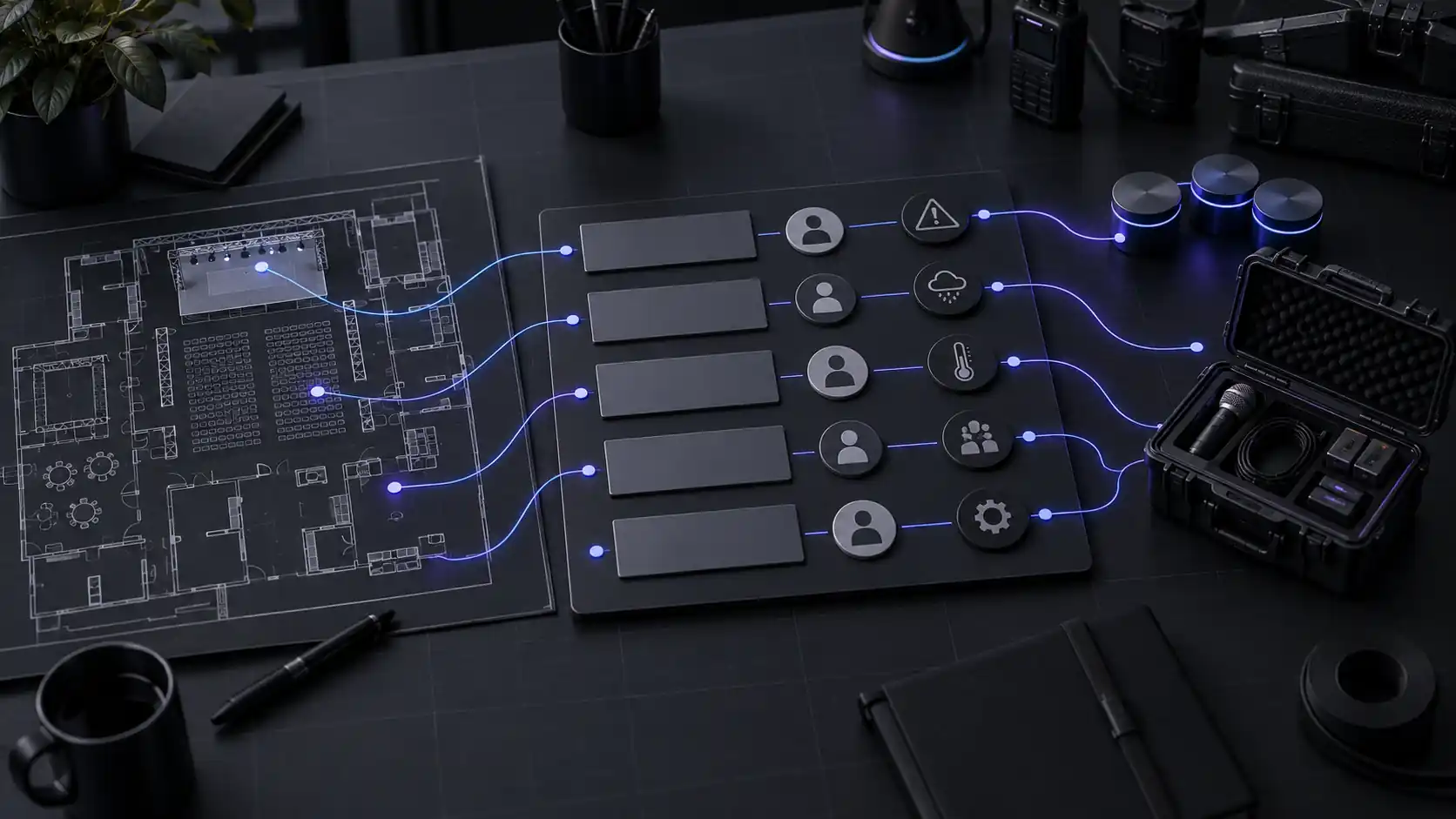
A usable event risk management plan can be built in seven passes. Start with the event's objectives, then move from risk identification to controls, triggers, ownership, decision rights, rehearsal, and review.
1. Define the objectives and non-negotiables
Write down what the event must achieve and what it must never compromise. Commercial objectives might include delivering 12 confirmed account meetings, opening the booth by 9:00 a.m., running three executive sessions, and capturing consented follow-up records.
Non-negotiables sit above those outcomes. They include applicable safety requirements, accessible evacuation, data protection, contractual restrictions, and venue rules. A meeting target never overrides an evacuation instruction. A sponsor deliverable never overrides a stop decision made by the authorized safety lead.
The event's goals should already be measurable. If they are not, use the trade show goals framework before scoring risk. You cannot assess impact without knowing what success means.
2. Map risks across the whole operating system
Do not run one brainstorming session called “what could go wrong?” Use categories so the group does not stop after obvious weather and AV risks.
Cover at least five areas:
- People and safety: medical events, crowd movement, accessibility, staffing gaps, fatigue, harassment, and security concerns.
- Venue and logistics: access windows, freight, power, internet, room capacity, catering, transport, and local disruption.
- Program and production: speaker availability, content approval, rehearsal, playback, interpretation, and show calling.
- Data and technology: registration, badge printing, lead capture, consent, device loss, access permissions, and recovery copies.
- Commercial and reputation: sponsor obligations, executive meetings, customer communication, cancellation terms, and public response.
Invite the people who see different failure modes: venue, production, security, registration, marketing, sales, IT, legal or privacy, and the vendor owners. A polished document produced by one event manager will miss dependencies that live in other teams.
Pro Tip: Ask each owner for one upstream dependency and one downstream consequence. A freight delay is not just a logistics problem if it also blocks rehearsal, sponsor delivery, and the opening meeting schedule.
3. Score probability and impact separately
Probability and impact answer different questions. Probability estimates how plausible the scenario is within the event's context. Impact estimates the consequence if it occurs.
Use a simple 1–5 scale, but define the words behind the numbers. “High impact” could mean any of the following: stop the event, put people at risk, lose a critical customer commitment, create a reportable data incident, or exceed a set financial threshold.
Do not multiply two numbers and let the product make the decision. A low-probability, life-safety event may still require a strong control and formal emergency planning. A high-probability, low-impact issue may be accepted with a small buffer. The score starts a decision; it does not replace judgment.
4. Add controls before fallbacks
Prevention reduces the chance or impact of a risk; contingency defines the response after a trigger. Both belong in the register.
For a late shipment, prevention might include an earlier ship date, tracked milestones, split freight, and local print-ready files. The contingency might be a locally produced minimal booth kit. For a speaker cancellation, prevention includes confirmation deadlines and rehearsal. The contingency is a prepared moderator-led session with approved content.
Put the most reliable control closest to the source. A backup deck on the same cloud account is not independent. A second badge printer connected to the same failed power strip is not resilience.
5. Define triggers, decision deadlines, and authority
Every fallback needs an observable trigger and an authorized decision-maker. “If needed” is not a trigger.
A trigger can be a time, threshold, status, or instruction:
- The shipment misses the carrier scan by 3:00 p.m. two business days before install.
- The speaker has not confirmed travel by the contractual decision deadline.
- Registration latency exceeds the agreed operating threshold during the load test.
- The venue or public authority issues an instruction that changes access or operations.
For each trigger, record who recommends, who approves, who executes, and who must be informed. The person watching the signal should not have to search a group chat for authority while the response window closes.
The run of show template can carry the live cue, owner, and escalation path for time-sensitive decisions. Keep the full risk analysis in the risk register; put only executable cues in the live show document.
6. Connect the plan to money, schedule, and data
A risk plan is operational only when resources are reserved. Link each selected response to its budget line, procurement path, time allowance, contact, and required data.
For commercial recovery, identify what can still be changed without approval and what needs a budget owner. For schedule recovery, protect fixed points such as venue access, doors open, executive travel, and contracted broadcast windows. For data recovery, define the latest approved offline copy, who can access it, and how changes will be reconciled.
Use the event budget planning guide to separate base spend, optional scope, and contingency. The goal is not to hide a reserve in miscellaneous spend. It is to show which risks have funded responses.
7. Test the decisions, not just the document
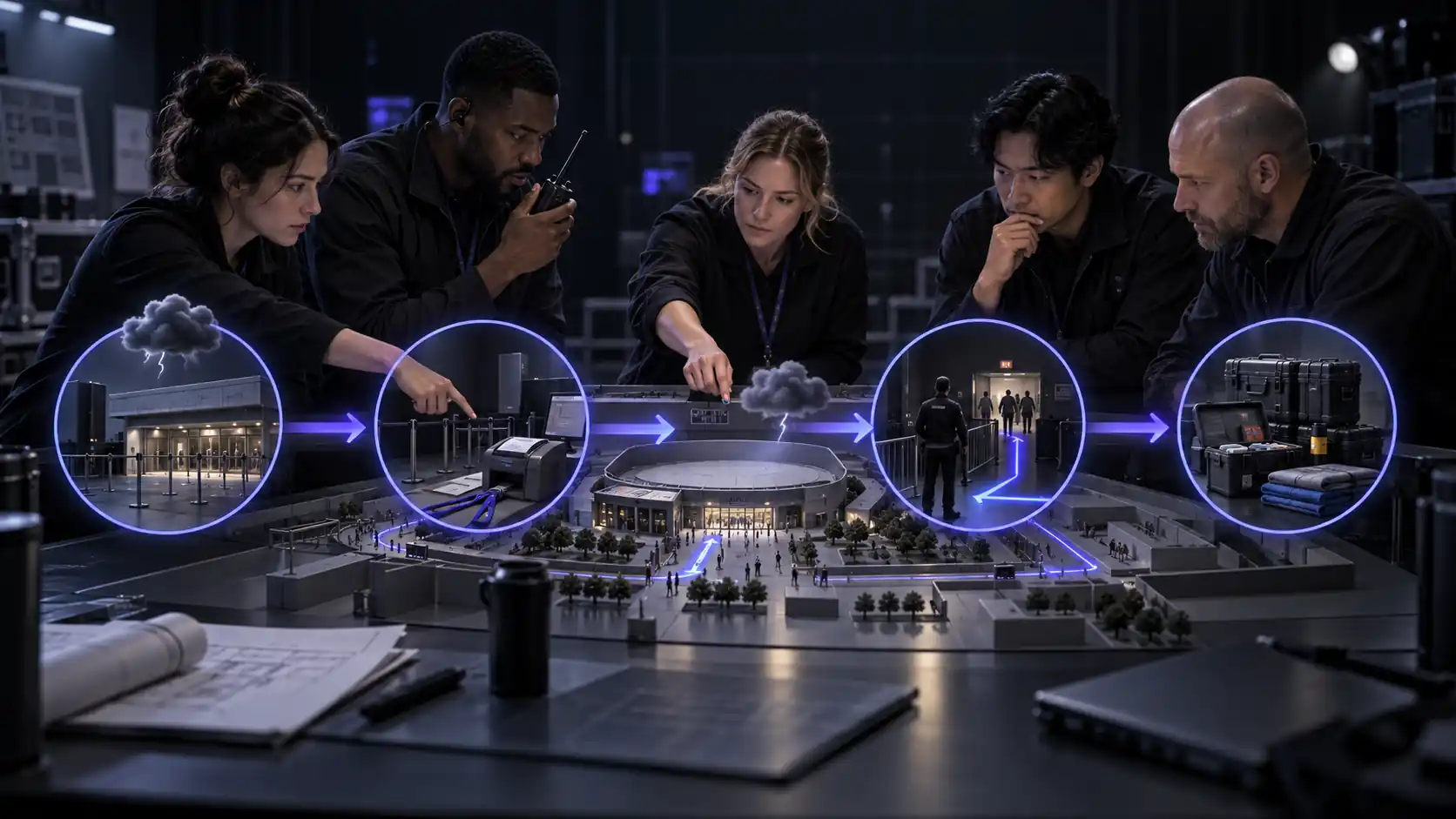
A tabletop exercise reveals coordination gaps before an incident does. Give the team a realistic scenario, advance the clock, and ask what each role sees and does.
The U.S. Cybersecurity and Infrastructure Security Agency's Mass Gathering Security Planning Tool is designed to help planners characterize venues, existing plans, and security considerations. FEMA also provides a large-scale event exercise starter kit built around planning, event management, immediate response, and recovery.
For a B2B conference, test at least one operational scenario and one emergency handoff. The first might be an internet outage during check-in. The second should be developed with the venue and qualified safety or emergency professionals.
Pro Tip: During the exercise, ban the phrase “we would communicate.” Require the speaker to name the channel, message owner, approving authority, audience, and deadline.
What should an event risk register include?
A risk register should make ownership and action visible in one row. At minimum, record the risk, objective affected, probability, impact, preventive controls, trigger, response, owner, and decision authority.
The example below is fictional. Replace every threshold with values agreed for the event, venue, contracts, insurance, technology, and local requirements.
The table is short enough to scan, but each row may need a linked procedure. The safety row should point to the venue's current plan. The data row should point to the organization's incident process. The contract row should point to the signed obligation rather than someone's memory.
What is the difference between a risk plan and an emergency plan?
Risk management, contingency planning, business continuity, and emergency action planning overlap, but they are not interchangeable. Treating them as one document creates confusion about authority and purpose.
OSHA's Emergency Action Plan standard lists minimum elements when an EAP is required, including reporting procedures, evacuation procedures, accounting for employees, rescue or medical duties, and contacts for more information. Applicability depends on the workplace and the standards involved; this article does not determine whether a specific event satisfies those requirements.
The UK Health and Safety Executive's event emergency-planning guidance emphasizes proportionate plans, clear roles, communication, evacuation, stopping a show, and testing. Its legal context is UK-specific, but the operational lesson travels well: the plan should match the event's risks and be rehearsed with the people expected to act.
Pro Tip: Put a visible boundary in the register: “commercial event team decision,” “venue/safety authority decision,” or “emergency-services command.” Ambiguity about authority is itself a risk.
How should the plan change before, during, and after the event?
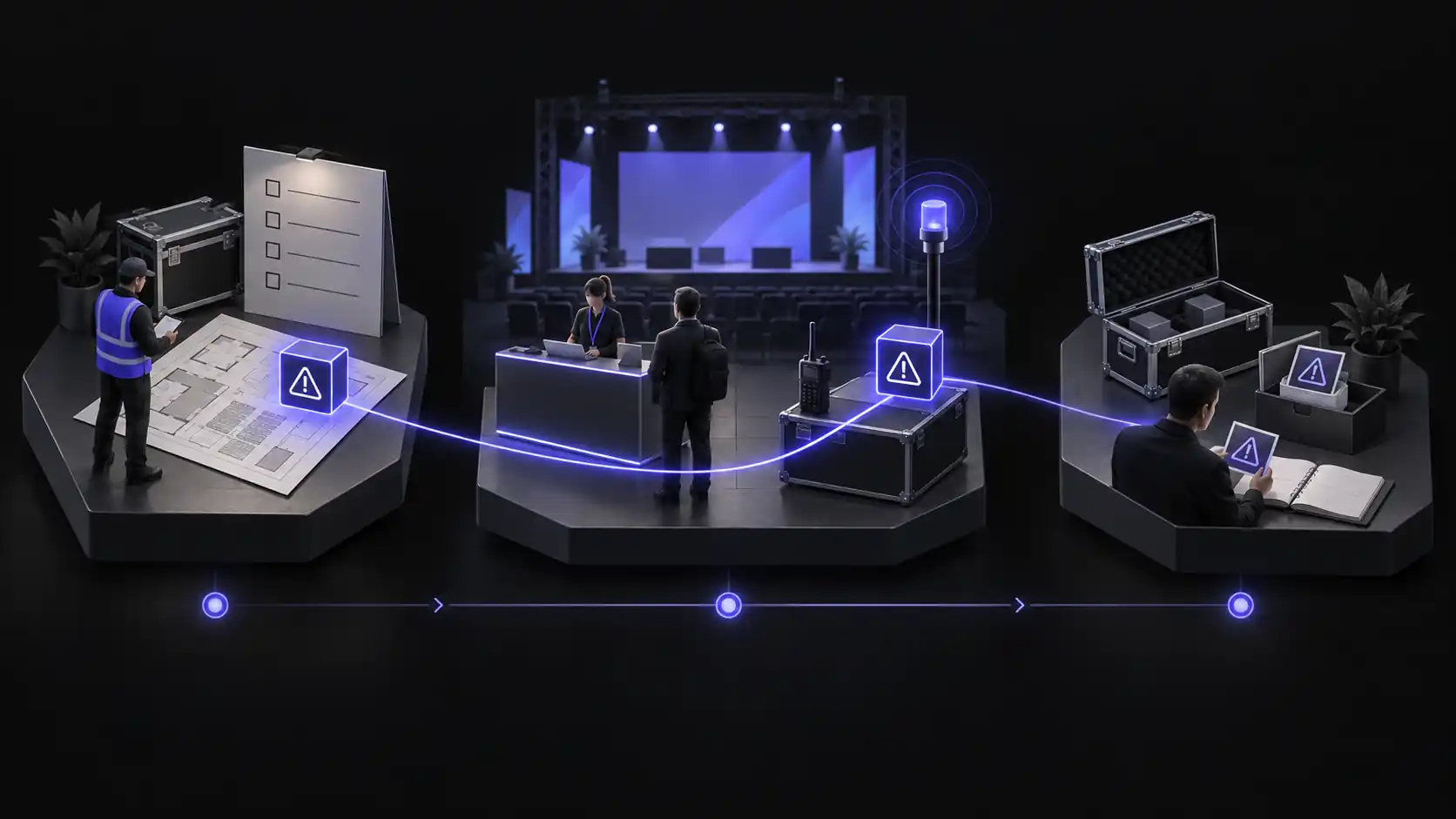
Risk management is a live cycle, not a pre-event workshop. The register should become more specific as the event approaches and shift from analysis to monitoring during delivery.
Before the event
Start with the brief and contracts, then run formal reviews at meaningful decision points: before signing the venue, before non-refundable production, before freight, and before the final operating briefing. Close assumptions with evidence. “The venue has backup power” is not complete until the team knows what it covers, how it starts, and who owns the decision.
Freeze the critical contact list and escalation paths close enough to the event that they are current. Share only the data each role needs. Test radios, message templates, offline documents, and recovery assets.
During the event
Monitor a short list of triggers instead of rereading the whole register. Put time-sensitive items into the show call, operations channel, or command briefing. Log material decisions with the time, signal, approver, and action.
Do not allow the commercial team to improvise around venue or emergency instructions. If authority transfers, make that handoff explicit and follow the applicable plan.
After the event
Review what actually happened: triggers observed, controls that worked, false alarms, decisions delayed, recovery cost, and unresolved actions. Distinguish a risk that did not occur from a control that prevented it.
Use the post-event report template to record material deviations and owners. The register should improve the next event, not disappear into an archive.
Put risk decisions into the operating rhythm
The best event risk management plan is not the longest one. It is the plan that lets the right person see a signal, make an authorized decision, and execute a prepared response before the window closes.
Start with the five risks most capable of changing safety, access, delivery, customer commitments, data, or committed spend. Give each one an owner, a trigger, a response, and a decision deadline. Then test one scenario with the people who will act.
Start Free Trial — Start using Lensmor's event intelligence platform today. Predict attendee lists, discover relevant events, and enrich contact data for your next trade show.



.avif)