
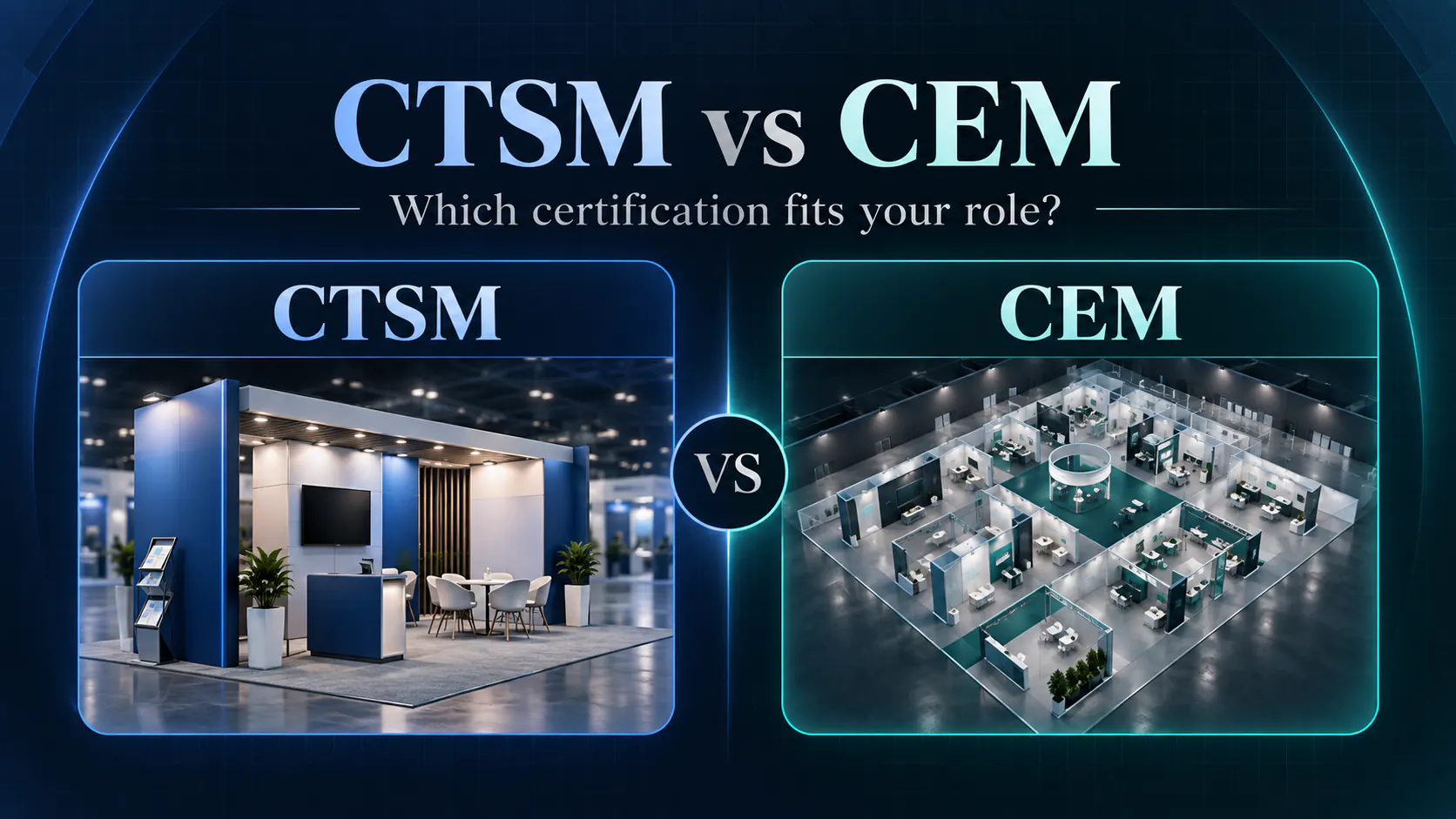
CTSM certification is usually the more relevant starting point if you market your company's presence at trade shows. IAEE's CEM is usually the stronger fit if you manage the exhibition itself. Neither is automatically worth the investment: the deciding factors are your responsibilities, access to a real project, and who pays for the learning.
The useful question is not which set of initials looks better after your name. It is which program will help you make decisions you are already accountable for—or will be accountable for in your next role.
This guide compares the requirements and practical trade-offs for B2B exhibitors, event marketers, and exhibition organizers. Program information was checked on September 15, 2026. Confirm your delivery format, location, and current fees with the provider before enrolling.
What are CTSM and CEM?
CTSM stands for Certified Trade Show Marketer. EXHIBITOR's program combines coursework, an exam, and an applied portfolio. Its audience includes people responsible for trade show and corporate event marketing, making it a natural program to investigate when your job is to make an exhibiting investment work. See the official CTSM program.
CEM means Certified in Exhibition Management in this article. It is IAEE's designation, with a course-and-exam pathway covering the management of exhibitions and events. The current IAEE learning catalog includes operations, floor plans, finance, contracts, marketing, and other exhibition-management subjects.
These are different educational lenses, not opposing professions. Exhibitors need operational knowledge; organizers need marketing knowledge. The distinction is where you expect to apply most of the learning.
Check the full credential name when researching. A search for CEM can also refer to Certified Energy Manager, which is a different profession. Likewise, a certificate for attending a short course is not necessarily the full CTSM or IAEE CEM designation.
CTSM vs CEM: the practical comparison
Requirements above come from EXHIBITOR, IAEE's application guidance, and IAEE's recertification guidance. The role-fit recommendations are our interpretation of the programs, not admission restrictions or a promise that employers prefer one designation.

Which certification fits the work you actually do?
If you own your company's exhibiting program
Start by evaluating CTSM. Your recurring decisions may include which shows to attend, what the booth needs to accomplish, how marketing and sales prepare together, and how to explain the result after the event.
For this role, a useful development program should change the quality of the plan. You want clearer objectives before approving spend, a stronger connection between the audience and the exhibit experience, and a more defensible review afterward. A credential without those changes is harder to justify.
Imagine a corporate marketer inheriting a calendar selected mainly because the company attended those shows last year. Their problem is not a missing badge. It is the absence of a repeatable way to compare audiences, set objectives, and decide whether to return. Coursework can provide structure, but the employer must also allow the marketer to use it.
Before committing, choose a show you can influence from planning through evaluation. Our guide to setting trade show goals is a practical place to establish the decisions and evidence that an applied learning project should improve.
Pro Tip: Ask your manager to approve both the training and a named project. An education budget without access to planning meetings, results, or decision-makers can leave you with knowledge you cannot demonstrate.
If you manage the exhibition rather than one booth
CEM deserves closer examination. Its breadth is more directly aligned with responsibilities such as coordinating an exhibition floor, working with service contractors, planning registration, or managing event operations.
This is not just a question of event size. The important difference is the system you manage. A corporate exhibitor works within a show; an organizer has to make the show work for multiple stakeholders with competing requirements.
Consider an operations manager who is reliable on site but is moving into broader commercial responsibility. Learning more about budgets, contracts, and the exhibition's business model could be more relevant than focusing mainly on one company's exhibit-marketing program.
The 2026 Event Operations course, for example, addresses stakeholder timelines, show rules, communications, teams, and post-event analysis. Compare those topics with your actual responsibilities. Do not choose the credential solely because the course names sound senior.
If your next role is different from your current one
Evaluate both the current job and the next credible job. An exhibitor marketer moving into an organizer role may reasonably favor CEM; an agency professional specializing in corporate exhibit strategy may find CTSM more directly applicable.
Make the move concrete. Review the responsibilities in relevant job descriptions, then ask a hiring manager or experienced professional whether the credential would matter for that position. Separate “helpful professional development” from “required for consideration.” They are different reasons to spend money.
If the career move is still vague, taking one relevant course and testing the work may be a better first step than committing to an entire designation.
Requirements: what you would actually have to complete
CTSM combines education with a real project
EXHIBITOR currently lists 23 required sessions, 7.5 elective hours, a comprehensive online exam, and a candidate portfolio. The program is self-paced; its guidance says most candidates finish in three to four years. That is a typical duration, not a fixed minimum or a guarantee about your schedule.
The portfolio is the practical constraint to investigate early. You need work you can document, not just time to study. Ask what project access, company information, permissions, and advisor support you will need before choosing your completion date.
Do not wait until after an event to discover that the evidence you needed was never collected. Start with a clear objective, preserve the reasoning behind decisions, and agree on what can be shared. The official portfolio guidance should determine the submission requirements; a generic report template is not a substitute.

For your own work, a useful evidence trail connects the brief, actions, and results. It should explain what you controlled, what changed, and what remains uncertain. That is more convincing than a collection of attractive booth photographs with no account of why the choices were made.
You can use a post-event report structure to organize your team's learning alongside the official portfolio process. Keep the two purposes distinct: the provider assesses its certification requirements, while your employer needs an honest account of the event investment.
CEM uses a course-and-exam pathway
IAEE's application guidance requires three years of full-time experience in exhibitions and/or events. Candidates complete nine courses and the corresponding exams within three years of passing their first exam. Confirm eligibility with IAEE before paying if your experience is part-time, mixed with another role, or otherwise difficult to classify.
The current CEM FAQ describes exams and on-demand learning through Elevate. It also explains the 90-day exam window and consequences of missing it. Put individual exam deadlines into your plan rather than treating the overall three-year window as the only deadline.
For someone working around a busy show calendar, the scheduling test matters as much as motivation. Identify your peak delivery weeks, available learning formats, and realistic study blocks. Buying several courses at once is not useful if you cannot complete the assessments within the required windows.
Pro Tip: Ask for a written course plan before registration: which courses you will take, when each assessment is due, and which dates conflict with major events. A feasible calendar is more valuable than an optimistic completion promise.
How much does CTSM certification cost—and how should you budget for CEM?
Use a total-cost budget, not just a course-price comparison. Include tuition, assessments, travel, accommodation, time away from delivery, and any renewal obligation. Employer-paid tuition can still be costly if the learning happens during your busiest event cycle.
EXHIBITOR's current program page estimates tuition at about $8,000, plus $379 each for the exam and portfolio. Together, those published components imply approximately $8,758 before travel and lodging. This is arithmetic based on a provider estimate, not a guaranteed all-inclusive quote. Your session choices and registration options affect the actual cost.
For CEM, request a current, itemized quote for your location, delivery format, and membership status. We are deliberately not presenting a single universal total: IAEE's older application page includes legacy delivery references, while its current learning catalog uses Elevate. A historical fee table is not a reliable substitute for the price attached to your chosen registration.
Ask the provider to separate application charges from course and assessment costs and explain any retake charges. If you are enrolling through a regional partner, confirm that partner's terms rather than assuming US pricing applies to you.
The maintenance difference also matters. CTSM's program page states that the designation is lifetime and does not require renewal. IAEE's current CEM recertification page requires 15 credit hours every three years and lists a $150 renewal fee. Verify the current fee and eligible-credit rules when budgeting.

A break-even calculation without invented returns
Here is an illustrative scenario, not a forecast or a quote for either program. Suppose an employer budgets $10,000 for training, associated costs, and staff time. If the organization later verifies $2,000 of incremental savings per event that can reasonably be attributed to applying the learning, five such events would recover that investment.
The difficult part is not dividing $10,000 by $2,000. It is demonstrating that the improvement is real and attributable. A smaller event budget could reflect fewer deliverables rather than better decisions. More leads could reflect a larger show rather than improved execution. Do not count ordinary business results as a training return simply because they happened afterward.
Before funding the program, choose the evidence you will review. It might be avoidable rework, unnecessary expenditure, a better qualification process, or more consistent reporting. Record the baseline and the limitations. Some benefits, such as confidence and a useful professional network, can matter without being converted into a fabricated revenue number.
When is certification worth it?
Certification is easier to justify when it addresses a recurring responsibility, you have the authority to apply the learning, and the financial commitment is manageable. It is harder to justify when the main hope is that the initials alone will create a career opportunity.
For an employer, the strongest case is an employee who can connect the curriculum to a specific improvement project. “I want professional development” is reasonable, but “I want to redesign how we set objectives and review our exhibiting portfolio” gives the investment a practical purpose.
For an individual paying personally, the bar should be higher. Check whether the program fits roles you genuinely want, whether you can complete the applied work or meet eligibility requirements, and whether the expense would crowd out more immediate needs. Do not use an assumed salary increase to make an otherwise unaffordable plan look safe.
A credential can demonstrate that you completed the provider's requirements. It cannot independently prove that every event you run will succeed, that your judgment is stronger than another candidate's, or that a particular employer will reward the designation. Keep the qualification and the evidence of your work together.
Three situations where waiting makes sense
First, you have not yet identified the work you want to do. Explore the role before buying the credential. Shadowing an organizer or owning a limited exhibit project can reveal whether the responsibilities actually appeal to you.
Second, your immediate problem is narrow. If the next event is failing because ownership is unclear or follow-up is inconsistent, fix that operating problem now. A multi-year learning plan should not delay assigning responsibilities and correcting the process.
Third, you cannot access a meaningful project or protect study time. Resolve those constraints with your employer before registration. Starting later with a viable plan can be better than accumulating unfinished coursework while the delivery workload keeps growing.
Pro Tip: Write a one-paragraph investment case before you enroll: the responsibility you want to improve, the program component that supports it, the project where you will apply it, and the evidence your manager will review. If that paragraph is vague, the decision is not ready.
What should you ask your employer to fund?
Ask for a learning agreement, not just a reimbursement approval. It should cover the money, the time, the project, and the review process. That makes the commitment clearer for both sides and reduces the chance that urgent event work repeatedly pushes the education aside.
The budget should identify what is included and excluded. The work plan should identify which meetings or projects you can participate in, who can advise you, and how company information will be handled. The review should focus on what you learned and changed, not an unsupported promise of commercial results.
If full funding is not available, propose a smaller first step. A relevant course plus an agreed project can test whether the material improves your work before either party commits to the full pathway. Confirm whether that course can count toward future certification; do not assume all event education transfers.
The bottom line: choose the responsibility, then the credential
Investigate CTSM first when your central challenge is making your company's trade show investment more effective. Investigate IAEE CEM first when your responsibility is the management of exhibitions and the coordination of the people, services, and commercial decisions around them.
Choose neither automatically. The better investment is the one you can finish, apply, and explain—not the one with the most impressive-sounding title. Before enrolling, confirm the current requirements and fees, agree on a real project, and protect time to do the work.
If your immediate task is researching the events and companies behind an exhibiting plan, you can also explore Lensmor: Start Free Trial. Treat event research as a practical workstream, not as a replacement for professional education or evidence that a certification will pay off.


.avif)