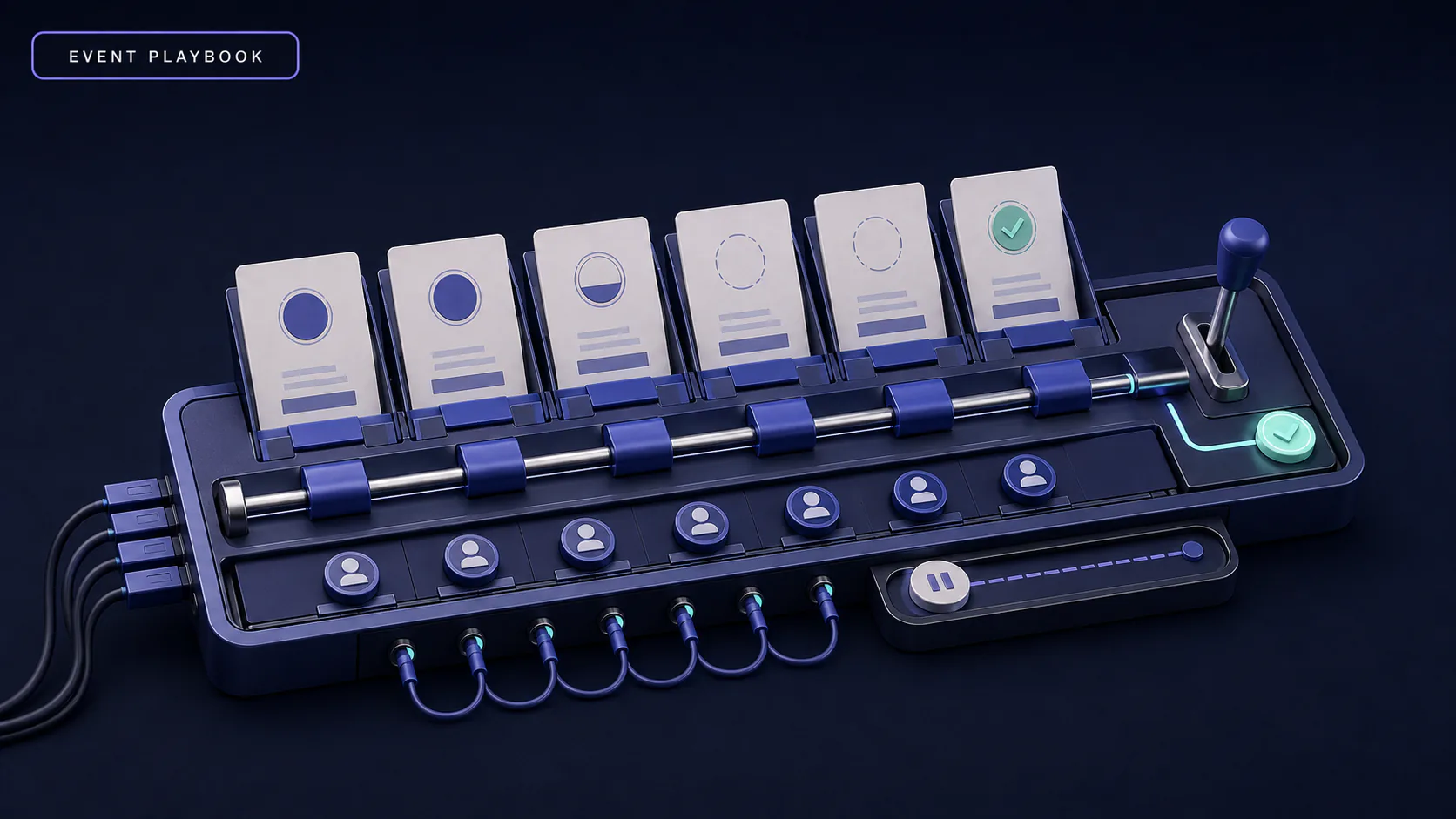

A SaaS conference strategy for a new market starts with a buyer hypothesis, then tests which event can support it. The useful output is a small campaign with relevant accounts, a clear conversation goal and a spending decision the team can explain.
Consider a SaaS company whose established product serves commercial teams. A new offering addresses a different problem: coordinating approvals across operations teams at industrial businesses. The event marketer has an established calendar, but the sales director needs access to a new buying group. Repeating last year's software conferences would be easy. Proving they contain the right operations buyers takes more work.
For this use case, give the team one quarter, two sellers and a choice between a familiar technology expo, an established operations conference and a promising first-year event. The event lead must turn those options into a campaign before committing to a booth. The question is practical: where can the team learn about the new market and earn relevant next conversations?
What does the team need to learn before buying a booth?
The first conference should test a specific buyer problem.
The product marketer starts with a working assumption: operations leaders at multi-site industrial businesses struggle to coordinate approvals across locations. The account executive adds a qualification question. Is the problem owned by operations, by IT, or by a business-unit leader? A room full of senior people will not resolve that distinction unless the team asks about responsibility.
The team writes a short meeting brief. It wants to understand how approvals currently move between sites, where delays occur, who is responsible for changing the process and what would trigger an evaluation. A product demonstration is available when appropriate, but discovering that the assumed buyer does not own the problem is also useful.
This follows the logic of testing critical business assumptions: identify the uncertainty that matters, choose a suitable test and compare the evidence with the original hypothesis. Here, the conference provides access to conversations. It does not automatically validate a market.
The spending discussion comes early. Suppose the team sets an illustrative ceiling of $15,000 for a booth-led campaign, including travel and staff time, and a target of 10 completed, qualified conversations. That is $1,500 per conversation. A $6,000 attendee-led pilot with six such conversations would cost $1,000 each. Neither scenario is a forecast; both make the commitment easier to question.
For a separate break-even check, suppose an incremental customer would contribute $12,000 after the direct costs of serving that customer. Recovering $15,000 would require two such customers; recovering $6,000 would require one. Two customers would produce ($24,000 − $15,000) ÷ $15,000 = 60% campaign ROI under those assumptions. The team cannot substitute pipeline value or booked meetings for that realized contribution.
Marketing therefore proposes a smaller pilot first. Its budget buys a test of buyer access and problem relevance. A larger presence can be considered after the team has evidence that justifies it.
Pro Tip: Agree what makes a conversation qualified before counting it. In this scenario, the person must belong to a target account, understand the approval workflow and be able to describe who owns a change.
How does the team define the new buyer without recycling the old list?
The new account list needs its own inclusion rules.
The event lead works with product marketing and sales to separate the old audience from the new one. Commercial leaders at software companies may have been a strong fit for the established product. The new offer needs businesses with operational complexity across locations and people close enough to explain it.
The team does not discard its existing CRM. Instead, it checks which accounts match the new use case and which are present only because a prior campaign reached them. An existing customer can still introduce a relevant colleague. An old conference contact should not become a priority simply because their email is available.
The account executive reviews a small research sample before the marketer expands it. A company with several offices is not necessarily a multi-site operator with the required workflow. A senior title does not prove ownership. The review asks what observation supports each inclusion and what remains to be established in a conversation.
Desk research creates a defensible shortlist. Direct conversations then test whether the assumed problem exists and matters to the people on that list. The team asks for examples from the buyer's actual work instead of treating a suitable company profile as proof of demand.
A rejected account is not a wasted lookup. It improves the inclusion rule. If too many apparently suitable companies turn out to outsource the process, the researcher adds that exclusion before building the event audience.
How does the team choose between three plausible conferences?
The best first event combines buyer fit with a practical way to meet.

The familiar technology expo initially looks attractive. Sales knows the venue and the company already has a supplier relationship. Research finds useful software partners, but the new operations buyer is less central to the audience. Marketing keeps the expo as a partnership option instead of making it the main test of the new segment.
The established operations conference looks more promising. Its agenda discusses process ownership and cross-site coordination, and the team can connect relevant companies and roles to the event. The marketer checks whether the ticket, meeting areas and networking arrangements actually allow the conversations the pilot requires.
The first-year event has a well-matched theme but little operating history. That does not make it a bad event. It makes a large commitment harder to justify from historical evidence. The team asks about the current audience, the meeting format and what is included in the proposed participation package.
The event lead does not award a numerical score to every uncertain input. An impressive agenda can coexist with poor access to the buyer. A large audience can include many suppliers. Instead, the decision note names the unresolved condition that would change the recommendation.
For the operations conference, that condition is access to relevant conversations at an acceptable cost. For the new event, it is enough current evidence to justify a test. Each option has a next action, so uncertainty becomes work someone can complete rather than a vague concern in a presentation.
Pro Tip: Compare participation formats before comparing event brands. An attendee pass with permitted meeting access can test this scenario more directly than a booth whose value depends on unproven walk-up traffic.
How does the team turn event records into a buyer shortlist?
Account fit and event participation answer different questions.
The researcher uses Lensmor to explore relevant events and review companies and people connected to them. For the operations conference, the team examines the attendee and visitor audience as well as exhibitors. The purpose is to find the people close to the operational problem, regardless of which part of the event first revealed the account.
An exhibitor is not automatically a poor prospect. An industrial supplier exhibiting at the conference might also have the cross-site workflow the software addresses. Conversely, someone attending as a visitor may work for a company outside the target segment. The researcher checks buying relevance rather than sorting every exhibitor into “seller” and every visitor into “buyer.”
Within each suitable account, the team identifies the operational owner, a possible technical reviewer and the person who would sponsor a change. The account-mapping guide covers this broader buying-group approach. For this campaign, it prevents the meeting plan from depending on one impressive title.
The event connection remains a separate field. Exhibitor participation, public professional activity, visitor data and a direct meeting confirmation provide different context. The team keeps the source and event edition attached to the record instead of turning all of those relationships into a blanket statement that the person will attend.
This also improves the outreach. A buyer who has directly agreed to meet gets a specific time and place. A suitable account with an event-related signal gets a relevant invitation that asks about availability. A strong prospect without a confirmed connection can still receive ordinary outreach about the business problem.
The marketer now has a shortlist that explains three things: why the company fits, why the person is relevant and why this event creates a timely opportunity to approach them. A list containing only names and email addresses would leave the seller to reconstruct all three.
What would make the team approve, change or cancel the pilot?
The team sets its decision rules before the event deadline.
The sales director wants a clear answer before travel and participation costs become difficult to change. Marketing therefore defines a review date ahead of the relevant cancellation deadlines and checks three conditions: buyer fit, meeting access and evidence of interest.
Buyer fit requires enough relevant accounts to make the research effort worthwhile. Meeting access requires a usable way to hold conversations under the event's rules. Interest requires actual responses and agreed next steps, rather than an assumption that a long contact list will convert.
Suppose the campaign can reach 60 relevant contacts and aims for six completed conversations. That requires a 10% contact-to-completed-conversation rate across this particular pilot. If the team assumes only three quarters of booked meetings will be completed, it would need eight bookings to support that goal. These are sensitivity inputs, not benchmark conversion rates.
Now the team can ask a useful question: does its early response support those assumptions? If the answer is unclear, the event lead can reduce the commitment or keep the activity as research. If access is unsuitable, adding more contacts does not fix the problem.
A smaller commitment also preserves the team's ability to learn. The marketer can change the meeting brief after the first few conversations without defending a large booth investment. What matters is whether the pilot improves the next decision, not whether the original plan survives unchanged.
How does research become a campaign the sales team can run?
Every handoff needs an account reason, a conversation purpose and one owner.
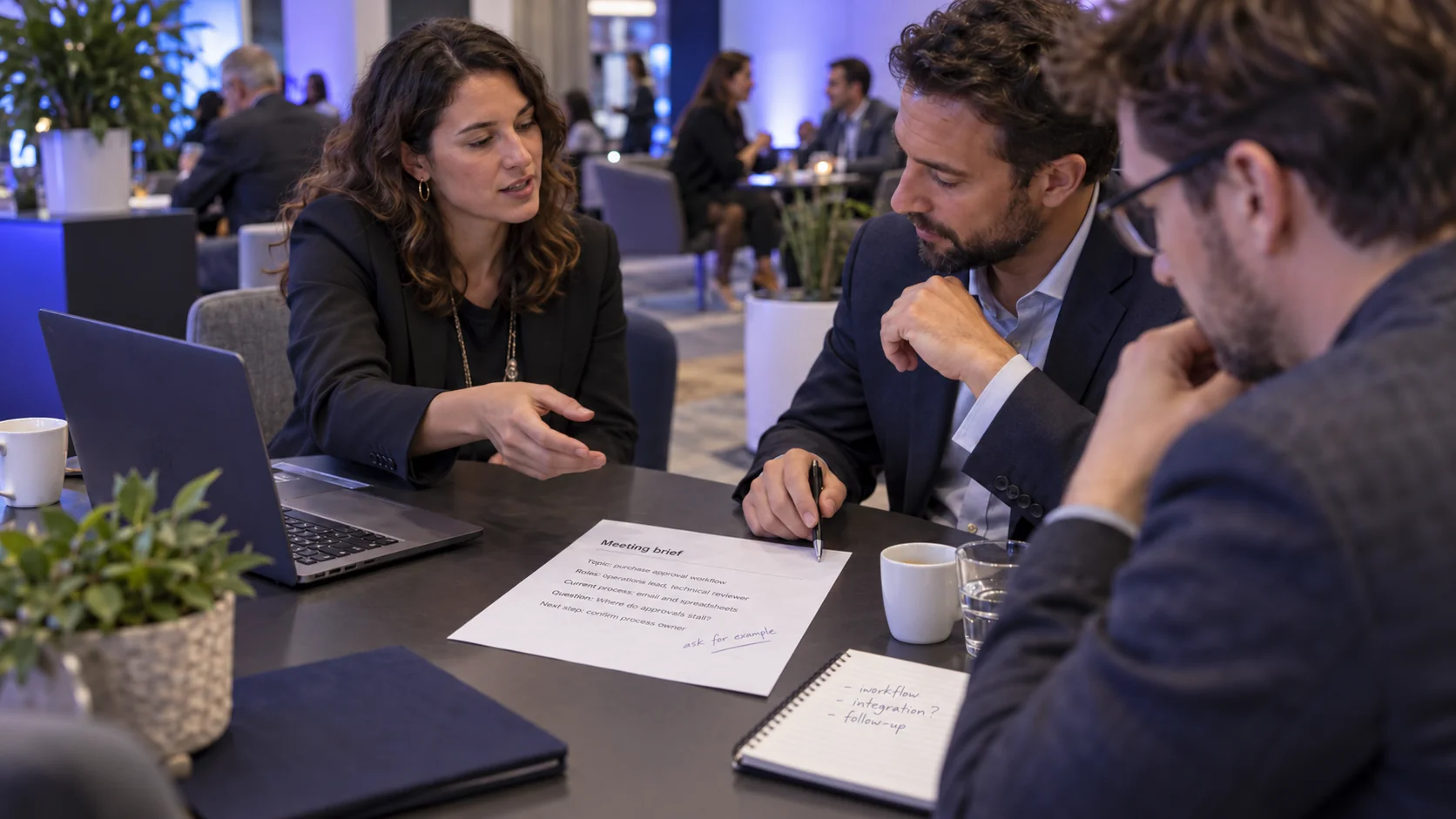
The event lead prepares a compact brief for each priority account. It identifies the relevant operation, the person responsible for the initial outreach, the evidence connecting the account to the event and the question the seller needs to resolve. Existing customer or opportunity relationships are checked before assigning a new owner.
The company already uses a CRM and an outreach system, so the researcher tests a small export before moving the full audience. Company identity, contact identity, role, event edition and source context need to arrive in the right places. The CRM remains the record for ownership and activity; the research should not create a parallel sales process.
The first invitation focuses on the workflow. In this scenario, the seller might ask whether the prospect coordinates approvals across sites and whether comparing approaches during conference week would be useful. That is more specific than offering a generic product tour, and it still makes sense if the person is not attending.
A positive response changes the task. The seller confirms the purpose, timing and participants rather than sending another automated invitation. A reply that names a different process owner is routed for research. A clear lack of fit closes the contact's place in this campaign rather than starting an indefinite follow-up sequence.
The same account may have several relevant people. That does not mean each should receive disconnected outreach from a different seller. The account owner coordinates the approach and records which relationship is active. Otherwise, a small pilot can look like a mass campaign from the buyer's side.
Pro Tip: Test the handoff with one seller before expanding it. Ask them to explain why each account is included and what they would say first. If they cannot, add the missing context before adding more contacts.
What happens at the conference and in the review afterward?
The on-site conversation tests the problem before the team pushes the product.

At the operations conference, the seller starts with the buyer's current process: how an approval begins, which teams contribute, where work stalls and what happens when a deadline slips. The product marketer listens for the language the buyer uses, including signs that the team has named the problem incorrectly.
Strategyzer's guidance on customer evidence makes a useful distinction: stated interest should be tested against behavior. For this team, a buyer describing a recent approval failure and agreeing to involve its owner provides more useful evidence than a general expression of enthusiasm.
A useful conversation may lead to a demonstration, a technical discussion or an introduction to a different owner. It may also reveal that the company has little need for the offer. Those outcomes should be recorded distinctly. An enthusiastic conversation without a supported next action is not yet a qualified opportunity.
After the event, the team reviews evidence by account. A recurring pain across several relevant businesses strengthens the case for further testing. One unusual account may suggest a niche rather than an entire segment. Notes from people outside the target profile should not be mixed into a claim that the new market has been validated.
The review separates completed conversations, agreed next steps, accepted opportunities and eventual customer contribution. A prospect who books a meeting, attends it and enters an opportunity is one relationship progressing through stages, not three separate wins. For reporting across those stages, the event marketing attribution guide explains how to avoid counting the same pipeline repeatedly.
There are several credible next decisions. The team might repeat the pilot at a similar conference, move toward a larger presence after stronger evidence, change the buying role it targets, or continue customer research outside events. The purpose of the first campaign is to make that choice more informed.
The event lead finishes with a usable operating package: a revised buyer definition, a reasoned event choice, a focused account list, meeting briefs and a record of what remains uncertain. Another seller can pick up the work without starting the research again.
What should another SaaS team take from this use case?
A new market needs a new reason for every event commitment.
Start with the buyer problem your existing campaign cannot yet explain. Identify the accounts and roles that can test it, then choose a participation format that gives your team access at a cost it can justify. Keep the first campaign small enough to change when the evidence changes.
Start Free — Use Lensmor to research the events, companies and people relevant to your next market, then turn the shortlist into a focused sales campaign.