
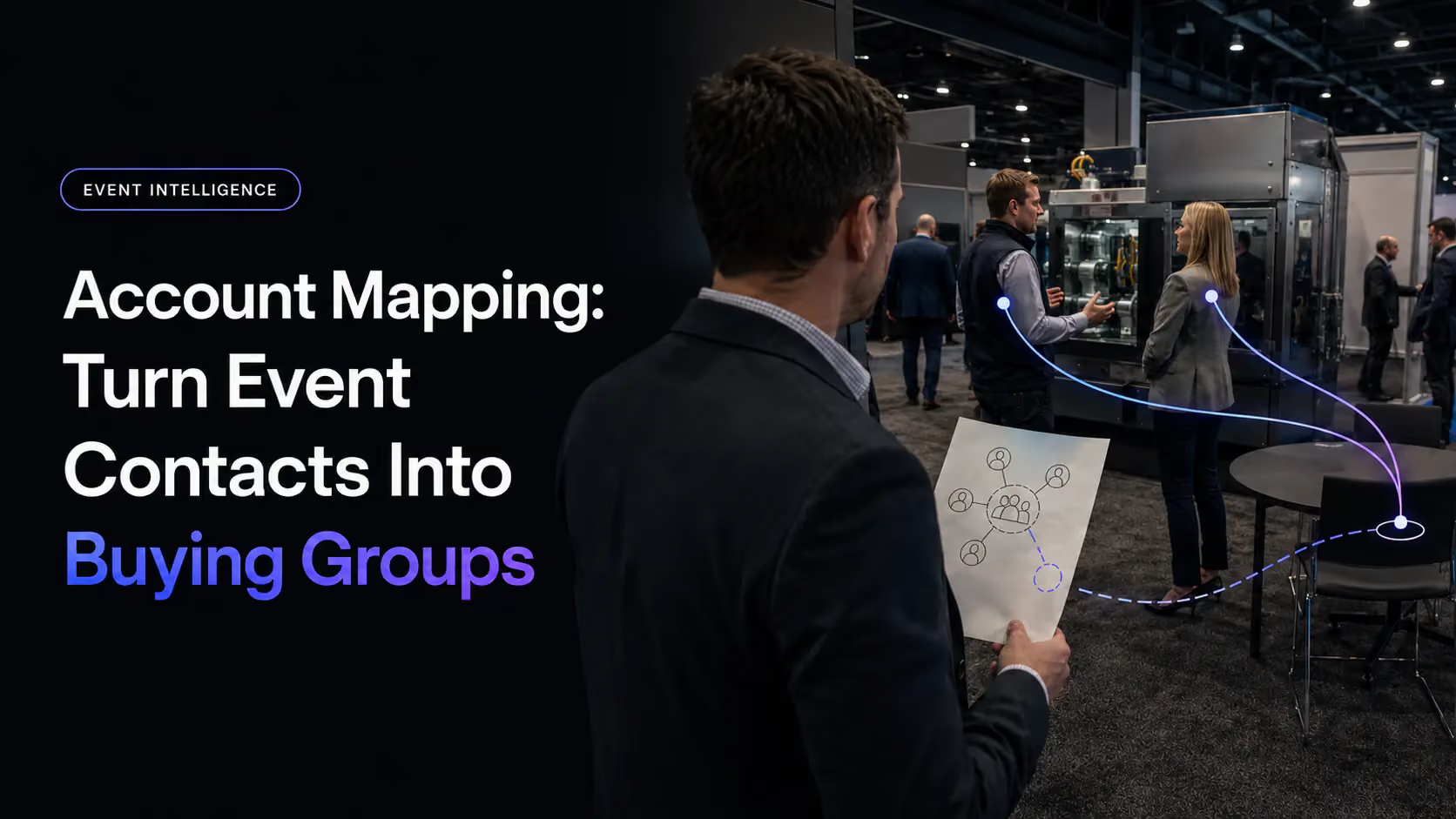
Account mapping connects the people at a target company to a specific buying decision: who owns the problem, who evaluates a solution, who approves spending, and how those people work together. For event teams, it turns a collection of booth conversations and researched contacts into a plan for the next useful relationship.
Imagine leaving a trade show with six contacts from one target account. Three watched the same demonstration, two work in another division, and one mentioned a colleague who controls the project. A contact count says six. Your sales team still needs to know whether anyone can move that particular decision forward.
The map should make that uncertainty visible. This guide shows how to build a practical sales account map around event evidence, keep assumptions separate from confirmed roles, and use the gaps to plan outreach.
What is account mapping in B2B sales?
A sales account map represents the people and relationships relevant to an account opportunity. It adds decision context to contact information: responsibility, influence, connection to a project, and the next question your team needs to answer.
DemandFarm's account mapping guide describes this as a visual representation of customer relationships and decision dynamics. The useful distinction is between knowing someone's place in an organization and knowing their involvement in a purchase.
An organizational chart might put an operations director above a plant manager. Your account map could show that the plant manager owns the process problem, an engineer tests proposed changes, and a regional team approves the investment. The reporting structure alone doesn't establish that purchasing path.
The term also has a different meaning in partnerships. Crossbeam's account mapping approach identifies overlaps between a company's accounts and its partners' accounts. That can reveal an introduction route, but this article focuses on relationships inside a buyer organization.
Keep one account map tied to one defined initiative. A global company could have separate teams buying manufacturing equipment, recruitment services, and marketing software. Combining those decisions creates a large diagram that points your team in conflicting directions.
Why event contact counts can hide an expensive gap
Event spending buys access; the map shows whether that access reaches the decision you care about. A busy booth can produce many conversations with people who all occupy the same role.
Consider a hypothetical planning example, not a customer result or industry benchmark. A team spends $24,000 on a show and holds 24 relevant account conversations. The cost is $24,000 ÷ 24 = $1,000 per conversation. That calculation is valid, but it says nothing about how many distinct buying decisions the conversations advance.
Suppose 12 conversations belong to one account, and all 12 are with end users of the same system. The team has learned about the problem. It still hasn't identified who can authorize an evaluation or approve the budget.
Now suppose the team adds $600 of research time, using an internal planning rate, to prepare maps for its priority accounts. Total investment becomes $24,600. At an assumed 40% contribution margin, that extra $600 would require $1,500 in additional attributable revenue to break even: $600 ÷ 0.40.
That is a threshold to test, not a forecast that mapping generates revenue. If a completed sale later produces $30,000 in contribution attributable to the program, illustrative event ROI would be ($30,000 − $24,600) ÷ $24,600, or about 22%. An opportunity amount or a promising introduction cannot substitute for that contribution figure.
Use the map earlier in the process to improve the question your team asks: which conversation would remove the most consequential uncertainty? The answer might be another technical discussion, an introduction to a budget owner, or confirmation that there is no active project.
Pro Tip: Review your most-contacted account before expanding the list. A dozen people in the same function may reveal a coverage gap more clearly than an account with only two contacts.
What belongs in an event account map?
Record the decision, the evidence, and the next action together. A name without that context is easy to misinterpret when another teammate picks up the account.
Start with the initiative at the top: the business problem, the relevant division or location, and the stage you can actually support with evidence. “Exploring ways to reduce production downtime” is a useful discovery context. “Ready to buy a new system” needs much stronger confirmation.
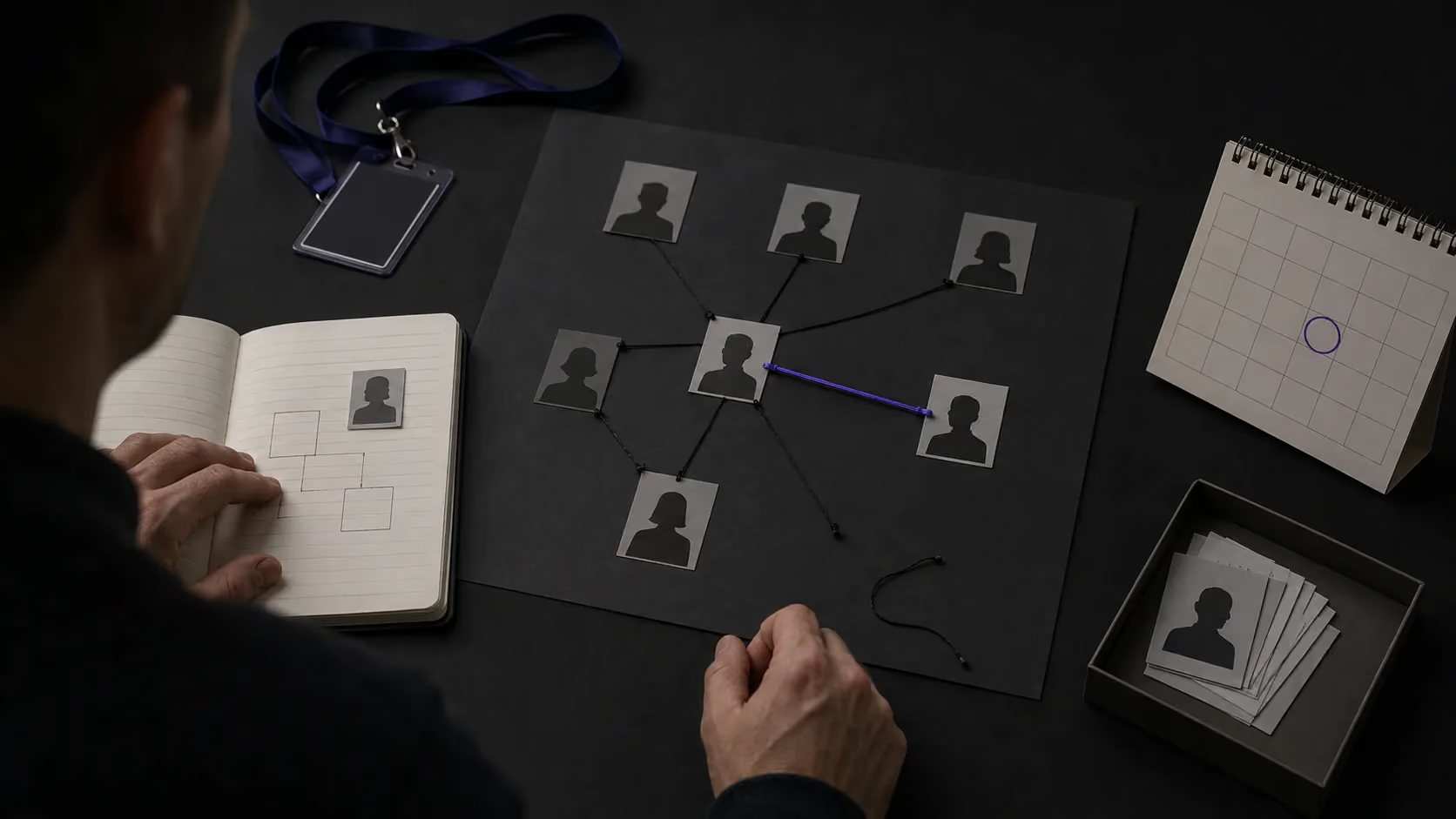
Then give each person a compact record: current company and role, relationship to the initiative, source of that information, observation date, confidence, internal owner, and next action. Add a connection to another person only when there is a reason to believe it exists.
An empty field should stay visible. If you haven't identified procurement, write “procurement contact unknown” instead of filling the space with the most senior purchasing title you can find.
Separate job titles from buying roles
A job title describes someone's position. A buying role describes what they do in a particular decision. One person may fill several roles; different people may share a role.
LinkedIn's buying committee guidance includes economic buyers, technical evaluators, users, executive sponsors, and procurement or compliance stakeholders. Use these as prompts for discovery rather than a fixed committee size that every account must match.
For an event conversation, translate each role into a question:
A friendly contact isn't automatically a champion. Look for behavior: they explain the internal process, correct your assumptions, or help arrange a relevant next conversation. Until then, “engaged contact” is a more accurate description.
Keep evidence and interpretation in separate fields
Use three simple states: observed, reported, and unverified hypothesis. These describe the evidence behind a claim, not a person's value.
“Spoke with us at the booth” is observed by your team. “Says their regional manager approves pilots” is reported by the contact. “Probably owns the global budget because of their title” is a hypothesis.
The distinction matters when several people repeat the same story. Three colleagues copying one salesperson's note still provide one source. Record where a statement began so repetition doesn't make an assumption look independently confirmed.

How to build an account map before a trade show
Begin with a small set of priority accounts and a concrete research question. You can expand the map when a new contact or observation changes what the team should do.
1. Define the account boundary and the buying problem
Choose the organization, division, and initiative you mean. Check company domains and existing CRM records before combining contacts. A subsidiary, distributor, and parent company can share branding while having different purchasing authority.
Write a working scope in plain English: “Understand who would evaluate a packaging inspection pilot at the European manufacturing division.” This is precise enough to guide research without pretending the project has already been approved.
Ask the account owner what the team already knows. Review existing opportunities, previous conversations, and any promised next steps. Event research should add context to that history. It shouldn't restart a conversation that another rep has already advanced.
Set a practical limit for the first pass. For example, map only the responsibilities needed to decide whether a discovery meeting is worthwhile. You do not need a complete corporate hierarchy before sending a relevant question.
2. Attach event evidence to the right person and company
An exhibitor record establishes a company-level event connection. A speaker page identifies a public role in a program. A person's event-related post may suggest interest. An accepted meeting invitation establishes an agreed meeting.
These observations support different statements. They should not all become “confirmed attendee” when imported into a spreadsheet.
Lensmor's platform documentation distinguishes Exhibitors, public Social Signals, and Visitors from organizer or data-partner sources. Keep those source categories visible while researching companies and people, then verify the specific relationship you intend to use.
A contact could be relevant to your buying map even if they never attend the event. The show may be where you meet the person who can introduce them. Conversely, a confirmed attendee could work in a division unrelated to the opportunity.
For interpretation of the activity itself, use the separate framework for B2B buying signals. The account map adds another question: what does this person contribute to the decision?
3. Mark role hypotheses and find the most useful gap
Place known contacts against the decision responsibilities. For each tentative assignment, add the supporting source and the question that would confirm or disprove it.
If a product engineer gave a technical presentation, you can record that expertise. You cannot infer that they approve purchases. Your next question might be: “Would your team evaluate a pilot, or does another group handle that?”
Choose the gap based on the current stage. During early discovery, finding the person who owns the problem may matter more than identifying the final signatory. During evaluation, an unknown security or implementation reviewer may become the immediate constraint.
Pro Tip: Give every unknown role a question and an owner. “Budget owner missing” becomes useful when it reads “Account executive to ask the project lead how pilot approval works.”
4. Plan introductions around a useful conversation
Match the proposed meeting to what the contact knows and can reasonably discuss. A technical evaluator may welcome a conversation about test conditions. A process owner may want to compare operational constraints. Neither needs a generic executive pitch simply because the event is approaching.
Use the existing relationship to ask for guidance: “Who else should help us check whether this would fit your workflow?” Explain why their involvement would make the conversation useful. An introduction should help the buyer do their work.
Coordinate the approach through one account owner. When marketing, sales, and a partner all know different people, an account map can help them avoid three overlapping requests. Record who will contact whom and what context they can legitimately reference.
Once the relationship path is clear, connect it to your plan to book meetings before a trade show. Keep meeting status separate from the relationship hypothesis so a tentative introduction doesn't appear as a booked appointment.
How to update the map during and after the event
A useful update changes the account story, the next action, or both. Adding every badge scan as an equally important node will make the map harder to use.
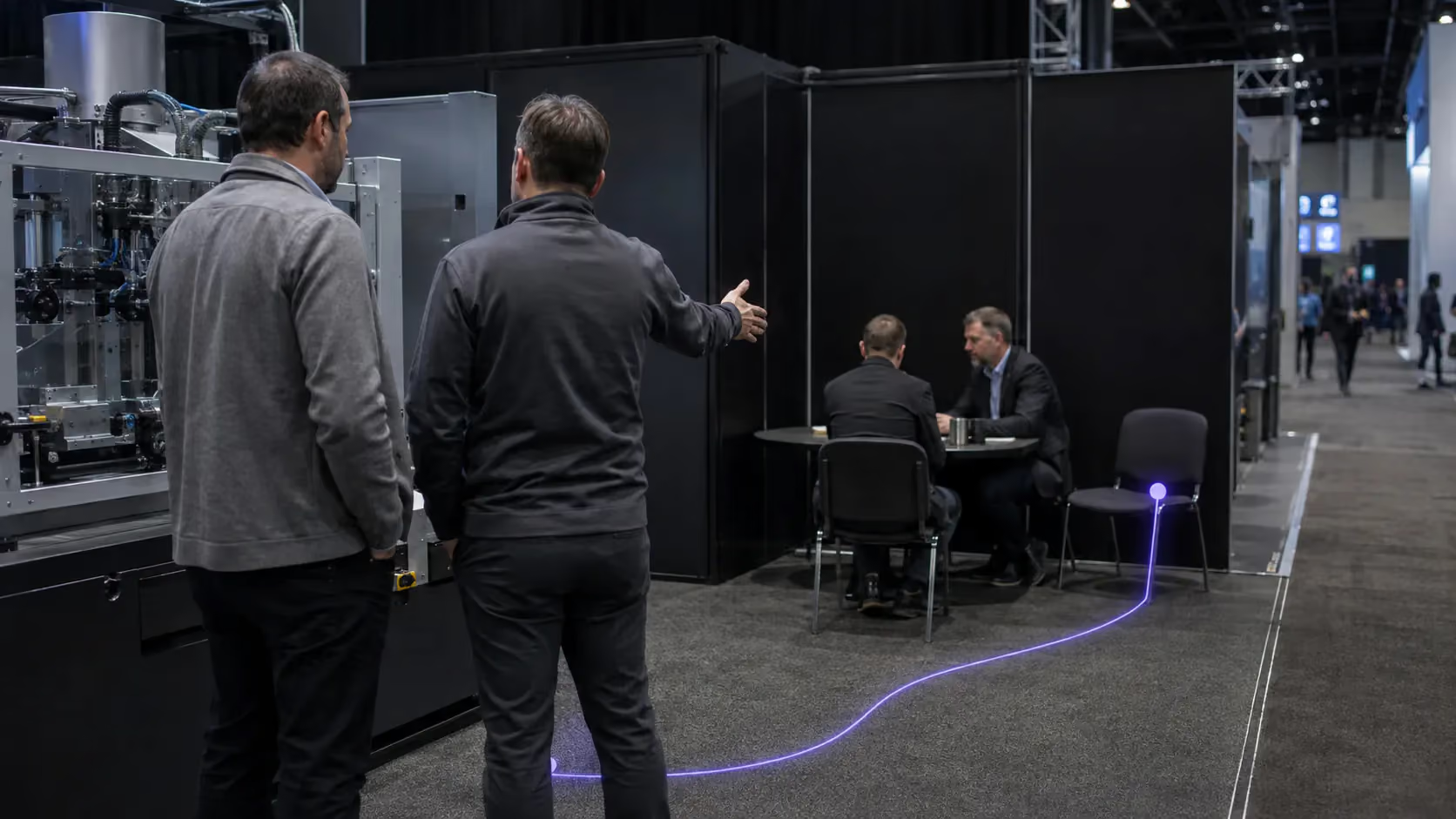
During a conversation, ask short questions that uncover the process naturally. “Who would use this day to day?” reveals one relationship. “What would need to happen before you could test it?” reveals a different one. Record the person's words closely enough that a teammate can distinguish what was said from your interpretation.
Capture notes promptly while the conversation is clear. Store the event and observation date, the internal person who heard the statement, and any promised follow-up. Avoid recording private personal detail that has no bearing on the business discussion.
If the contact corrects your map, treat that as progress. Learning that the project belongs to another division can save the team from preparing an irrelevant proposal.
After the show, the account owner should review conflicting notes before launching outreach. One rep may have heard “next quarter,” while another heard “no budget approved.” Both can be true: the buyer may be exploring a future project without authorization.
Pro Tip: Keep the correction history for consequential facts. “Previously assumed central purchasing; division lead confirmed local pilot approval” explains why the next action changed.
A hypothetical account map in practice
Imagine a supplier researching an equipment monitoring project. Before the show, the team knows an operations manager and has identified an engineer through a public conference session. Neither record proves that a purchase is active.
At the booth, the operations manager confirms responsibility for investigating downtime. They say the engineer would assess technical feasibility, while a regional director would decide whether to fund a pilot. The director's role is now reported evidence, still awaiting direct confirmation.
The next move is a feasibility discussion with the right participants. The example does not establish a qualified opportunity, an approved budget, or a sale.
A second conversation might reveal that the engineer works at a different plant. Update the boundary and preserve the correction. Keep them as a helpful technical contact if appropriate, but don't count them as confirmed coverage of the original initiative.
This is where a map earns its space: the team can see what changed and stop acting on an outdated assumption.
Which account mapping metrics should event teams track?
Measure what the team has learned and what the buyer has agreed to do. Keep those operating measures distinct from revenue attribution.
Start with priority-account coverage: the number of selected accounts with a reviewed map divided by the number selected for mapping. This measures whether the team completed its preparation, not whether the accounts are ready to buy.
Next, track the decision responsibilities you have identified and validated. If a particular initiative requires four responsibilities and two are confirmed, coverage is two of four for that initiative. Do not turn an arbitrary five-person committee into the denominator for every account.
Also record meaningful gaps resolved, introductions accepted, and agreed next steps completed. A smaller map with a verified evaluator and a completed discovery discussion may be more useful than a large map of unverified titles.
Review rejected hypotheses as learning. If an account has no relevant project or the event connection refers to a different division, the map has still informed a decision about where to spend effort.
For the contact-level outreach queue, apply your normal contact prioritization process. Keep it connected to the map, but don't replace the map with a single score that hides missing relationships.
Common account mapping mistakes to avoid
The biggest failure is letting a neat diagram imply more certainty than the evidence supports. Review the claims behind the connections before presenting the map in an account meeting.
First, avoid treating seniority as authority. A senior person may sponsor a conversation without owning the budget. Ask about the actual process.
Second, avoid merging every project at a company into one buying group. Keep separate initiatives distinct, even when a person participates in more than one. Cross-reference that person without collapsing the decisions.
Third, avoid treating another person's attendance as an introduction you already possess. A shared event gives you context for a relevant question; it doesn't establish a relationship or permission to imply an endorsement.
Finally, don't let the map become a private document that the account owner never sees. Agree where updates live and who resolves disagreements. A spreadsheet can work for a small pilot if ownership, dates, and evidence are clear.
Pro Tip: End the review by asking a teammate to explain the next action using only the map. If they need the original researcher to interpret it, simplify the notes and clarify the owner.
Put one account map to work
Choose an upcoming event, one priority account, and one buying problem. Record what you know, mark what remains uncertain, and identify the next conversation that would help the buyer and your team make progress.
Bring that map back after the conversation. Its value comes from the decisions it improves and the assumptions it helps you correct.
Start Free Trial — Start using Lensmor's event intelligence platform today. Predict attendee lists, discover relevant events, and enrich contact data for your next trade show.


.avif)