
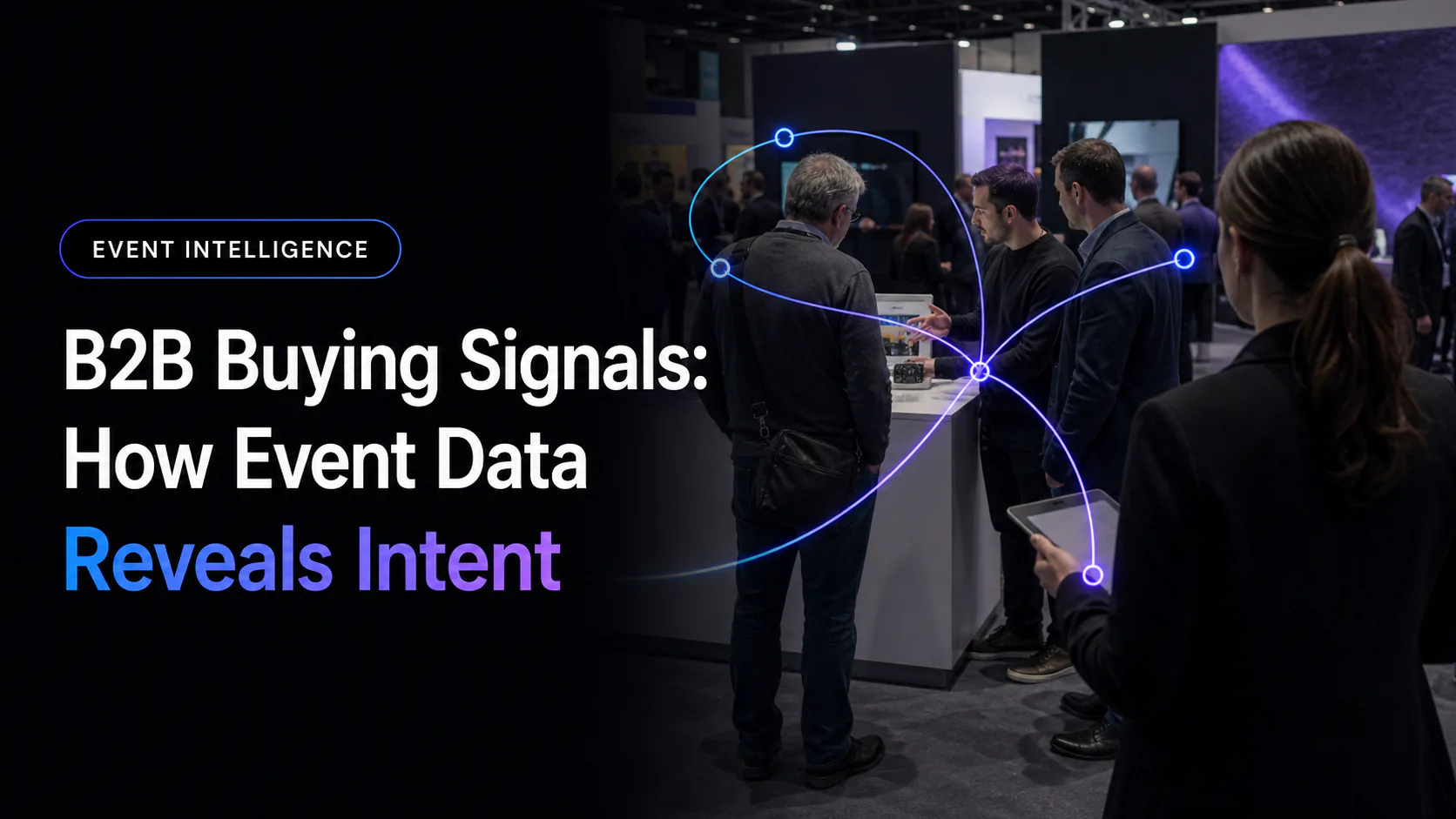
B2B buying signals are observable actions or changes that suggest an account may be moving toward a purchase. The useful signals reveal more than interest: they connect a relevant problem, the right people, credible timing, and a next step your team can take.
Event data belongs in that picture, but it needs careful interpretation. A company exhibiting at a trade show has committed budget to a market. A person speaking on a relevant topic has demonstrated expertise. A prospect accepting a meeting has made a direct commitment. These are different kinds of evidence, and none should be flattened into a single “high intent” label.
The practical goal is not to collect more signals. It is to rank evidence well enough that sales and marketing know which account to prioritize, why the timing matters, and what to do next.
What are B2B buying signals?
A B2B buying signal is evidence that an organization may be researching, evaluating, or preparing to purchase a product or service. Signals can come from first-party behavior, third-party research, company changes, sales conversations, or physical-world activity such as trade shows and conferences.
Salesforce describes buying signals as communication cues that indicate interest, while LinkedIn's buyer-intent guide focuses on the actions prospects take as they research and decide what to buy. Both definitions point to the same operating truth: a signal is evidence to interpret, not a verdict.
That distinction matters in a long B2B buying cycle. One content download may come from a student, consultant, competitor, or early researcher. One conference registration may never become attendance. One pricing question may be a serious evaluation or a budget check for next year.
The signal becomes useful when your team can connect it to four questions:
- Fit: Is the account the kind of company you can serve?
- Problem: Does the behavior relate to a problem your product solves?
- Timing: Is there a reason to act now rather than next quarter?
- Commitment: Has the account invested time, money, reputation, or internal coordination?
Strong prioritization requires all four. Intent without fit wastes sales time. Fit without timing produces generic outreach. Timing without a relevant problem creates a news alert, not a sales opportunity.
Why signal quality changes event economics
Signal quality determines whether an event program concentrates effort or spreads it thin. A team can have thousands of contacts and still miss the 20 accounts with a credible reason to engage.
Consider an illustrative planning scenario, not an industry benchmark. A company is evaluating a $60,000 event investment and expects an average first-year contract value of $30,000. If the team needs four qualified opportunities to justify the program and assumes 25% of qualified opportunities close, it needs 16 qualified opportunities:
4 expected wins ÷ 0.25 close rate = 16 qualified opportunities
Now compare two research approaches. The first gives 800 unranked contacts. The second identifies 80 target accounts, 24 accounts with relevant event evidence, and 16 accounts with both evidence and an agreed sales owner. The second list is smaller, but it maps directly to the operating requirement.
The point is not that 16 opportunities will appear. The assumptions must come from your own history, and the model should include conservative, base, and strong cases. The math simply exposes whether the signal program can support the business target before the show opens.
Pro Tip: Write every planning assumption beside the number. “25% close rate” is useful only when the team knows which stage, segment, and time window produced it.
What is the difference between intent data and buying signals?
Intent data is collected behavioral information; buying signals are the interpreted evidence used to make a decision. The two terms overlap, but treating them as synonyms hides important differences in source, confidence, and actionability.
First-party intent data comes from properties your company controls: website sessions, product usage, webinar attendance, email engagement, form submissions, and sales interactions. Google, for example, describes customer data used in Analytics as consented first-party data and emphasizes matching and measurement controls in its first-party data guidance.
Third-party intent data observes research or engagement outside your owned properties. It may identify a company-level increase in activity around a topic, but it often cannot tell you which person has authority, what problem they are solving, or whether the activity represents a current project.
Buying signals are the decision layer. Your team combines intent data with account fit, relationship history, company changes, event activity, and direct conversations. The result should explain what the evidence means and what action it supports.

The most reliable model preserves these differences. It does not convert every source into one mysterious score and ask sellers to trust it.
Which B2B buying signals are strongest?
The strongest B2B buying signals combine relevance, recency, specificity, and commitment. A signal becomes more credible when it is clearly connected to your category, happened recently, points to a specific account or person, and required a meaningful action.
Direct evaluation signals
Direct evaluation signals sit closest to a purchase decision. A prospect confirms a problem, brings a decision-maker into the process, asks for security documentation, discusses implementation, requests pricing for a defined scope, or agrees to a dated next step.
These actions do not guarantee a purchase. They do show that the evaluation has moved beyond passive interest. Sales should record the source, date, participants, and agreed action instead of merely increasing a score.
First-party engagement signals
First-party engagement is useful because your company can see the sequence. One pricing-page visit is ambiguous. A known account returning to product, integration, security, and pricing pages within a short window is more specific.
The pattern matters more than the isolated click. Tie engagement to account fit and relationship context. An existing customer exploring an integration page should not enter the same workflow as a net-new prospect doing the same thing.
Company-change signals
A new executive, funding round, market expansion, hiring plan, acquisition, regulatory deadline, or technology migration can create a reason to evaluate. These signals are valuable for timing, but they say little about your solution on their own.
The right question is not “Did the company raise money?” It is “What changed, which team now owns the consequence, and does our product address that consequence?”
Event signals
Event signals reveal market participation in a defined place and time. They can show which companies are investing in a category, which experts are shaping the conversation, and where face-to-face access may exist.
They also create a common failure: treating every event connection as attendance and every attendance signal as purchase intent. A company may exhibit to recruit partners, serve customers, monitor competitors, build its brand, or sell its own product. A speaker may attend only for one session. A historical attendee may not return.
Pro Tip: Store the event role and source beside the signal. “Official exhibitor,” “announced speaker,” “publicly confirmed attendee,” “historical participant,” and “predicted attendee” should never collapse into one field.
How should you score event buying signals?
Score event signals by evidence strength before adding account fit or sales context. This keeps the model explainable and prevents a low-confidence prediction from looking equal to a confirmed meeting.
Use a four-level evidence ladder:

After evidence strength, add three separate dimensions:
- Account fit: industry, size, geography, use case, technology environment, and strategic value.
- Problem fit: whether the observed topic or event role connects to a problem you solve.
- Relationship context: net-new account, active opportunity, customer, partner, former evaluation, or known disqualification.
Do not hide these dimensions inside one total if sellers cannot see the components. A score of 87 means nothing without an explanation. “Official sponsor, priority industry, active opportunity, executive meeting not yet scheduled” tells the owner what to do.
Pro Tip: Let evidence set the language. Confirmed signals support direct wording; modeled signals should trigger research or a hypothesis, not “We know you'll be there.”
How to turn B2B intent data into an action queue
A signal becomes valuable only when it changes a decision. The workflow below turns evidence into an owner, message, and next step.
Step 1: Define the decision before collecting data
Start with one operational question. Which accounts deserve pre-show meeting outreach? Which open opportunities should receive executive attention? Which exhibitors match a partner program? Which market should influence next year's event budget?
A clear decision protects the team from collecting every available field. If the decision is meeting outreach, the minimum useful record may be account, person, event role, evidence source, confidence, fit, relationship stage, owner, and proposed reason to speak.
Step 2: Separate identity from activity
Identity answers who the company and person are. Activity answers what happened. Keep them separate so that stale activity does not become a permanent trait.
An account can remain a strong ICP match even after an event signal expires. A weak-fit company can produce intense activity without becoming a useful prospect. Your data model should allow both truths to exist.
Step 3: Preserve source and time
Every signal needs a source, observed date, and expiration rule. An accepted meeting remains relevant through the event and immediate follow-up. A public post about attending becomes stale once the event ends. A historical participation pattern may remain useful for annual planning but not for person-level outreach.
This is where many intent programs fail. They retain the score but lose the evidence trail.
Step 4: Combine signals without double-counting
Several tools may observe the same underlying action. A website visit appears in analytics, marketing automation, an account-intelligence platform, and the CRM. Counting four records as four independent signals exaggerates confidence.
Group evidence by underlying event. One person viewing three related pages in one session is an engagement sequence. The same session replicated across systems is still one sequence.
Step 5: Assign an owner and a next-best action
A signal queue without ownership becomes another dashboard. Route active opportunities to the account executive, customer expansion signals to the customer owner, strategic accounts to the appropriate executive sponsor, and net-new event research to the prospecting team.
The next action should fit the evidence. A confirmed meeting needs preparation. An official exhibitor may deserve account research. A modeled attendee may need verification. A pricing-page return from an active opportunity may require a direct sales follow-up.
Step 6: Record the result
Track whether the signal was verified, rejected, ignored, or converted into a useful conversation. This feedback improves both the model and the source.
For event programs, useful result fields include account accepted by sales, person verified, meeting offered, meeting accepted, conversation held, next step agreed, opportunity created, and opportunity advanced. Each result belongs to a specific stage.

Pro Tip: Review false positives every month. A source that creates many alerts but few verified accounts should lose weight, even if its dashboard looks busy.
What should a B2B signal scorecard include?
A useful scorecard shows evidence, confidence, and action—not just a rank. Keep enough detail for sales to challenge the conclusion.
The scorecard can live in a CRM, data warehouse, spreadsheet, or event-intelligence workflow. The system matters less than the discipline. Sellers should be able to open a record and understand why it is prioritized in under a minute.
Where event intelligence fits
Event intelligence adds time, place, and market context to B2B intent data. It helps teams see where target accounts are investing attention and where a relevant interaction may be possible.
Lensmor's role is to help teams research events, exhibitors, likely attendees, and contact context before the show. That evidence is most useful when it travels with its source and confidence into the team's existing sales workflow.
For a deeper look at one source, read why the exhibitor list is an overlooked GTM signal. To keep weak records out of the queue, use the guide to separating event signal from data noise. And before choosing a source, compare what an exhibitor list and attendee list can actually prove.
The operating principle is simple: event evidence should increase relevance, not manufacture certainty.
Conclusion
B2B buying signals work when they help a team make a better decision with less guesswork. Preserve the source, separate fit from activity, rank evidence by confidence, assign an owner, and feed the result back into the model.
Event data strengthens that system by adding a defined market moment. Use it to prioritize research and conversations, but let the evidence determine what you claim.
Start Free Trial — Start using Lensmor's event intelligence platform today. Predict attendee lists, discover relevant events, and enrich contact data for your next trade show.



.avif)