
A useful event sponsorship strategy answers three questions before anyone signs: which buyers can we reach, what interaction are we buying, and what would justify the full cost?
Picture a $50,000 proposal arriving with a Friday deadline. It includes a booth, a speaking slot, executive passes, and enough logo placements to fill a slide. Sales likes the event. The package sounds substantial. Yet nobody has priced the production work or established whether the people you want can actually attend your session.
That is the decision this guide addresses. For B2B sponsors, a defensible approval connects audience evidence, usable rights, delivery capacity, and commercial expectations. The result should be a clear choice: approve, renegotiate, run a smaller test, or decline.
What is event sponsorship?
Event sponsorship is an agreement in which a company contributes money, products, or services in exchange for specified promotional or engagement rights associated with an event. Those rights might include exhibition space, a hosted discussion, brand placements, hospitality, or access to an approved lead-capture process.
The agreement gives you an opportunity to engage an audience. Your team still has to create the reason to engage, staff the experience, and earn a next conversation.
That distinction matters when comparing sponsorship with simply attending. A delegate pass might already let your sales team hold useful meetings. Paying more makes sense when the additional rights remove a real constraint: access to a relevant audience, space for a technical demonstration, or a credible setting for an executive discussion.
Start with the full budget and the business case
Price the work required to use the package before judging its value. A low rights fee can conceal an expensive activation; a larger fee can include services you would otherwise buy separately.
Here is a hypothetical budget for the $50,000 proposal. These figures illustrate a planning method, not typical market prices or Lensmor customer results.
Check whether taxes, mandatory venue services, or cancellation exposure add anything to your own estimate. Avoid counting staff costs twice if another line already includes them. Track the contingency separately and replace it with actual expenditure in the final report.

Suppose the team plans for 20 held, qualified meetings and eight sales-accepted opportunities. At the $85,000 envelope, that means $4,250 per qualified meeting and $10,625 per opportunity. A calendar booking or badge scan does not meet either definition.
Now assume those eight opportunities average $40,000 each: $320,000 in pipeline. That is 3.76 times the proposed cost, but it is still potential business. It is not a 276% return.
For a later outcome example, assume actual all-in cost reaches $85,000, two deals close, and the resulting $80,000 revenue earns a 75% gross margin. Gross profit is $60,000. On that basis, return is ($60,000 − $85,000) ÷ $85,000 = −29.4%. Three equivalent wins would generate $90,000 gross profit and a 5.9% return.
This simplified model excludes further acquisition costs and assumes the revenue can reasonably be credited to the program. Use your finance team's agreed cost, attribution, and time-period definitions. The arithmetic makes the decision visible; it does not prove causation.
Pro Tip: Approve the rights fee and activation funding together. If someone later cuts the activation budget, reopen the expected-outcome discussion before preserving the original target.
Build the decision in five steps
1. Give the sponsorship one primary job
Choose the outcome that will govern the purchase. Pipeline creation, customer relationships, product education, and awareness can all justify sponsorship, but each requires a different experience and evaluation method.
A pipeline brief might read: “Create 20 held meetings with operations leaders at named target accounts, with eight opportunities accepted by sales within 60 days.” Those are hypothetical targets. Their usefulness comes from defining who, what, and when.
For that brief, define a qualified meeting as one with a relevant account and role, a documented business need, and an agreed next step. Sales should accept the definition before marketing buys the package. Otherwise, the event can hit its meeting target while sales disputes every handoff.
If the primary job is customer engagement, use account-team evidence: which relationships need attention, which executives should meet, and what progression would matter. Do not force dinner attendance into a new-pipeline calculation just because that metric is easier to put on a dashboard.
Secondary benefits belong in the brief too, with their own measures. They should not quietly replace the primary outcome when results disappoint.
2. Ask for audience evidence you can actually evaluate
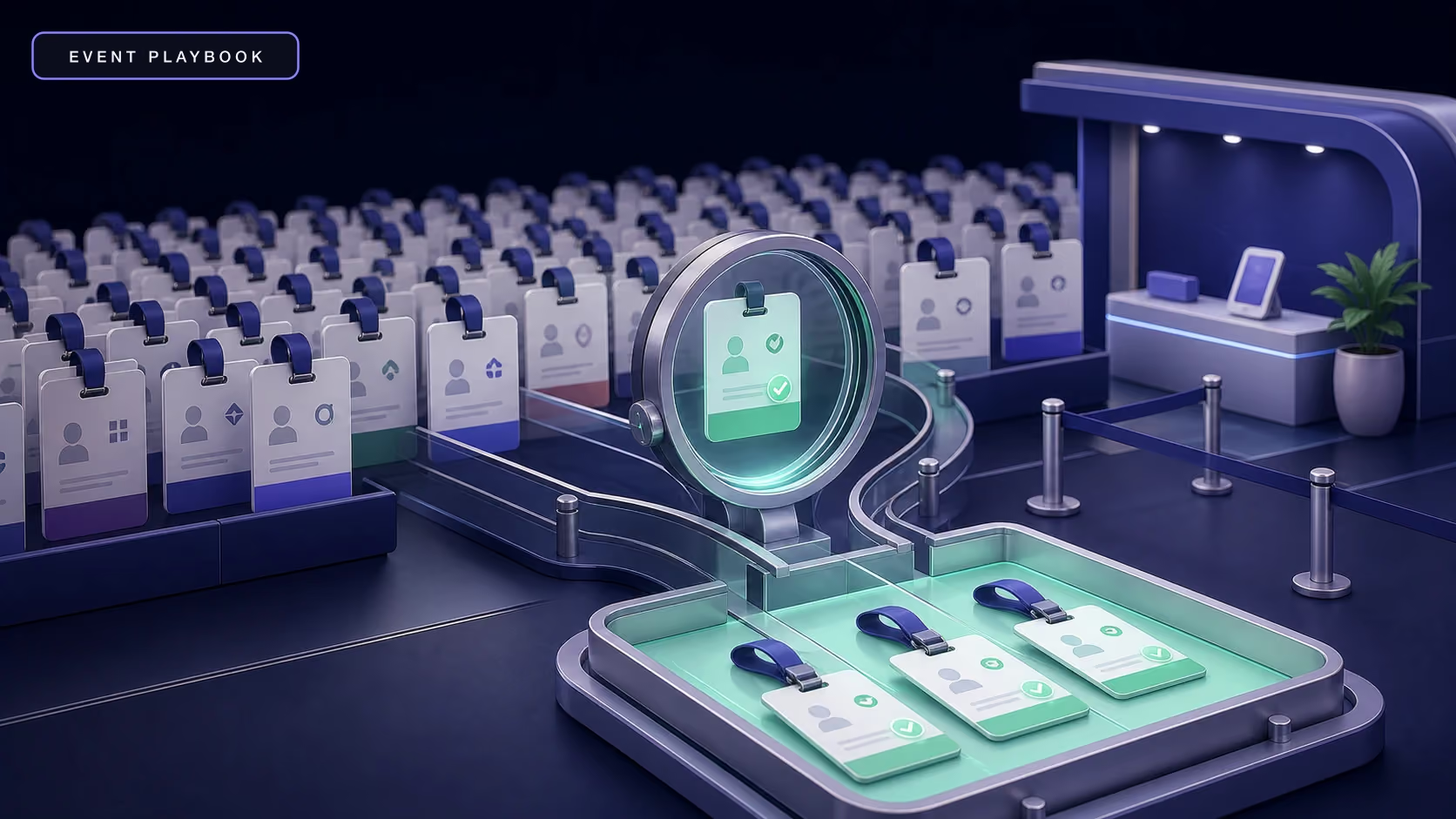
The organizer's headline attendance number is a starting point. Request the population behind it: current registrations or previous check-ins, in-person or virtual participation, and whether speakers, exhibitors, and sponsor staff are included.
Then narrow the evidence to your market. You need company characteristics and buying roles together. A conference can have many enterprise attendees and many operations leaders without having many enterprise operations leaders.
Cvent's organizer guidance recommends giving B2B sponsors details about roles, company size, industry, and buying authority. It also distinguishes historical event evidence from the community data available to a first-time event. That is a useful basis for the questions you send back. Cvent's sponsorship proposal guidance.
Ask for a dated, aggregate breakdown that answers:
- How many attendees match our industry, company-size, geography, and role criteria together?
- Which figures describe last year's actual audience, and which describe this year's registrations or expectations?
- What portion of that audience can use the specific session, meeting program, or hospitality right we are considering?
- What evidence supports comparable sponsors' engagement results, and how were those results counted?
An anonymized breakdown can answer many of these questions without transferring personal data. A logo wall cannot: it may represent a past participant, an exhibitor, or a single employee with no connection to your buying committee.

Next, explain how enough of those people could reach your activation. If the financial case requires 20 qualified meetings but the relevant audience is only 30 people, the proposal needs unusually strong access evidence. Room capacity does not establish that access.
For a new event, missing historical attendance is expected. Reduce the commitment to match the uncertainty: a smaller activation with a defined learning objective may be reasonable. Record the assumption explicitly instead of giving an untested audience the same confidence as demonstrated attendance.
The broader trade show selection framework helps establish whether the event belongs on your shortlist. Sponsorship diligence then tests whether its paid rights improve on ordinary participation.
3. Buy the interaction that supports your goal
Break the package into individual rights and trace the attendee journey for each. How will the right person discover it, choose to participate, arrive, engage, and agree to a next step?
A speaking slot needs more than a room. Ask who selects the topic, where it appears in the agenda, what runs concurrently, and how the organizer promotes it. A networking feature needs an adoption and invitation process. A dinner needs guests who have a reason to attend beyond receiving another sales pitch.
Value optional inventory at what you would independently pay for it. If you would never buy the app banner, its inclusion should not turn a weak package into a strong one.
Also compare a smaller sponsorship, delegate attendance with permitted meetings, and the best non-event use of the budget. Include any relevant event or venue restrictions in that comparison; do not assume an offsite activation grants access to the organizer's audience.
Pro Tip: Ask for the invitation or promotion journey before requesting a discount. Improving one missing step can matter more than reducing the price of an activation nobody discovers.
4. Confirm the team can deliver what the model assumes
For each valuable right, name an owner, a deadline, a cost, and an organizer dependency. A sales director agreeing that an event looks promising is different from committing two account executives to attend and follow up.
Work backward from the first irreversible deadline. If the speaker abstract is due before the product team can approve the topic, resolve that conflict now. If a hosted discussion requires recruitment during the team's busiest launch, reserve capacity or simplify the activation.
Stress-test the $85,000 example. If the speaker becomes unavailable, can another qualified person deliver the session? If shipping costs rise, what does the contingency cover? If meeting acceptance is weak, is there a useful alternative experience, or does the primary outcome become unlikely?
Write the fallback and its trigger alongside the plan. This gives the team permission to change course while there is still time to protect the investment.
5. Score the opportunity, then apply veto conditions
Use a scorecard to make judgment visible. The following weights and thresholds are an illustrative starting policy, not an industry standard or a proven predictor of ROI.
Score each criterion from zero to five. Zero means it fails; three means adequate with documented limitations; five means strong evidence and a workable plan. Intermediate scores represent intermediate strength. Weighted points equal the score divided by five, multiplied by the weight.
Attach the evidence, its date, and the unresolved assumption to each score. Unsupported optimism should not receive a five because someone feels confident about the event.
Under this example policy, 75 or more proceeds to approval, 60–74 requires negotiation or a bounded pilot, and below 60 is declined. A score of 71 therefore stays conditional. If stronger access and reporting terms each lift their score from three to four, the total becomes 78.

No total overrides these veto conditions:
- Audience fit scores two or lower, or the critical audience assumption remains unsupported.
- The required interaction is unavailable under the actual package terms.
- There is no committed owner or sufficient activation budget.
- The data or reporting available cannot support the primary outcome's measurement plan.
- The business case depends on treating all pipeline as revenue or assigning all existing opportunity value to the sponsorship.
An unresolved veto pauses approval until the evidence or plan changes. If it cannot be resolved, decline. A discount can improve the economics; it cannot supply a missing buyer audience.
Pro Tip: Have marketing and sales score audience fit and access independently, then discuss their largest differences. The disagreement often identifies the assumption that deserves another organizer question.
Turn open questions into negotiation terms
Negotiate around the gap between the proposed package and your operating plan. For the hypothetical 71-point opportunity, the priority is stronger access and reporting. Another logo placement leaves both weaknesses intact.
Replace broad promises with observable deliverables:
Ask what happens if a material right changes: a canceled session, different venue, removed meeting feature, or missed promotion. Put the agreed replacement, credit, refund, or other remedy into the contract through your normal procurement review. A verbal assurance will be difficult to reconcile when the onsite team is solving a different problem.
Personal-data access needs its own diligence. A searchable event directory, opt-in lead export, and badge-scanning tool enable different workflows. Confirm the applicable permissions and use conditions with the organizer and your data owner before planning outreach. Do not assume that paying a fee provides unrestricted use of attendee details.
Keep the commercial request specific. “Replace the banner with a promoted technical workshop and supply the agreed engagement report within ten business days” is assessable. “We need more value” gives the organizer little to work with.
If the organizer cannot provide a critical right, consider a smaller experiment only when it answers a useful question. Name that question, cap the expenditure, and define the evidence needed before expansion. A pilot should earn the next commitment.
Measure delivery, pipeline, and revenue separately
Before signing, agree on three reporting layers. First, delivery: did the organizer and sponsor fulfill their commitments? Second, audience behavior: who attended, engaged, or accepted a next step? Third, commercial progression: what happened in the CRM afterward?
Use distinct records for sourced opportunities and engagement with opportunities already open. Under an agreed sourced rule, the event originates the opportunity. An influenced label records a qualifying event interaction with an existing opportunity. Adding both totals together can count the same deal twice.
Attribution is an accounting policy for reporting credit; by itself it does not establish what would have happened without the sponsorship. Compare results with relevant previous programs or an appropriate comparison group where feasible, and acknowledge differences that weaken the comparison.
For digital placements, use consistent campaign links. Google documents how UTM parameters identify referral campaigns in Analytics, including source, medium, campaign, and creative content. Use these for traffic reporting, then reconcile meaningful interactions with your CRM. They do not automatically prove an onsite meeting or a sale. Google's campaign URL guidance.
Record the account, contact, interaction, owner, next step, and relevant permission status. Deduplicate before calculating unique meetings or opportunities. Keep a snapshot of opportunities already open before the event so later influence claims remain reviewable.
Set reporting dates that fit the sales cycle. An early review can confirm delivery and follow-up; a later one can evaluate accepted opportunities; revenue may need a longer window. Label interim pipeline as interim. The event ROI framework covers the broader measurement process.
Pro Tip: Agree on the renewal review date before agreeing to a renewal deadline. If the organizer wants a commitment before commercial results mature, make the unresolved evidence part of the decision.
Make approval start a working plan
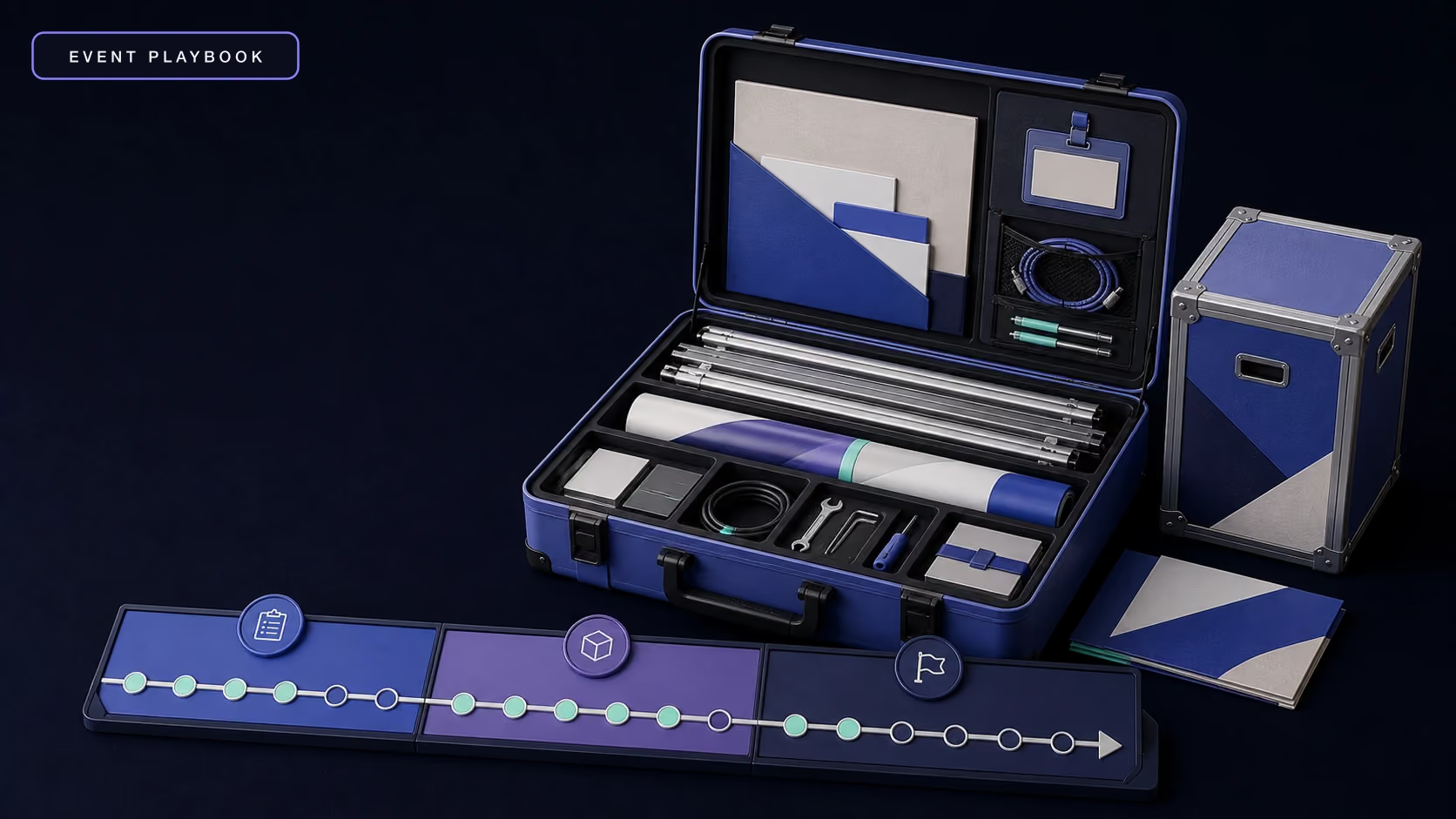
Within the first week after approval, turn the decision brief into a shared schedule. Give every contracted right and internal deliverable one accountable owner. Attach the agreement, budget, evidence, campaign definitions, and organizer contacts where the team can find them.
Use four practical checkpoints:
- Before production: confirm specifications, owner capacity, and the final activation budget before ordering materials.
- Before invitations: confirm the audience route, approved messaging, meeting availability, and permitted contact use.
- Before doors open: verify placements, session logistics, capture tools, staffing, and the escalation contact for missed rights.
- After the event: reconcile delivery and actual cost, complete promised follow-up, and review pipeline and revenue at their agreed dates.
At the review, compare the result with the original assumptions. If meetings were scarce, investigate audience fit and access. If meetings happened but opportunities did not, examine qualification and the proposition. If opportunities stalled, involve the account teams before blaming the event or claiming success from pipeline alone.
A missed target can still produce a useful decision when the evidence shows what changed. An unexplained total of scans cannot tell you whether to renew, redesign, or leave.
Make the next proposal earn its approval
Take the next sponsorship deck and produce a one-page decision: primary outcome, audience evidence, valuable rights, full cost, delivery owners, score, unresolved vetoes, and the best alternative. Close the gaps that could change the purchase before spending time polishing the approval presentation.
Lensmor supports the early research by helping teams discover trade shows, examine exhibitors and likely attendees, and research relevant contacts. Use those signals to build a shortlist and ask better organizer questions. Likely attendance remains a research signal until separately confirmed. Explore Lensmor's event research capabilities.
Start Free Trial — Research relevant events and prospects before committing your sponsorship budget.