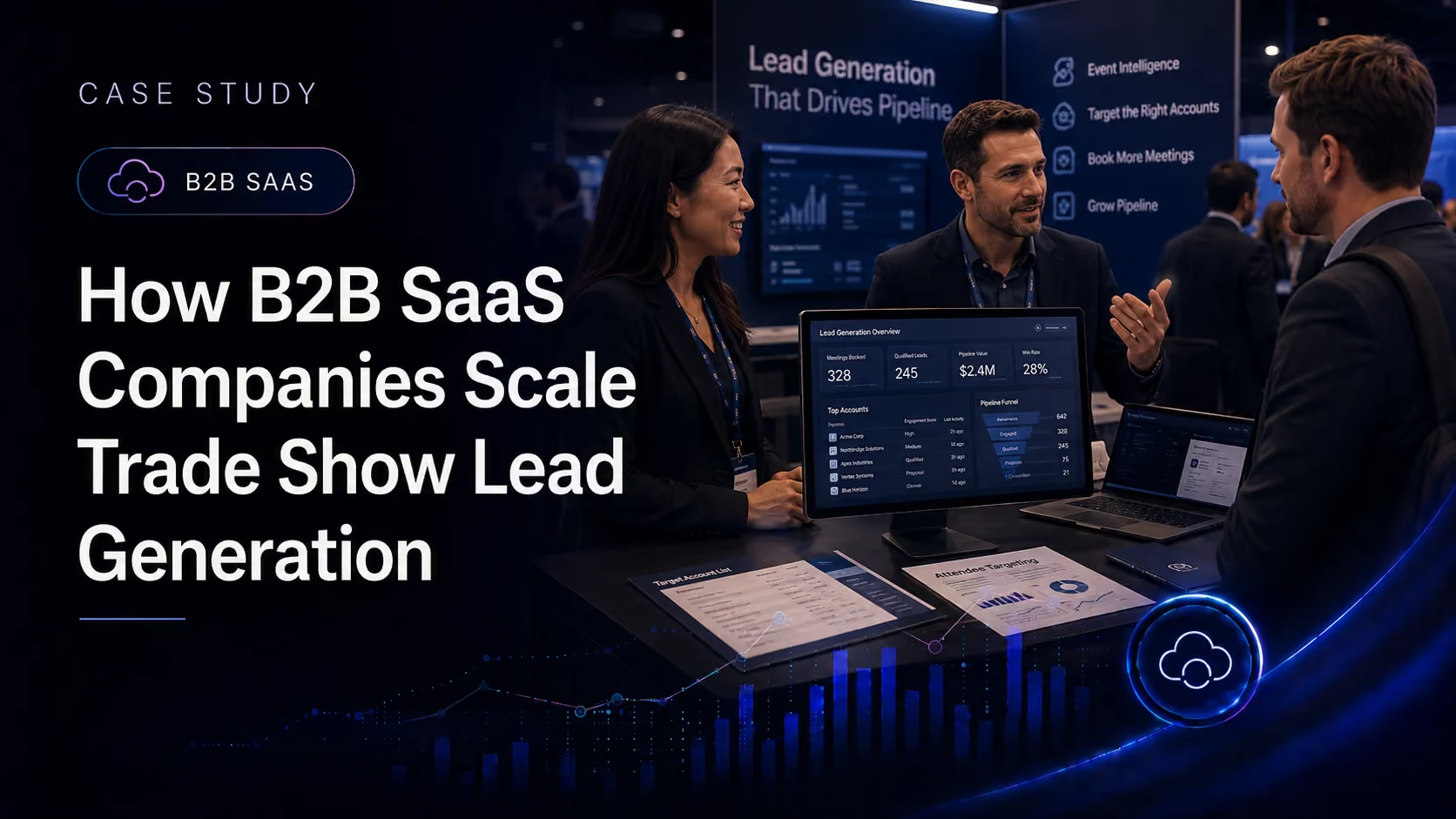
B2B SaaS lead generation scales across trade shows when companies replace an organizer-dependent, one-event-at-a-time research process with a single ICP and title filter that runs the same way on every show, then hand the output to SDRs as a standing queue instead of a one-off export.
This anonymized case study follows a growth-stage B2B SaaS company evaluating that shift. The company name, employee names, event names, commercial terms, and identifying calendar details have been removed. The operating problem has not.
The company's event calendar had grown far faster than its event marketing headcount. A handful of flagship industry conferences justified real investment: a staffed booth, executive travel, and a coordinated pre-show campaign. Beyond those, the sales team kept adding smaller regional and vertical conferences as it tested new markets, expanding the plan into a double-digit calendar across the coming quarters.
A lean team had recently taken over event strategy. There was no established process for getting a usable attendee list across that calendar — just a relationship with each organizer, and whatever came back when someone asked. Some organizers shared a list without being asked twice. Most did not share anything until the team followed up, and a few never did.
What does it mean to scale B2B SaaS lead generation across trade shows?
Scaling B2B SaaS lead generation across trade shows means running one repeatable attendee-research and qualification process across the entire event calendar, instead of a custom process for each show that depends on organizer cooperation.
Most B2B SaaS event programs start small. A company picks a few flagship conferences, invests heavily in each, and builds a manual process around them: request a sample attendee list, review it by hand, filter for the right titles, and hand a short list to sales. That process works when there are only a few events a year.
It breaks when the calendar triples or quadruples. The company cannot ask an event marketer to manually chase, review, and filter dozens of organizer relationships with the same headcount that used to manage a handful.
Some organizers will not share a list at all. Others share one that is incomplete, outdated by the time it arrives, or in a format — a scanned PDF, a locked spreadsheet, a portal login that expires — that takes hours to make usable on its own.
Scaling the process means the qualification logic — the ideal customer profile and the priority titles — gets defined once and applied automatically to whatever event data is available, rather than rebuilt by hand for each show. Salesforce's guide to an ideal customer profile frames the ICP as a reusable filter built from a company's best customers, not a one-time exercise for a single campaign. That reusability is the entire point once a calendar reaches double digits.
Trade shows are one channel inside a broader B2B SaaS lead generation mix. Their advantage is timing and context: target accounts are already gathering around a known business problem. Their operational weakness is that every event creates another research, qualification, and sales-handoff cycle.
Why do trade shows become a B2B SaaS lead generation bottleneck?
A process that only works for a handful of hand-picked shows effectively takes the rest of the calendar out of the pipeline conversation.
Use a capacity-planning assumption, not this company's measured result. If requesting, reviewing, and filtering an attendee list takes 15 hours per event — including organizer outreach, spreadsheet cleanup, title filtering, and handoff — one event marketer has time to work four shows a quarter and little else. Applying that process to the other sixteen shows on a twenty-event model would require another 240 hours.
The realistic outcome is not slightly weaker execution across those sixteen shows. Most receive almost no pre-show work: the company arrives without a qualified list, and any pipeline depends on whoever happens to stop by the booth.
Under a second planning assumption of two hours per event, the same team could cover all twenty events in about 40 hours instead of 300. That model assumes the ICP and title filters already exist and the team no longer chases a separate organizer list for every show.
That example does not predict time savings, demos, pipeline, or revenue. It only shows how a non-repeatable process creates a capacity ceiling.
Pro Tip: Track hours spent per event, not hours spent on event marketing in total. A team can look fully staffed while still leaving most of the calendar effectively unworked.

Should every trade show receive the same research investment?
No. A scalable event program gives flagship shows deeper research and the rest of the calendar a repeatable baseline.
A handful of flagship conferences still deserved deep investment: executive meetings, account mapping against named target companies, and a coordinated pre-show campaign. Those shows justified the heaviest research the team could produce, including cases where an organizer-provided list was still the right starting point.
The rest of the calendar needed a different bar. Those events did not need a hand-built account plan. They needed a baseline: a filtered attendee list, sorted by ICP fit and priority title, handed to an SDR with enough context to start a conversation. Treating every event like a flagship show would burn the team out. Treating every event like an afterthought would waste the travel and booth spend the company was already committing.
The practical model split the calendar into two tiers:
- Tier 1 — flagship shows: Heavy account research, executive involvement, and, when available, a direct organizer relationship for attendee data.
- Tier 2 — the growing calendar: A repeatable, lighter-weight process that produces a usable SDR queue without depending on any single organizer's cooperation.
Where did the previous workflow break?
The previous workflow was not missing sources. It was missing a way to apply the same qualification logic to every source.
| Decision point | Previous constraint | Required B2B SaaS lead generation workflow |
|---|---|---|
| Which events get a working attendee list? | Only the events where an organizer proactively shared one | Every event on the calendar gets a baseline list regardless of organizer cooperation |
| How is the list qualified? | ICP and title review happened by hand, per event, when there was time | The same ICP and title filters apply automatically to any event's attendee data |
| Who receives the qualified list? | An ad hoc handoff — sometimes a spreadsheet, sometimes nothing | A standing SDR queue with a clear owner assigned per event |
| What happens to accounts already in the pipeline? | No link between event data and open deals | Attendee data is cross-checked against open opportunities to flag accounts that are attending |
| What does "attendee" actually mean? | Registered visitors, exhibitors, and social signals were treated as one list | The source and confidence behind each record stay visible through the handoff |
| How does coverage grow without adding headcount? | Each new event added linear manual work | One filter and export process scales to new events without new manual setup |
The team did not need to replace its CRM, dialing tools, or email platform. It needed an event-intelligence layer that standardized qualification across the entire calendar.

What is the difference between confirmed and predicted event participation?
Confirmed registration can support a direct attendance claim. Predicted or contextual signals should support softer event-based outreach.
An event-person view may bring together official registration records, exhibitor associations, historical participation, and public activity. These sources can help prioritize an event or account, but they do not prove the same thing.
An individual's name on an official registration record, when that data is available, can support a statement such as "I saw you're attending." An official exhibitor listing confirms a company's booth presence, not that a specific employee is registered. Predicted participation is a research signal, not registration proof.
| Evidence type | What it confirms | Appropriate outreach language |
|---|---|---|
| Confirmed registration record | The named person appears on an official attendee record | A direct attendance reference, provided the source is current |
| Confirmed exhibitor association | The company has an official booth or exhibitor listing | Reference the company's event presence, not the individual's registration |
| Predicted participation signal | Public activity or historical patterns suggest the person may attend | Use broader event context without claiming confirmed attendance |
Pro Tip: Keep the evidence type and source beside each record. Use direct-attendance language only when the source confirms the person, not merely their company or booth.
How did the company design the scalable workflow?
The proposed workflow moved from calendar tiering to standing qualification, SDR handoff, pipeline cross-reference, and portfolio-level budgeting.
1. Split the calendar into two tiers before building any list
The team would classify each event as Tier 1 or Tier 2 before deciding how much research it deserved. This would keep the flagship shows from losing investment while preventing the growing calendar from consuming time it did not have.
2. Define the ICP and priority titles once, then apply them everywhere
Because the company's buying committee was often simple — the person who could say yes was usually the CEO or the owner — the qualification logic did not need to be complicated. It needed to be consistent. The same company-fit criteria and the same priority titles applied whether the event was a flagship conference or a smaller regional show.
Pro Tip: Resist the urge to write a custom ICP for each event category. One well-defined filter that runs everywhere beats dozens of slightly different versions that nobody has time to maintain.
3. Build a standing SDR queue per event, not a one-off export
Rather than emailing a spreadsheet once and moving on, each event would get a queue with a named owner: who reviews it, who works it, and by when. This would matter most for Tier 2 events, where there was no flagship-level attention to catch a dropped list.
4. Match outreach language to the participation evidence
SDR messaging would reference confirmed attendance only when the underlying record supported it. For exhibitor associations or predicted participation, outreach would reference the company's presence or the broader event context instead of claiming that a specific person had registered.
5. Cross-reference attendee data against open pipeline
The same qualified list would do more than surface new contacts. It would flag which accounts already in an active deal were attending a given show — a reason to accelerate a conversation — and which existing customers were nearby, a reason for a relationship touch rather than a cold pitch.
6. Give SDRs two asks, not one
The primary ask would be a demo. When a demo was not immediately viable, the fallback ask would be an invitation to a speaking session, a smaller hosted experience, or another lower-commitment touchpoint at the event.
This would give SDRs a next step for every qualified contact instead of a binary book-or-skip decision. HubSpot defines a sales-qualified lead around readiness for direct sales engagement. Operationally, every accepted record still needs an owner and a next action.
7. Size the data budget to the portfolio, not to one event
A pricing or credit model built around unlocking a single show at a time did not fit a double-digit calendar. The team needed a way to plan usage across the full portfolio, so a growing calendar did not mean linearly growing cost per event.
Pro Tip: Ask any event-data vendor how their pricing behaves at your projected calendar size in twelve months, not just at today's event count. A model that works for a handful of shows can become the most expensive part of scaling to dozens.
8. Measure coverage across the whole calendar, not just the flagship shows
The team's old reporting mostly tracked what happened at its flagship shows, because those were the only events with enough data to report on. A scalable workflow needed a different measurement question: what share of the full calendar actually had a working SDR queue, not only how the flagship shows performed.
Useful metrics for that view:
- Events with a working attendee queue versus events run without one.
- ICP-matched contacts identified per event, including the smaller Tier 2 shows.
- Demo asks made versus fallback asks made.
- Open opportunities flagged as attending a given event.
- Existing customers flagged as nearby a given event.
- Hours spent per event, tracked separately for Tier 1 and Tier 2.
Pro Tip: Report coverage as a percentage of the calendar, not just a count of qualified contacts. A team can generate an impressive contact count from a handful of shows while the rest quietly produce nothing.
Why did the company evaluate Lensmor?
The company evaluated Lensmor because it needed one workflow that could keep up with a fast-growing calendar without a fast-growing headcount.
The buying criteria were concrete:
- A single ICP and title filter that applies to every event, not a rebuilt process per show.
- Coverage that does not depend on any one organizer's cooperation.
- A clear distinction among confirmed registration, confirmed exhibitor association, and predicted participation.
- A standing handoff structure SDRs could work from, not a one-time export.
- The ability to cross-reference attendee data against open pipeline and existing customers.
- A data or credit model that could reasonably scale to a full-quarter calendar instead of one event at a time.
- A low-risk way to test the workflow on one upcoming show before rolling it out further.
Lensmor's intended role was the qualification and attendee-intelligence layer: applying one ICP across the calendar, preserving the evidence type behind each event-person record, and producing a queue the SDR team could act on without waiting on any single organizer. The existing sales stack — CRM, dialing, and email tools — stayed in place.
No public demo, pipeline, or revenue result was documented for this workflow. This case study describes the company's problem, evaluation criteria, and intended operating model — not a claimed performance outcome.
What can other B2B SaaS teams copy?
Other B2B SaaS teams can copy this sequence before their calendar reaches double digits, because the constraint shows up earlier than most teams expect.
The reusable checklist is:
- Split the calendar into flagship shows and a repeatable baseline tier.
- Define the ICP once, while preserving the evidence type behind every event-person record.
- Give each event an owned SDR queue and cross-reference it against open pipeline and customers.
- Benchmark research time and data usage across the portfolio before adding more events.
Teams still deciding which shows deserve flagship-level investment can start with Lensmor's guide to choosing the right trade shows, then use the pre-show meeting-booking framework once the calendar tiering is set.
Conclusion
The company's constraint was never really a shortage of events worth attending. It was a research and qualification process that only worked for a handful of shows a year, in a business that had already outgrown that number.
A scalable B2B SaaS lead generation workflow reverses that constraint. It defines the qualification logic once, applies it to every event regardless of organizer cooperation, preserves the confidence behind each attendee record, and gives SDRs a standing queue instead of a one-time list. That is what lets a growing event calendar keep contributing pipeline instead of quietly becoming too large to work.
Start Free Trial — Start using Lensmor's event intelligence platform today. Predict attendee lists, discover relevant events, and enrich contact data for your next trade show.