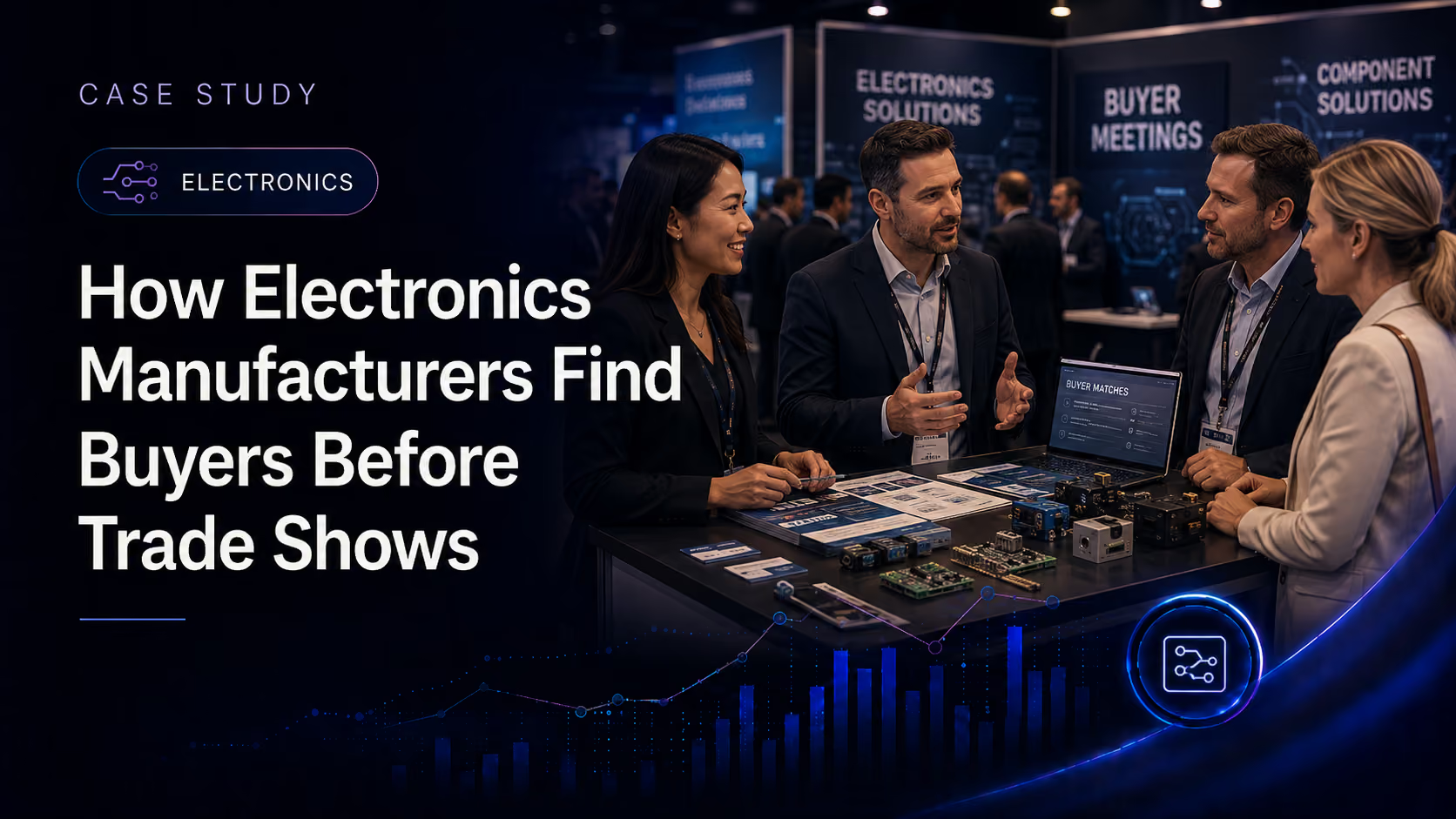
Manufacturing lead generation works better before a trade show when the sales team starts with companies connected to the event, filters them against a narrow ideal customer profile, and identifies a named buyer before choosing an outreach channel.
This anonymized case study follows a B2B electronics hardware manufacturer evaluating a more precise way to find customers around industry trade shows. The company name, employee names, event names, commercial details, and identifying calendar information have been removed. The operating problem has not.
The manufacturer did not need thousands of leads. A handful of well-matched accounts could make the year worthwhile. Its sales team already used event websites, LinkedIn, company websites, and a general contact database. The problem was the work required to connect those sources—and the uncertainty that remained when the research was finished.
The team wanted to answer three questions before the show opened:
- Which smaller companies matched its buyer profile?
- Which of those companies had a credible connection to the event?
- Who was the specific person worth calling, messaging, or finding on the show floor?
That changed the job from collecting an exhibitor list to building a pre-show buyer pipeline.
What is manufacturing lead generation before a trade show?
Manufacturing lead generation before a trade show is the process of using event participation, company fit, buyer roles, and contact data to identify and approach likely customers before everyone arrives at the venue.
It is narrower than ordinary list building. A generic database can show electronics distributors, integrators, resellers, or equipment manufacturers in a market. It usually cannot explain why a particular account is timely for a particular event.
An event website adds context, but it rarely shows the best person to contact. Company pages, announcements, social posts, historical participation, and predicted attendance expand the research surface, but they do not carry equal certainty.
The useful workflow combines two kinds of fit:
- Commercial fit: Does this company resemble a buyer the manufacturer can realistically win and serve?
- Event fit: Is there credible evidence that the company or person is connected to this show now?
Salesforce's guide to an ideal customer profile distinguishes the company-level ICP from an individual buyer persona and includes firmographic criteria such as industry, geography, and company size. For this manufacturer, company size was not a minor filter. It was part of the sales strategy.
Why a few qualified accounts can change the economics
A focused manufacturing sales motion can justify deep research when each qualified account is valuable and the team only needs a small number of wins.
Consider an illustrative planning model, not this customer's measured result. A sales representative spends 45 minutes researching each of 80 event companies across an event site, company websites, LinkedIn, and a contact database. That is 60 hours of research. At an internal cost of $65 per hour, the research cost is $3,900 before the first conversation.
If only eight companies match the manufacturer's ICP and have a credible event connection, the research cost is roughly $488 per qualified account. If a structured workflow reduces the first-pass review to 15 hours and reserves deep research for those eight accounts, the equivalent research cost falls to $975, or about $122 per qualified account.
That calculation does not predict meetings, opportunities, or revenue. It shows why sequence matters. The team should not enrich every contact and then decide whether the account fits. It should qualify the account first, preserve the event evidence, and enrich only the people it may actually approach.
Pro Tip: Measure research hours per qualified account, not only contacts exported. A large export can hide the fact that sales still has to inspect every row before acting.
The manufacturer was not looking for more vendors
The company attended trade shows to find potential B2B customers, not to source suppliers.
That distinction sounds obvious, but many event datasets flatten every exhibitor into the same prospecting list. For a manufacturer, another exhibitor may be a buyer, distributor, partner, competitor, vendor, or company with no useful commercial relationship at all.
The team had a defined market. It preferred smaller and mid-sized companies it had a realistic chance of winning, particularly organizations with fewer than 200 employees. Large global companies were visible and easier to research, but visibility did not make them the best targets. The sales team believed it could create more value by finding overlooked buyers that matched its actual deal motion.
It also valued precision over volume. A long lead list would not improve performance if most accounts were too large, poorly matched, or disconnected from the event. The team wanted a short list it could pursue persistently by phone, LinkedIn, email, and in-person follow-up.
Where the previous research workflow broke
The previous workflow contained the right sources but placed the integration burden on the salesperson.
The representative could open the event website, copy a company name, visit the corporate site, search LinkedIn, consult a contact database, and then decide whom to call. Each source answered one part of the question. None explained why this account, why this person, and why now.
| Decision point | Previous constraint | Required manufacturing lead generation workflow |
|---|---|---|
| Which event companies are possible buyers? | The exhibitor list mixed customers, vendors, partners, and competitors | Classify the account by market role and ICP fit before contact research |
| Which company sizes deserve effort? | Large companies had more visible people and public data | Prioritize the smaller accounts the sales team could realistically win |
| Who is connected to the event? | Company-level participation did not always reveal a named person | Combine company evidence with attendee, public, historical, and predicted person signals |
| How certain is the connection? | Different evidence types could be flattened into an “attendee” label | Store the source, date, scope, and confidence of the event signal |
| Who should sales contact? | Generic search returned many employees with no recommended next step | Identify one primary buyer and one fallback role per priority account |
| Which channel should come first? | Email availability could dictate the workflow | Choose phone, LinkedIn, email, or on-site contact based on data and sales preference |
| When should the list be refreshed? | A one-time export became stale as the event approached | Recheck the priority accounts three to four weeks before the show |
The team did not view a general contact database as useless. It viewed it as incomplete for this job. The database could help retrieve contact details once the company and person were known. The event intelligence layer needed to explain why those records deserved attention.
The signal hierarchy the team needed
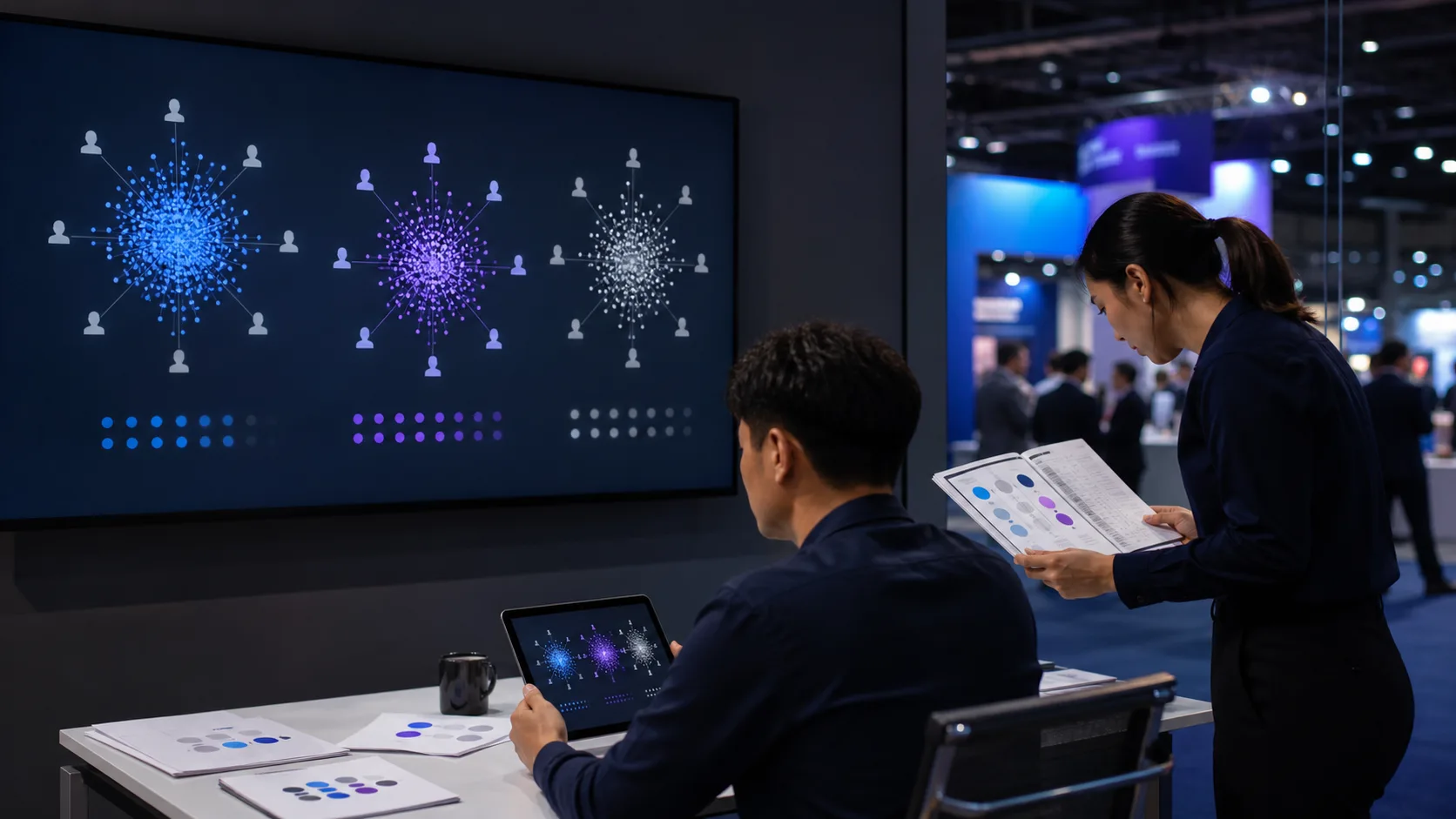
The manufacturer needed more coverage without pretending that every signal was a confirmed attendee record.
Trade show prospecting becomes risky when discovery language and outreach language are treated as the same thing. A prediction can be useful for prioritization. It should not automatically become “I saw you are attending” in a sales message.
| Signal type | What it can support | What it should not automatically claim |
|---|---|---|
| Official exhibitor, sponsor, or speaker listing | Direct company or named-person connection to the event | That every relevant employee will be on site |
| Organizer-provided named attendee | Strong person-level participation evidence | That plans cannot change before show day |
| Public company or individual announcement | Timely outreach using the public context | Details beyond what the source actually states |
| Historical participation at similar events | A reason to prioritize the account for research | Confirmed attendance at the upcoming show |
| Social, hiring, campaign, product, or market signal | A reason the event and offer may be relevant | That the signal proves physical attendance |
| Predicted participation | A ranked research hypothesis | A factual attendance statement |
Pro Tip: Keep the signal label next to the contact when exporting to a CRM or spreadsheet. If the evidence disappears during handoff, the salesperson cannot choose accurate language.
How the pre-show buyer workflow was designed
The proposed workflow moved from event selection to account qualification, signal review, person research, multi-channel outreach, and on-site execution.
1. Start the account market one to two months before the show
The manufacturer began planning early enough to research accounts and book conversations, but it did not assume the first list was final.
An initial review one to two months before the event established the market: exhibitors, sponsors, speakers, relevant visitors where available, and companies connected through public or historical evidence. This created enough time to qualify accounts and start outreach.
The team expected the data to improve as the event approached. A second review three to four weeks before the show could capture new exhibitor updates, named people, announcements, and changed priorities.
The U.S. Commercial Service describes trade events as a way to meet buyers and business partners. For a manufacturer, the opportunity begins before the meeting itself: deciding which buyers make the event worth the effort.

2. Define the buyer ICP before unlocking more contacts
The next step was to translate the manufacturer's sales experience into filters.
Company size was central, with smaller accounts receiving more attention. Industry and business model mattered because the company sold into a specific B2B electronics ecosystem. Geography mattered because not every market could be served with equal speed. The team also needed to distinguish end customers, distributors, integrators, and adjacent manufacturers.
A practical event ICP included:
- Target industries and subsegments.
- Preferred employee or revenue range.
- Target geographies.
- Buyer, distributor, integrator, partner, and competitor classifications.
- Product or application fit.
- Evidence of relevant market expansion, hiring, launches, or campaigns.
- Existing relationship and CRM stage.
- Minimum event-signal confidence for outreach.
Pro Tip: Review the first 20 recommendations manually. If the best-looking rows are consistently too large, too remote, or the wrong business model, fix the ICP before adding contacts.
3. Rank accounts by commercial fit and event confidence
The manufacturer then needed a simple priority system that combined the two dimensions.
An account with excellent product fit but weak event evidence could stay on a research list. An account with strong participation evidence but poor commercial fit should not enter active outreach. The highest-priority group contained companies that scored well on both.
A practical four-tier model looked like this:
- Tier A: Strong ICP match and direct event evidence.
- Tier B: Strong ICP match and credible public, historical, or predictive evidence.
- Tier C: Partial ICP match with direct event evidence.
- Research only: Weak fit, unclear role, or insufficient evidence.
4. Identify one named buyer and one fallback role
Once an account qualified, person-level research began.
The team valued a named contact because the name improved every channel. It supported a direct LinkedIn request, a targeted phone call, a more relevant email, and a specific on-site question. Even when no digital outreach succeeded, the representative could approach the booth and ask whether the relevant person or role was available.
The workflow did not require enriching an entire organization. Each priority account needed a compact contact map:
- Primary buyer or commercial decision-maker.
- Secondary role if the primary person was unavailable.
- Job title and functional relevance.
- LinkedIn profile where available.
- Business phone or direct dial where lawfully available.
- Verified email where useful.
- Event signal, source, and confidence.
- One sentence explaining why the account matched the ICP.
For this team, phone data deserved equal or greater attention than email. That is an important design choice. A prospecting workflow should reflect how the seller actually creates conversations, not whichever field is easiest for software to populate.
5. Use the event context without overstating attendance
The message should become more specific as the evidence becomes stronger.
For direct evidence, a representative could reference the event and the person's public role. For company-level evidence, the message could refer to the company's presence. For historical or predicted evidence, the safest approach was to reference the market gathering or the team's own plans without saying the person would definitely attend.
Compare three approaches:
I know you will be at the show. Can we meet?
I saw your company is listed for the industry show. I work with electronics businesses in your segment and thought it might be useful to compare priorities before schedules fill.
Our team is preparing for the industry show next month and is speaking with smaller distributors and integrators in this market. Is that relevant to your work this year?
The first message needs person-level confirmation. The second can work with company-level evidence. The third creates a timely reason to talk without making an attendance claim.
For a broader pre-show sequence, see Lensmor's guide to booking meetings before a trade show.
6. Route each account through the strongest available channel
The manufacturer did not want an email-only workflow.
If a named person was visible on LinkedIn, the representative could connect there first and use the event as context. If phone data was available, a call could be the fastest path to a real answer. Email supported follow-up and calendar coordination. When no contact channel produced a response, the target account and name still improved on-site execution.
A practical sequence was:
- Review the signal and select accurate wording.
- Send a concise LinkedIn request or relevant email.
- Call the company or direct line with a specific person or function in mind.
- Record the response and next step.
- Refresh the account before the show.
- Carry unresolved Tier A accounts into the on-site plan.
7. Turn unanswered outreach into an on-site account plan
The team therefore wanted a usable on-site list, not only an outreach report. For every unresolved priority account, the representative could carry:
- Company and booth location.
- Primary and fallback names.
- Role and reason for fit.
- Product or market context.
- Participation evidence and confidence.
- Outreach already attempted.
- One qualifying question.
- Desired next step.
That turned “walk the floor” into a specific account motion. The representative could ask for a named person or the relevant functional owner instead of opening every booth conversation from zero.
Pro Tip: Put unresolved Tier A accounts into the daily show plan with an owner and time window. A target list that never reaches the floor is only research.
8. Measure account movement, not raw lead volume
The measurement model needed to fit a low-volume, high-value sales strategy.
Useful metrics included:
- Event companies reviewed.
- ICP-matched accounts identified.
- Smaller target accounts with sufficient contact coverage.
- Named buyers identified.
- Accounts reached by phone, LinkedIn, or email.
- Meetings booked before the show.
- Priority accounts engaged on site.
- Qualified opportunities created or advanced.
- Research hours per qualified account.
- Pipeline and revenue tied back to the event motion.
The U.S. Commercial Service recommends evaluating whether a trade show produced meetings with the right buyers and matching follow-up to the buyer's potential and buying stage in its trade show follow-up guidance.
Why the manufacturer evaluated Lensmor
The company evaluated Lensmor because it wanted an event-specific prospecting layer rather than another generic company-and-contact database.
The buying criteria were concrete:
- Person-level attendee or likely-attendee coverage where evidence existed.
- Better coverage of companies with fewer than 200 employees.
- Clear confidence behind company and person participation signals.
- Less manual movement between the event website, company pages, LinkedIn, and contact tools.
- ICP-based recommendations that reflected the manufacturer's real market.
- Phone data alongside LinkedIn and verified email.
- Personalized outreach grounded in company and event context.
- A lower-risk way to test one important event before expanding the workflow.
The relevant comparison was not Lensmor versus the event website. It was a fragmented manual process versus a prioritized account-to-person workflow.
Lensmor's intended role was to supply the event context: which companies were connected, which people had meaningful signals, how confident those signals were, and which accounts matched the ICP. Existing tools could continue supporting contact enrichment and general market research.
The evaluation also exposed a meaningful product requirement. Person data concentrated at large companies would not solve this customer's problem. The manufacturer specifically wanted to reach smaller accounts that were commercially attainable but harder to research. Coverage quality therefore had to be measured against the customer's ICP, not against the total number of records in the database.
No public meeting, opportunity, pipeline, or revenue result was documented for this workflow. This case study describes the customer's problem, evaluation criteria, and intended operating model—not a claimed performance outcome.
What other electronics manufacturers can copy
Other manufacturers can copy the sequence even if they use a different event or data stack.
Start with one upcoming show and a narrow customer definition. Separate vendors, competitors, partners, and plausible buyers. Give company size and business model the same weight they receive in the real sales process. Then combine ICP fit with event evidence before spending time on person-level enrichment.
The reusable sequence is:
- Build the event-linked company market one to two months out.
- Define the buyer ICP, including the company sizes the team can realistically win.
- Separate direct, public, historical, and predicted participation evidence.
- Rank accounts using commercial fit and event confidence.
- Identify one primary buyer and one fallback role.
- Choose phone, LinkedIn, email, or on-site outreach based on the available data.
- Refresh the list three to four weeks before the event.
- Carry unresolved priority accounts into a named on-site plan.
- Measure qualified account movement and research efficiency.
If the workflow cannot explain why an account fits, why the timing matters, and who should receive the next action, adding more contacts will not fix it.
Manufacturers that need to build the first account market can also use Lensmor's guide to finding buyers before a trade show before moving into contact enrichment.
Conclusion
The manufacturer's challenge was not a shortage of companies on the internet. It was the time and uncertainty involved in connecting event companies, buyer fit, named people, contact channels, and show-floor execution.
A stronger manufacturing lead generation workflow reverses the usual order. It qualifies accounts before enriching contacts, preserves the confidence behind every event signal, and gives sales a short list it can actually work. That matters most when the team does not need hundreds of weak leads. It needs a few attainable buyers and a timely reason to start the conversation.
Start Free Trial — Start using Lensmor's event intelligence platform today. Predict attendee lists, discover relevant events, and enrich contact data for your next trade show.


.avif)